Project Management

You started with one project management tool. Then someone on your team swore by another. A client insisted on a third. Now your Monday morning looks like this: seven open browser tabs, three unread notification badges, two different task boards showing conflicting priorities, and a Slack message asking which tool is actually the source of truth. Sound familiar?
This is called tool sprawl — and it is quietly killing your team's productivity. Not in a dramatic, obvious way. It happens gradually, through small friction points that stack up until your people spend more time managing tools than managing actual work.
The irony is sharp. You adopted all these tools to get more organized. But having too many project management tools at once creates the exact chaos they were supposed to solve. Here is what that actually costs you — and what to do about it.
The Real Cost of Running Too Many Tools at Once
Tool sprawl is not just an inconvenience. It carries measurable costs across focus, time, and team morale. Harvard Business Review has consistently reported that context switching — jumping between apps, platforms, and conversations — is one of the biggest hidden drains on deep work. Every time your team switches tools, they pay a cognitive tax.
Employees spend nearly 20% of their working week just searching for information or tracking down colleagues. When your work lives across five different platforms, that number only goes up. You are not just losing hours — you are losing momentum.
Scattered Information Means Scattered Teams
When tasks live in one tool, updates in another, and decisions in a third, nobody has the full picture. Your operations lead is working from a board that is two updates behind. Your remote team member missed a decision that happened in a chat channel they were not added to. This is not a people problem — it is a systems problem.
The result is duplicate work, missed deadlines, and endless "just checking in" messages. Each of those messages is a symptom of a system that does not give people visibility by default.
Onboarding Becomes a Recurring Nightmare
Every new hire has to learn not one workflow, but five. Which tool do we use for client projects? Where do internal tasks live? Should I post this update in the project board or message someone directly? These questions waste everyone's time and make it harder to get new people contributing quickly.
For growing companies especially, this friction compounds fast. What worked when your team was eight people becomes a genuine operational problem at thirty.
Why Teams Keep Adding Tools Instead of Consolidating
It rarely happens by design. A team adopts a tool to solve a specific problem. It works. Another problem appears, another tool gets added. Over time, the stack grows because removing a tool feels riskier than adding one — someone is always relying on it for something.
There is also a buyer behavior pattern at play. Organizations regularly overestimate how much of a tool's functionality their teams actually use. Most teams use 20-30% of any given platform's features — meaning they are paying for and managing complexity they never actually needed.
The "Best Tool for Each Job" Trap
The instinct to find the perfect specialized tool for every function sounds reasonable. In practice, it creates a fragmented ecosystem where no single person has a complete view of work in progress. You end up optimizing individual functions while degrading overall team coordination.
For most teams — especially those under 100 people — the overhead of managing multiple tools outweighs the marginal benefit of specialization. A tool that covers 80% of your needs in one place will almost always outperform a collection of five tools that each cover 100% of one narrow thing.
What Productivity Actually Looks Like When Tools Are Consolidated
Teams that consolidate their tools do not just save money on subscriptions. They recover something harder to quantify: clarity. When everyone knows exactly where work lives, where to communicate about it, and how to find decisions that were made last week — the team moves faster without anyone having to push harder.
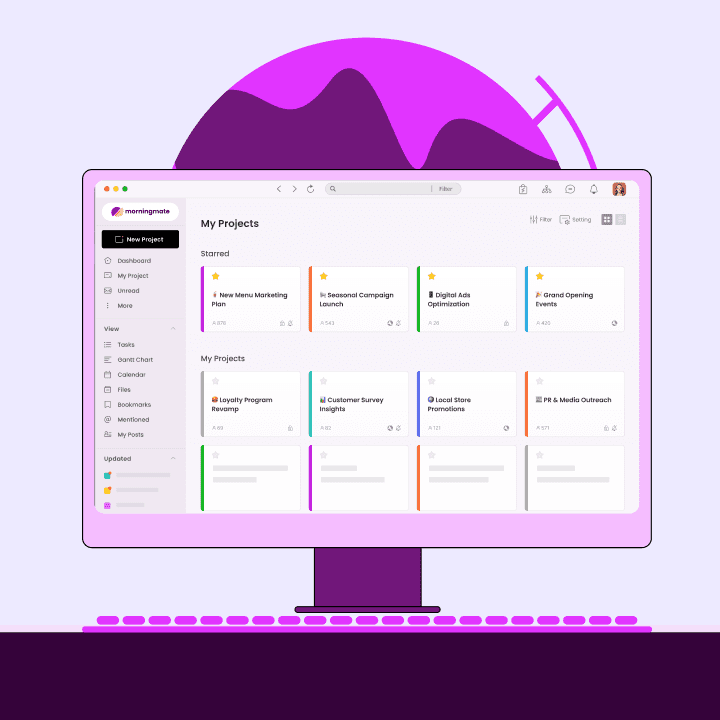
This is exactly the problem Morningmate was built to solve. It is a lightweight work management tool that brings task management, team communication, and file sharing into one place — without the steep learning curve of enterprise tools like Jira or Asana. The interface feels familiar from the start, which matters enormously for non-technical teams who do not have time for long onboarding cycles.
One Feed, Full Visibility
One of Morningmate's most practical features is its Feed view — a social-media-style stream where project updates, tasks, and announcements surface in one scrollable view. Instead of checking three different boards and a separate chat app, your team sees everything relevant in one place. For managers trying to maintain visibility across multiple projects or departments, this alone removes a significant daily overhead.
If you are currently juggling email threads, WhatsApp groups, and a project tool simultaneously, that single consolidated feed is not a small upgrade — it is a fundamentally different way of working.
How to Audit Your Current Tool Stack
Before you can fix tool sprawl, you need to see it clearly. A quick audit takes less than an hour and will show you exactly where the redundancies are.
List every tool your team actively uses — include even the informal ones like WhatsApp groups or personal email threads used for work updates.
Map each tool to a function — task tracking, communication, file storage, reporting, etc. Note where functions overlap.
Ask your team where they actually look first — this tells you which tools have real adoption and which are ghost platforms nobody trusts.
Identify your source-of-truth gaps — where do decisions get made and then lost? Where do updates go that others do not see?
Count the handoffs — every time information has to be copied from one tool to another is a failure point and a productivity drain.
Once you have this map, consolidation becomes obvious rather than overwhelming. You are not guessing — you are working from evidence about where the actual friction lives.
What to Look for in a Replacement Tool
The goal is not to find the most feature-rich platform. The goal is to find one that covers your core needs without requiring your team to change how they think about work. Here is a practical checklist:
Can tasks, communication, and files live in the same place?
Is the interface intuitive enough that non-technical team members will actually use it?
Does it give managers visibility without requiring everyone to write status reports?
Is the onboarding short enough that a new hire can be productive on day one?
Does it replace personal messenger apps, or will your team just use both?
That last point matters more than it sounds. If the tool does not have built-in chat, your team will default to WhatsApp for quick conversations — and you are back to split information within weeks. Morningmate includes a built-in chat with an interface that feels exactly like the messaging apps your team already uses every day, which is a significant reason teams actually stick with it rather than reverting to old habits.
The Quiet Productivity Gains You Will Notice First
When teams consolidate tools, the first thing they notice is not some dramatic productivity spike. It is smaller than that — and more sustainable. Fewer "where did you share that file?" messages. Fewer meetings that exist only to sync people who are on different platforms. Fewer times a manager has to piece together project status from four different places before a client call.
These micro-frictions are invisible when you are inside them. They only become visible when they stop. That is the real productivity dividend of simplifying your tool stack — not working harder, but removing the small, constant drag that was slowing everything down without anyone naming it.
If your team is currently managing work across more tools than you can count on one hand, that is worth taking seriously. The answer is rarely a better tool added on top of what you have. Almost always, it is fewer tools — chosen more deliberately.