Project Management

Most teams don't fail at the work itself. They fail at keeping track of it. Tasks get buried in chat threads, someone forgets a deadline, and by Friday nobody's quite sure what actually got done. The solution most people reach for is a project management tool — but then the tool becomes its own job.
Here's the thing: your team doesn't need a complicated planner to stay on top of team tasks. What they need is a clear, shared system that doesn't require a three-hour onboarding session to understand. The right approach is simple enough that everyone actually uses it — and robust enough that nothing falls through the cracks.
Whether you're managing a remote team of fifteen or running operations across a hybrid office, the fundamentals of keeping team tasks organized are the same. Let's walk through what actually works — without turning task management into a full-time project.
Why Complicated Planners Often Make Things Worse
There's a well-documented pattern in workplace tools: the more features a tool has, the less likely teams are to use it consistently. Harvard Business Review has noted that tool overload is a genuine productivity killer — when people spend more time managing their systems than doing actual work, something has gone wrong.
Complex planners also create a silent divide on your team. Tech-savvy members figure out the tool quickly and build elaborate boards and automations. Everyone else quietly reverts to WhatsApp and email because it's faster. Now you have two parallel systems, and coordination between them is a mess.
The goal isn't to find the most powerful tool. It's to find the one your whole team will actually open every morning.
The Core Elements of a Simple Team Task System
Before you choose any tool or build any process, get clear on what a functioning task system actually needs to do. Strip it back to the essentials.
1. Every Task Has an Owner
A task without a clear owner is just a wish. When something is assigned to "the team," it belongs to no one. Every item on your list should have one person's name attached to it — the person who is responsible for seeing it through to done.
This doesn't mean one person does all the work. It means one person tracks the progress and raises a flag if something is blocked. That distinction matters enormously on busy teams.
2. Deadlines Are Visible to Everyone
Hidden deadlines cause avoidable chaos. When due dates live in someone's personal calendar or inside a buried email thread, the rest of the team can't plan around them. Deadlines need to be shared, visible, and attached directly to the task — not stored separately.
This is one of the quieter benefits of moving team tasks into a shared workspace. You stop relying on individuals to proactively share timing information and start building it into the task itself.
3. Status Updates Don't Require a Meeting
If the only way to know the status of a task is to ask in a meeting or send a follow-up message, your system is working against you. A good task setup lets anyone glance at a shared view and know exactly where things stand — without interrupting anyone.
This is especially important for remote and hybrid teams where people are working across different hours. Async visibility isn't a luxury — it's a baseline requirement.
A Practical Framework for Managing Team Tasks Without Overcomplicating It
You don't need a methodology with a certification. You need a rhythm your team can follow without thinking too hard about it. Here's a straightforward framework that works for most teams under a hundred people.
Step 1: Create One Shared Space for All Tasks
Stop splitting tasks across email, chat, sticky notes, and spreadsheets. Pick one place and commit to it. Every task, no matter how small, lives there. This is the single biggest shift most teams need to make — not a new tool, just a new habit of centralization.
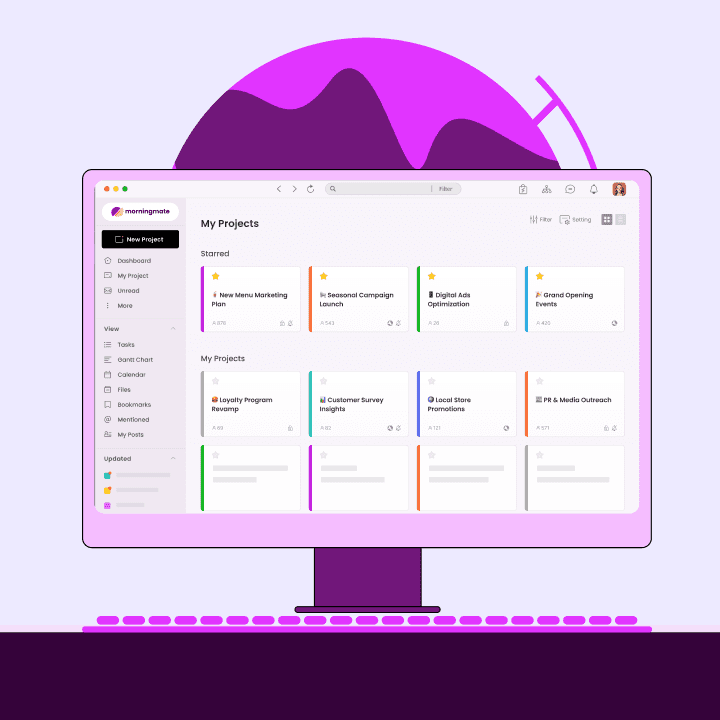
This is exactly the kind of problem Morningmate was built to solve. It's a lightweight work management tool that combines task management with built-in team chat, so instead of bouncing between five apps, your team works in one place. The task view is clean and simple — nothing to configure before you can get started.
Step 2: Use Three Status Labels, Not Ten
Over-engineered status systems slow teams down. You don't need "In Review," "Pending Approval," "Awaiting Feedback," and "Blocked" as separate categories. For most teams, three labels cover everything:
To Do — not started yet
In Progress — someone is actively working on it
Done — completed and closed
If something is blocked, that's a note or a comment — not a status category. Keep the system light enough that updating it takes seconds, not minutes.
Step 3: Run a Weekly 15-Minute Task Review
Once a week, carve out fifteen minutes as a team to look at the shared task list together. Not to report on every item — just to flag what's stuck, reprioritize if needed, and make sure nothing important is slipping. This replaces the sprawling Monday check-in that could've been a shared document.
Gallup research consistently shows that clarity around priorities is one of the strongest predictors of team engagement. A short weekly review does more for alignment than a lengthy monthly all-hands.
Step 4: Connect Tasks to Conversations
One of the most common frustrations with task tools is context loss. A task gets created, but the reasoning behind it — the discussion that led to the decision — lives in a separate chat. Three weeks later, nobody remembers why the task exists or what "done" actually looks like.
Morningmate handles this with a Feed view that sits alongside task management, so the conversations connected to a piece of work stay visible in context. It looks familiar — similar to a social media feed — which means even non-technical team members pick it up without a steep learning curve. You don't lose the "why" behind the task.
What to Do When Your Team Resists Changing Systems
Even the simplest system fails if the team doesn't adopt it. Resistance is normal — especially if your team has been burned by a complicated tool rollout before. Here's how to handle it.
Start Small, Not Comprehensive
Don't try to migrate every project on day one. Pick one active workstream and run it through the new system for two weeks. Let the team see the difference before you ask them to fully commit. Proof beats persuasion every time.
Make It the Path of Least Resistance
If it's easier to send a WhatsApp message than to create a task, people will send WhatsApp messages. Your job as a manager is to make the right behavior the easy behavior. That might mean setting a team norm: "If you assign work to someone, it goes in the task system — not in chat." Simple rules, consistently enforced, build habits faster than training sessions.
Tools like Morningmate help here specifically because the built-in chat interface looks and feels like the messaging apps people already use. There's no jarring context switch — the tool meets people where they already are, rather than asking them to change how they think.
Celebrate When the System Works
When a task gets completed on time, or when someone catches a deadline early because they checked the shared board, name it. "Hey, this worked because we had it in our task system" reinforces the habit better than any policy memo. Teams build systems they trust when they see the system working.
Signs Your Current Approach to Team Tasks Needs a Reset
Not sure if your current setup is holding your team back? Here are the most common warning signs:
You find out a task was never started because someone thought someone else was handling it
Deadlines get missed because they were buried in an email chain from two weeks ago
Your team status update meetings last over an hour and still leave people confused
New team members take weeks to figure out how work gets tracked
You personally have to chase people for updates on things that should be self-reporting
If any of these sound familiar, the fix isn't working harder — it's building a clearer, simpler shared system for tracking team tasks.
Keeping It Simple Is the Strategy
McKinsey research on organizational performance has found that simplicity in internal processes is a competitive advantage — not a shortcut. Teams that operate with clear, lightweight systems move faster and adapt more easily than teams bogged down in process overhead.
Managing team tasks without a complicated planner isn't about cutting corners. It's about being deliberate — choosing clarity over comprehensiveness, and building habits that stick. The best system is the one your team actually uses, consistently, without being reminded.
Start with one shared space, clear ownership, visible deadlines, and a short weekly rhythm. Then build from there as your team grows. You'll be surprised how far that foundation takes you.