Project Management

Team collaboration runs on shared understanding — and nothing quietly destroys shared understanding faster than someone saying, "don't worry, I'll remember that." It feels fine in the moment. Efficient, even. You're in the middle of a campaign sprint, decisions are flying, and writing everything down feels like extra work. Then launch day arrives and the thing nobody wrote down is the thing that breaks everything.
If you're managing marketing at a small business, you already know how chaotic team coordination gets during a campaign. You've got the founder dropping feedback in a voice note, a freelance designer working off a brief that's two revisions old, and an approval chain that lives entirely in someone's head. The work isn't hard. The remembering is hard.
This article is about what actually happens when your team collaboration relies on memory instead of systems — and how to close that gap without adding a mountain of process overhead.
When "I'll Remember That" Becomes a Campaign Crisis
Picture this: it's the morning of a paid social launch. Your designer sends over the final ad creative. It looks great — except the headline uses the old product name that got updated three weeks ago. You changed it in a Slack thread. The founder approved the new name on a call. The freelancer never got the memo because "you were going to loop them in" after the call, and then things got busy.
Now you're pulling the launch, reordering revisions, and sending a frantic message to your designer at 8 AM. The campaign goes live two days late. The window you planned around — a seasonal hook — is gone.
This is not a team performance problem. It's a team collaboration infrastructure problem. Decisions were made but never documented. Context existed but never traveled. Memory was trusted when a system was needed.
Where Team Collaboration Actually Breaks Down
Most small marketing teams assume their collaboration problems are about speed — things move too fast to write everything down. But the real issue is structural. There are three specific moments where team coordination fails, and "I'll remember that" lives in all three.
Moment 1: The decision that never got documented
Decisions happen constantly in campaign work — in calls, in hallway conversations, in quick founder check-ins. When those decisions don't land somewhere visible and shared, they exist only in the mind of the person who made them. Anyone else on the team is operating on outdated assumptions.
Moment 2: The handoff with missing context
You brief a freelancer. The brief is solid but it doesn't include the three things you discussed verbally with the founder last Tuesday. The freelancer delivers exactly what the brief said. You needed something slightly different. The gap between what was said and what was written is where revisions are born.
Moment 3: The approval that was never confirmed
Someone said "looks good" in a message thread. Was that approval? Formal sign-off? Or just a casual thumbs-up? When the feedback is ambiguous and undocumented, you find out it wasn't real approval at the worst possible moment — usually right before publishing.
Breakdown moment | What the team does now | What the team needs instead |
|---|---|---|
Decision made verbally | Trusts memory of the person in the room | A shared, written record anyone can find |
Freelancer briefing | Brief doc plus verbal context that isn't written | Brief linked to the task with full conversation history |
Approval round | Casual message reaction or verbal "yes" | Explicit status change with name and timestamp |
Post-call follow-up | Relies on whoever took notes to share them | Action items turned into tasks immediately |
A Repeatable Play for Team Collaboration That Doesn't Rely on Memory
The fix isn't a complex project management overhaul. It's a lightweight habit that your whole team — including the founder and freelancers — can actually follow. Here's the play, step by step.
Write the decision where the work lives. Every time a decision gets made — on a call, in a chat, wherever — it goes into the task or project it affects. Not in a separate notes doc. Not in someone's inbox. Right on the relevant task, as a comment. Date it. Name who decided it.
Make your brief the single source of truth. When you brief a freelancer or a new team member, the brief goes in the task itself. No external Gdoc that might drift out of sync. Any verbal additions get written into task comments before the work starts.
Treat approval as a status change, not a vibe check. Define what "approved" means before the campaign kicks off. It means one named person changes the task status to Approved — not a thumbs-up emoji. Everyone on the team knows which status means it's cleared to publish.
End every campaign call with a two-minute capture round. Before the call ends, someone reads back the decisions made and the action items. Those items become tasks immediately — assigned, with a due date — before anyone hangs up.
Give context a home that outlasts the conversation. Use a shared workspace that keeps task history, file versions, and comments together. That way, when a freelancer asks "wait, which version of the logo are we using?" the answer is findable in under thirty seconds.
Common Failure Points in Team Coordination (and How to Avoid Them)
Even teams that know better slip back into memory-dependent habits. Here's where the wheels come off and what to do about it.
The founder is the bottleneck
In most small marketing teams, the founder has final say on creative and messaging. But founders are busy, and their approvals often come through informal channels at odd hours. The fix: give the founder one place to react. If every creative asset lives in a task with a clear status, the founder can change a status and leave a comment without switching apps or losing the context of what they're approving.
Freelancers work off stale information
Freelancers aren't in your daily team coordination loop, which means they're often the last to hear about changes. If the brief is updated verbally but the task isn't touched, the freelancer keeps working off outdated info. Make it a rule: any change to scope, messaging, or direction gets written into the task before work continues. No exceptions.
Feedback arrives in too many places
The designer gets an email from the founder, a message from you, and a comment from a freelance copywriter — all about the same asset, all saying slightly different things. Consolidated feedback in one place isn't a luxury; it's the only way to avoid contradictory revisions that waste everyone's time.
Context disappears when people leave
A freelancer's engagement ends. A team member moves on. All the knowledge they were holding about why a campaign was structured a certain way evaporates with them. Documented decisions and task histories mean the context survives the departure.
How Morningmate Supports Real Team Collaboration — One Worked Example
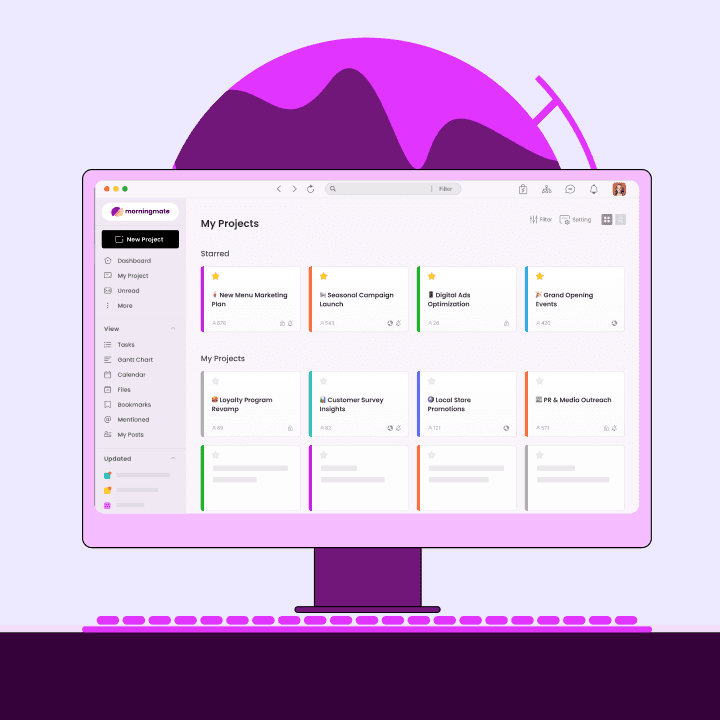
Here's what this looks like in practice with a tool built for exactly this kind of team. Morningmate is a lightweight work management platform with built-in task management, team chat, and file handling — all in one workspace. The interface looks familiar (think social media feed meets messaging app), so even non-technical team members and external freelancers pick it up quickly without a training session.
Say you're running a product launch campaign with a two-person internal team and two freelancers. Here's how the play above runs inside Morningmate:
You create a project for the launch. Each deliverable — ad creative, landing page copy, email sequence, social posts — gets its own task. The brief for each deliverable lives inside the task, alongside the deadline and the assignee. When the founder hops on a quick call and changes the campaign angle, you open the relevant task during the call and drop the updated direction into the comments before you hang up. The freelancer sees it the next time they open the task. No separate email. No "did you see my message?" follow-up.
When the creative is ready for approval, the designer moves the task status to "In Review." The founder gets notified, reviews the asset in context — with the brief and previous feedback visible right there — and changes the status to "Approved." That timestamp is the paper trail. No ambiguity, no he-said-she-said about whether something was cleared.
If anyone on the team later needs to find out why the campaign used a specific visual direction, Morningmate's AI Smart Search lets them ask in plain language — "why did we change the hero image?" — and surfaces the exact comment where that decision was recorded, including who wrote it and when. The context doesn't disappear. It lives in the workspace.
Team collaboration scenario | Memory-based approach | Morningmate approach |
|---|---|---|
Founder changes campaign direction | Verbal on a call, freelancer finds out later (maybe) | Comment added to task during call; freelancer notified instantly |
Creative approval | Emoji reaction in a message thread | Status changed to Approved with name and timestamp |
Finding past decision rationale | Ask whoever was in the room — if they remember | AI Smart Search surfaces the exact comment and its source |
Briefing a new freelancer mid-campaign | Reconstruct context from memory and scattered files | Task history, files, and comments already in one place |
Your Team Collaboration Checklist for This Week
Strong team collaboration doesn't require a wholesale process overhaul. It requires closing the gap between what gets said and what gets written. Start with these this week.
Pick one active campaign and move its decisions into tasks — not a separate doc, not a chat thread.
Define what "approved" means on your team. Write it down. Share it with the founder and every freelancer on the project.
End your next campaign call with a two-minute capture round. Turn every action item into a named, dated task before the call ends.
Audit your freelancer briefing process. Is the brief inside the task, or somewhere that can drift out of sync?
Identify one decision from the last campaign that only one person knew about. Figure out where it should have been written.
Consolidate your team collaboration into a single workspace where tasks, files, and conversations live together — not spread across three apps and someone's memory.
Team collaboration at a small marketing team is already hard enough without your most important decisions living rent-free in someone's head. The moment you treat "I'll remember that" as a red flag instead of a shortcut, your campaigns get tighter, your freelancers deliver better work, and your launch mornings stop feeling like crisis management. Write it down. Put it where the work lives. Let the system remember, so your team can focus on doing.