Project Management

Effective task management is the backbone of any operation that wants to scale — and right now, thousands of growing SMBs are quietly building that backbone out of WhatsApp group chats. It feels pragmatic at first: everyone's already on it, setup takes seconds, and messages fly instantly. But as your team grows from eight people to thirty, then fifty, the cracks don't just appear — they compound. What started as a convenient shortcut becomes the single biggest obstacle to standardized, scalable operations.
The problem isn't WhatsApp itself. It's that WhatsApp was designed for personal conversation, not task coordination, process management, or cross-team accountability. When you push it into a role it was never built for, you don't just get inefficiency — you get invisible inefficiency. Decisions get buried in scroll. Task ownership evaporates. New hires can't find context. And you, the ops manager, end up doing what no process-minded leader should ever have to do: manually chasing status on work that should already be tracked.
This article lays out exactly where and why task management in WhatsApp breaks down as teams grow, quantifies the real operational cost, and gives you a concrete framework to fix it — including how a standardized tool like Morningmate can replace the chaos with a system that actually scales.
The Compounding Cost of Broken Task Management
Inefficient task tracking is rarely a single, dramatic failure. It's a slow tax levied on every working hour. McKinsey research found that employees spend an average of 19% of their workweek searching for information and tracking down colleagues for updates. In a 10-person team, that's the equivalent of two full-time employees doing nothing but chasing context that should already be visible.
When your task workflow lives in WhatsApp, this cost multiplies with headcount. Every new team member added to a group chat increases message volume exponentially — not linearly. A 20-person group doesn't generate twice the noise of a 10-person group; it generates four to five times the noise, because every cross-thread reply, reaction, and out-of-context message competes for the same attention. Harvard Business Review has documented how context-switching between fragmented communication channels costs up to 40% of productive capacity — a number that should alarm any operations manager.
The downstream effects reach further than lost time. Onboarding slows because institutional knowledge is locked in private chats. Cross-team coordination degrades because there's no shared task tracking layer. Process standardization becomes impossible because every team member has developed their own workaround. These aren't minor frictions — they're structural failures dressed up as communication habits.
Introducing the SCALE Framework for Task Management Breakdown
To diagnose where WhatsApp-based task coordination fails, it helps to have a structured lens. The SCALE Framework identifies the five fault lines that break task management as teams grow:
S — Searchability: Can anyone find a task, decision, or file from last month in under 60 seconds?
C — Context: Does every task carry enough background that anyone — including a new hire — can act on it without asking questions?
A — Accountability: Is there a single, visible owner for every piece of work?
L — Linearity: Can you see the sequence and dependencies of work without reconstructing it from memory?
E — Escalation: Is there a defined path for blocked tasks to surface to the right decision-maker?
WhatsApp fails all five. And the failure isn't subtle — it's architectural. Let's examine each component and what it costs you in practice.
SCALE Component | WhatsApp Reality | Operational Impact |
|---|---|---|
Searchability | Keyword search only, no filtering by task or owner | Avg. 18 min to retrieve one decision |
Context | Tasks buried in unstructured conversation | New hires need 2–3x longer to onboard |
Accountability | No formal task ownership or assignment | Tasks dropped; manager manually follows up |
Linearity | No sequencing or dependency mapping | Blockers invisible until deadlines missed |
Escalation | Escalation requires manual interruption | Bottlenecks accumulate silently |
S — Searchability: Task Management Without a Trail
Ask yourself: if a vendor dispute from six weeks ago is referenced in today's meeting, can your team pull the original decision in under a minute? In a WhatsApp-based task workflow, the answer is almost always no. Messages are chronological, not categorical. There's no way to filter by project, assignee, or status — only by keyword, if you can remember the exact phrase that was used.
In practice, this means institutional knowledge lives and dies in individual phones. When a team member leaves, their WhatsApp history goes with them. When a decision needs to be audited, someone has to scroll through weeks of unrelated messages. This is not a task coordination system — it's a digital paper trail that disintegrates on contact.
C — Context: Why Task Tracking Without Background Fails Onboarding
Every task that gets assigned in a WhatsApp message carries exactly as much context as the sender chose to type in that moment — which is usually not enough. "Can you handle the supplier follow-up?" means something to the person who sent it. To a new team member joining the group two weeks later, it means nothing.
Effective task management requires that tasks carry their context with them: the relevant files, the previous discussion, the decision that triggered the work. WhatsApp's flat, conversational structure makes this structurally impossible. Context scatters across threads, disappears into archives, and forces every new team member to ask the same clarifying questions your senior staff have answered a dozen times before.
A — Accountability: The Hidden Cost of Unassigned Task Coordination
In WhatsApp, a task "assigned" in a group message is a task assigned to everyone and no one simultaneously. Without a named owner, a due date, and a visible status, the social dynamics of a group chat take over: whoever is most conscientious picks it up, and whoever is least engaged quietly assumes someone else handled it.
This is the mechanism behind most of the status-chasing that consumes ops managers' time. It isn't that your team is negligent — it's that the system produces ambiguity, and ambiguity produces dropped work. Gallup's workplace research consistently shows that clarity of role and ownership is one of the strongest predictors of team engagement and output quality. WhatsApp's structure actively undermines both.
Time Spent Chasing Task Status Per Week (Hours per Manager)
7.5 hrs
WhatsApp / Chat
5.2 hrs
Email-based tracking
1.1 hrs
Structured task tool
Fig 1: Estimated weekly hours spent on manual status-chasing by communication method (illustrative)
L — Linearity and E — Escalation: Task Workflow Without Structure
Work has sequence. Task B depends on Task A. A vendor sign-off can't happen before legal review. A campaign can't launch before assets are approved. WhatsApp has no mechanism to represent these dependencies — every message lands in the same flat stream, regardless of where it sits in a workflow. Blockers become visible only when someone misses a deadline and the team starts asking why.
Escalation suffers equally. In a structured task management system, a blocked task can be flagged, re-routed, or elevated without disrupting everyone in the group. In WhatsApp, escalation means tagging someone publicly in a group chat, sending a separate DM, or — in ops manager reality — calling the person directly. None of these are sustainable at scale.
Standardized Task Management: Before vs. After
The shift from WhatsApp-based task coordination to a dedicated task management system isn't just a tool swap — it's a structural upgrade. Here's how the same operational activities look on either side of that transition:
Operational Activity | WhatsApp Approach | Standardized Task Management |
|---|---|---|
Assigning work | Text message in group, no formal owner | Named assignee, due date, priority level |
Checking progress | Manual follow-up message or call | Real-time status visible in dashboard |
Onboarding new hire | Add to group; context lost in history | Access to structured tasks, files, and history |
Cross-team handoff | Verbal or message-based, easily missed | Task transferred with full context attached |
Auditing past decisions | Manual scroll through months of chat | Searchable task history with comments |
Applying the SCALE Framework with Morningmate: A Worked Task Management Example
Here's a concrete scenario. Your ops team is managing a monthly vendor review process involving procurement, finance, and department leads. Currently, the coordination lives across three WhatsApp groups and two email threads. Decisions get made in one channel, action items appear in another, and nobody has a complete picture.
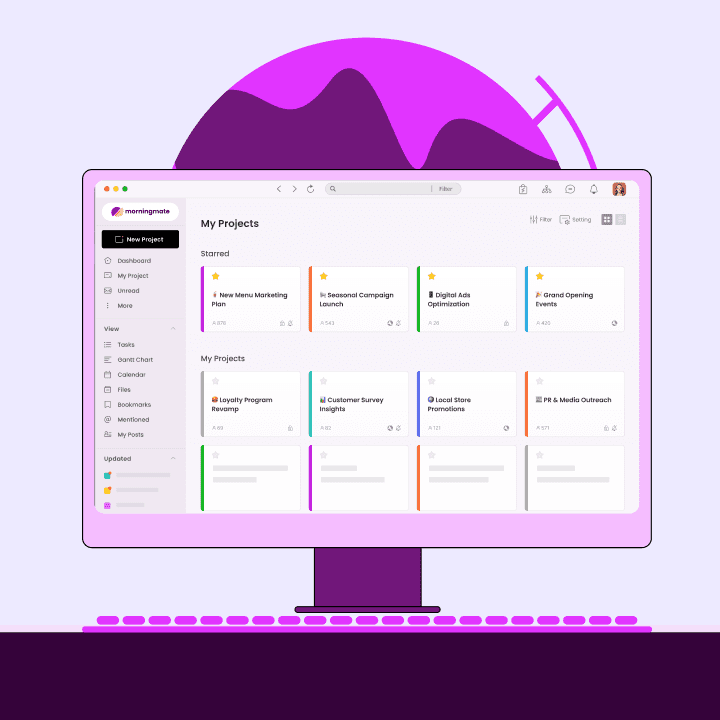
Here's how the same process runs inside Morningmate, a lightweight work management platform used by over 550,000 teams that combines structured task management with a built-in team chat — all in one place:
Create a dedicated project space for the vendor review. Every department involved gets access. No more group-hopping.
Break the process into structured tasks: "Collect vendor performance data" (assigned to procurement, due Day 3), "Compile cost comparison" (assigned to finance, due Day 5), "Department lead feedback" (assigned to three leads, due Day 7), "Final review meeting" (ops manager, Day 10).
Attach context directly to each task — the prior vendor scorecard, the budget file, the review template. Anyone picking up a task has everything they need without asking.
Use Morningmate's built-in chat for task-specific discussions, keeping conversation tied to the relevant work item rather than floating loose in a general group.
Monitor progress from the task dashboard — no status meetings, no follow-up messages. If a task slips, it's visible immediately and can be escalated or reassigned without disrupting the whole team.
The entire process — searchable, contextualized, accountable, sequential, and escalatable — maps directly to every component of the SCALE Framework. And because Morningmate's interface mirrors the social feed and chat style most teams already know, adoption doesn't require a training program or a rollout project. People use it from day one.
Task Completion Rate: Before and After Standardized Task Management Adoption
48%
WhatsApp (Before)
61%
Month 1 (Transition)
89%
Month 3 (Standardized)
Fig 2: On-time task completion improvement after structured task management adoption (illustrative)
Your Task Management Implementation Checklist
Standardizing task management doesn't require a six-month change program. It requires a clear starting point and consistent enforcement. Use this checklist to move your team off WhatsApp-based task tracking and onto a system that scales:
☐ Audit your current task workflow: Map every process that currently lives in WhatsApp or email. Identify which are recurring and which are ad hoc.
☐ Define ownership rules: Every task must have one named assignee. No exceptions. Group responsibility equals no responsibility.
☐ Standardize task structure: Every task needs a title, assignee, due date, and at least one line of context. Build a template your team uses every time.
☐ Centralize file attachment: Files and references attach to the task — not sent separately in chat or email.
☐ Set a status update cadence: Tasks update status (To Do / In Progress / Blocked / Done) without prompting. Make it a team norm, not a manager request.
☐ Define escalation paths: A blocked task follows a defined route to the right decision-maker. No more public tag-and-hope in group chats.
☐ Choose a lightweight tool your team will actually use: Complexity is the enemy of adoption. A tool like Morningmate offers structured task management without the setup overhead of enterprise platforms.
☐ Run a 30-day pilot on one recurring process before rolling out company-wide. Measure on-time completion rates before and after.
Effective task management at scale isn't about adding more tools — it's about replacing the wrong one with the right one. WhatsApp served its purpose when your team was small and informal. But as your headcount grows, so does the cost of every missing owner, every buried decision, and every dropped handoff. Standardized task tracking is how you stop absorbing that cost personally and start building an operation that runs without you chasing it.