Project Management

Effective task management starts before anyone opens a project board — it starts the moment a decision is made in a meeting room. And that is precisely where most growing operations teams have a structural leak. Decisions get made, heads nod, the call ends, and within 48 hours nobody can agree on what was actually decided, who owns it, or whether it was ever recorded at all. For an operations manager trying to standardize workflows across a scaling team, this is not a minor inconvenience. It is a compounding liability.
The problem is not that your team is careless. It is that task management for post-meeting decisions is almost always informal by design. Someone takes rough notes in a personal document. Someone else summarizes in a message thread. The actual owner of the decision is implied, not stated. When a new hire joins three weeks later, or a cross-functional partner asks what was agreed, the trail is cold. You are back to chasing status manually — the exact behavior you have been trying to eliminate.
This article lays out a practical model for turning meeting decisions into traceable, owned, executable work — consistently, without adding bureaucratic overhead. The goal is a standardized process that any team member can follow, regardless of department or seniority.
The Compounding Cost of Decisions That Disappear
A single lost decision is recoverable. A pattern of lost decisions is a structural operations problem. Consider what actually happens when post-meeting task management is informal: the decision exists in someone's memory, a notebook, or a buried message. The person who was implicitly assigned the work either forgets, deprioritizes it, or waits for a follow-up that never comes. A week later, a related meeting happens — and the same decision gets re-litigated because no one can confirm what was concluded the first time.
Multiply this across every team in your organization, every week of the quarter. The cost shows up as duplicated effort, delayed project execution, and onboarding friction when new team members cannot find the reasoning behind existing processes. Knowledge lives in people, not systems — which means it walks out the door with them.
Decision moment | Informal approach | What breaks downstream |
|---|---|---|
Ownership assigned verbally | Assumed, not written | Two people think someone else is doing it |
Deadline mentioned in passing | Noted in personal calendar only | No team-visible due date; missed handoff |
Rationale explained verbally | Never recorded | Decision re-opened; onboarding confusion |
Next steps listed at close | Summarized in meeting chat only | Buried within days; no status tracking |
A Practical Model: The Decision-to-Task Pipeline
The model described here is straightforward: every decision made in a meeting must pass through four consistent checkpoints before the meeting ends. Not afterward, not "by end of day" — before anyone closes the call. This creates a standardized task management handoff that does not depend on any individual's follow-up habits.
The four checkpoints are: capture, assign, anchor, and confirm. Each one takes less than two minutes when practiced consistently. Together, they form the complete pipeline from spoken decision to tracked, visible, executable task. Think of it as the operational equivalent of a closing checklist — the kind of structured discipline that prevents your team from rebuilding context every time a project touches a new hand.
Task Management Checkpoint One: Capture the Decision in Writing Before the Call Ends
This sounds obvious, but the failure mode is specific: most teams capture action items, not decisions. There is a meaningful difference. An action item says "update the vendor contract." A captured decision says "we agreed to switch to a monthly billing cycle starting next quarter because quarterly invoicing was causing cash flow delays." The second version gives any reader — including someone who was not in the room — enough context to act correctly without asking three clarifying questions.
The standard format for a captured decision should include: what was decided, why, and what it affects. This does not need to be a paragraph. Three bullet points in a shared task management system is sufficient. The discipline is making it non-negotiable that it gets written before the meeting closes — not promised in a follow-up email that may or may not arrive.
Task Management Checkpoint Two: Assign a Named Owner, Not a Team
Collective ownership is operational paralysis with polite branding. When a decision is assigned to "the marketing team" or "ops and finance together," it belongs to no one. Every standardized task management process requires a single named individual who is accountable for the next concrete step — even if the work itself is collaborative.
In practice, this means the meeting facilitator ends each decision with an explicit question: "Who is taking point on this?" The name goes into the task record immediately. Supporting contributors can be listed, but the owner is singular. This single habit eliminates more dropped work than any other process change you can make at the team level.
Checkpoint Three: Anchor Every Decision to a Visible Due Date and Project
A task with no deadline is a suggestion. For cross-team task coordination, the problem is compounded — each team is managing its own workload, and without a visible due date in a shared system, there is no way to flag when something is at risk of slipping before it actually slips.
Anchoring means two things. First, attach a due date at the point of decision — even a provisional one that can be adjusted. Second, link the decision-task to the correct project or workstream so it is findable. A standalone task floating in a personal to-do list is invisible to anyone managing cross-team dependencies. It needs to live in the shared task management environment where status is visible without anyone needing to ask.
Checkpoint Four: Confirm the Record Before the Meeting Closes
The final 90 seconds of every meeting should be a read-back. The facilitator or note-taker reads the decisions captured, the owners named, and the due dates set. Anyone who heard something different corrects it in the moment. This is the quality gate — the point at which "I thought you meant next Friday" gets resolved before it causes a missed handoff two weeks later.
This step also signals to the team that the task management process is taken seriously. When people know that decisions will be read back and recorded, they pay more attention during the meeting itself. The read-back is not administrative — it is cultural reinforcement of the standard.
Applying the Pipeline with Morningmate: A Worked Example
Picture a 35-person logistics coordination company running weekly cross-functional syncs between operations, vendor management, and finance. Previously, the operations manager sent a recap email after each meeting. By the time it arrived, team members had already moved on, and the email was often filed without action. Decisions lived in email threads nobody searched.
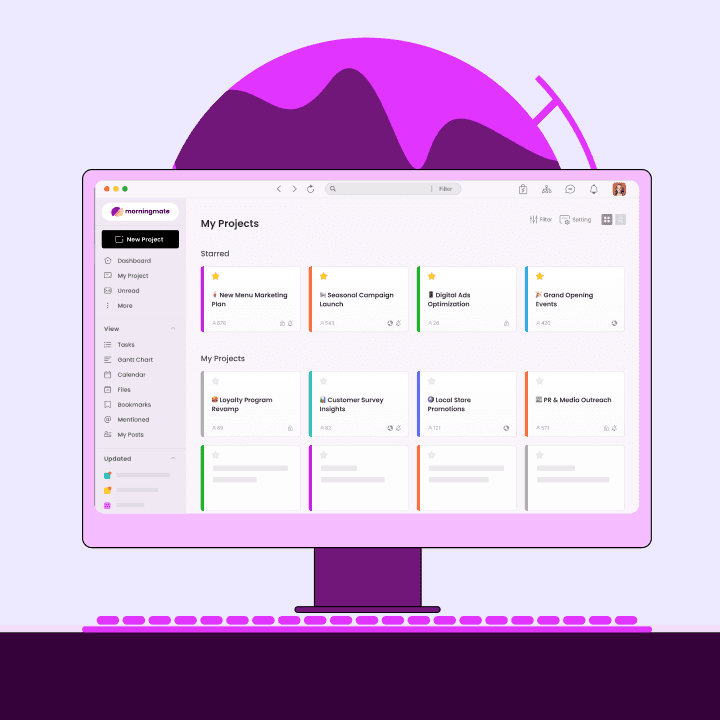
After standardizing on the Decision-to-Task Pipeline, the team used Morningmate — a lightweight work management platform with built-in task tracking and a shared workspace — as their anchoring system. Here is how the four checkpoints mapped to a real meeting workflow:
Capture: During the meeting, the designated note-taker created a new task in Morningmate's project board for each decision, using the three-field format: decision, rationale, and downstream impact. This happened in real time, visible to all attendees who had the project open.
Assign: Each task was assigned to a named individual before the call ended. Morningmate's task management view showed the full list of open items by owner, making it immediately visible if any task was still unassigned at close.
Anchor: A due date was set on every task at the point of creation and linked to the relevant project — in this case, a vendor contract renewal workstream. The operations manager could see the full workstream view without requesting a status update from anyone.
Confirm: The last two minutes of the meeting were a read-back of the task list now visible in Morningmate. Any corrections were made live. The meeting closed with every decision logged, owned, dated, and confirmed.
One specific feature that supported this process was Morningmate's task-creation agent, part of its Repattern AI suite. When a post-meeting chat message summarized a follow-on decision, the agent converted that message directly into a tracked task — so even decisions made asynchronously after the meeting entered the same structured pipeline without anyone manually re-entering the information.
Within four weeks, the operations manager reported zero instances of "I didn't know that was mine" during project reviews. Cross-team handoffs had a visible trail. Onboarding a new team lead required pointing them to the project board, not scheduling a knowledge transfer meeting.
Before and After: Manual Decision Tracking vs. Standardized Task Management
Workflow element | Manual / informal | Standardized pipeline |
|---|---|---|
Decision record | Personal notes; recap email (delayed) | Logged in shared task management system during meeting |
Ownership | Implied; assigned to a team | Named individual, confirmed at close |
Due date visibility | In personal calendar; invisible to others | Attached to task; visible in shared project board |
Status checking | Manual follow-up; ad hoc pings | Visible in task tracking view without asking |
Onboarding access | Requires knowledge transfer meeting | New hire reads project history directly |
Decision rationale | Lives in someone's memory | Recorded in task context; searchable |
Implementation Checklist: Standardize Your Post-Meeting Task Management
Use this checklist when rolling out the Decision-to-Task Pipeline across your teams. It is designed for operations managers who need consistent adoption without lengthy training programs. The goal is a task management process that is simple enough to follow in the last five minutes of any meeting and robust enough to eliminate status-chasing across the week.
Before the meeting: Designate a note-taker whose sole job is logging decisions, not action items. Rotate the role so it is not always the most junior person in the room.
During the meeting: Use the three-field capture format for every decision: what was decided, why, and what it affects. Log directly into your shared task management system — not a separate document.
At assignment: Ask explicitly: "Who is the single owner of this?" Assign in the system before moving to the next agenda item. Do not leave the meeting with unassigned decisions.
At anchoring: Set a due date — even provisional — and link the task to the correct project or workstream. A floating task is an invisible task.
At close: Reserve the final 90 seconds for a read-back of all decisions captured. Correct any discrepancies before anyone disconnects.
After the meeting: Do not send a recap email as a substitute for the recorded tasks. The task management system is the record of truth. If a follow-on decision happens in chat, convert it to a task immediately using whatever workflow your team has standardized.
For onboarding: Point new team members to the project board history as part of their first week. The recorded decision trail replaces the "let me walk you through how we got here" conversation.
For cross-team coordination: Ensure that tasks touching multiple departments are visible in a shared project — not siloed in a department-specific board that only one team can see.
Consistent task management at the point of decision is the lever that makes every other process improvement stick. When decisions are captured, owned, dated, and confirmed in the room, you stop losing work to memory and start building an operations infrastructure that scales — one that a new hire can navigate, a cross-functional partner can trust, and you can manage without manually chasing anyone for a status update. That is the standard worth building toward.