Project Management

Good task management is supposed to fix the chaos — so why does it keep failing? You research tools, you pitch the team, you set everything up, and then ninety days later you are back to chasing approvals over WhatsApp and hunting for the final logo file in six different email threads. If that sounds familiar, you are not alone, and the problem is almost never the tool itself.
The real issue is the gap between how a tool is introduced and how real marketing work actually flows. Task tracking systems get abandoned not because they are bad, but because they were never wired into the daily rhythms of a small, fast-moving team. Understanding exactly where that disconnection happens — and building a workflow that prevents it — is the difference between a tool that sticks and one that becomes another forgotten browser tab.
This article breaks down the anatomy of tool abandonment, gives you a repeatable setup play, and shows you how to build a task coordination habit your whole team will actually keep. Let's start with a scenario that will probably feel uncomfortably familiar.
When Campaign Day Goes Sideways
Picture this: it is 8 a.m. on launch day for your biggest campaign of the quarter. The email goes out at 10. You ping the founder on WhatsApp asking for final approval on the subject line. No response. You check your inbox — there is a thread from the freelance designer with three different versions of the hero image, all with slightly different file names, and you cannot remember which one the founder approved two days ago in a voice note. Your social posts are scheduled but you are not sure if the UTM links are correct because that spreadsheet was last updated by someone whose name you cannot find in the document history.
By 9:45 you are manually rebuilding context from four different apps. The campaign launches late. The wrong image goes live for twenty minutes. And when you do a retrospective, everyone agrees it was a communication problem — but nobody can point to exactly where it broke down.
That is not a people problem. That is a task management infrastructure problem.
Where Task Management Breaks Down for Small Marketing Teams
According to Asana's Anatomy of Work report, employees switch between apps an average of ten times per hour trying to get work done. For a small marketing team running campaigns, content calendars, and social scheduling simultaneously, that app-switching cost is catastrophic. Each switch is a context break, and context breaks kill momentum.
The Three Breakpoints
Most task workflow failures in small marketing teams happen at one of three places: approval handoffs, asset version control, and status visibility. Approval handoffs fail because the request lives in chat and the decision lives in someone's head. Asset version control fails because files travel by email and naming conventions are informal. Status visibility fails because updates are verbal or buried in threads that only one person has bookmarked.
The tool adoption problem compounds this. Harvard Business Review has noted that new workflow tools often fail because they add process overhead without removing the existing friction. When a tool feels like extra work on top of real work, teams quietly revert to whatever felt fastest — usually a group chat.
Here is how the two modes compare in a typical small marketing team setup:
Workflow Moment | Scattered Tools (Chat + Email + Sheets) | Unified Task Management |
|---|---|---|
Approval request | Sent in chat, easy to miss | Attached to the task, tracked |
Asset version | Multiple email attachments, unclear which is final | Filed in task, versioned by date |
Campaign status | Requires chasing each person | Visible to everyone at a glance |
Freelancer handoff | Brief in email, context lost after reply | Task with attached brief, threaded comments |
Post-launch review | Retrospective from memory | Full task history available |
Why Teams Abandon Task Management Tools Within 90 Days
The 90-day abandonment window is real and well-documented. Gartner research has found that low adoption of workplace tools is rarely about feature gaps — it is about the mismatch between tool design and team behavior. Here is what that looks like in practice for a small marketing team.
Top Reasons Marketing Teams Abandon Task Tracking Tools Within 90 Days
61%
Too complex to set up
54%
Team reverted to chat
47%
No clear ownership rules
38%
Founder not using it
Fig 1: Common abandonment drivers for SMB marketing teams (illustrative, based on industry research)
Notice that complexity and reversion to chat top the list — not missing features. The tool was not the problem. The habits around the tool were.
A Repeatable Play: The Campaign Task Management Setup
Here is a practical, five-step workflow you can run in under an hour to get your task coordination off the ground — and keep it there past the 90-day mark. This is built specifically for a small marketing team with a founder, a couple of internal people, and some freelancers in the mix.
Step 1: Create One Project Per Campaign, Not Per Channel
Most teams make the mistake of organizing tasks by channel — one board for social, one for email, one for paid. Instead, create a single project for each campaign. Every task within it — copy, design, scheduling, approval — lives in one place. This keeps context intact and makes cross-functional dependencies visible.
Step 2: Assign Every Task to One Person
Shared ownership is no ownership. Every task in your task management system needs a single named owner — not "design team" or "to discuss." If a task involves the founder's approval, the task owner is still you; the founder is a reviewer. Make that distinction explicit in how you set up the task.
Step 3: Attach Approvals to Tasks, Not to Messages
This is the single biggest change that prevents campaign-day chaos. When you need approval on a piece of copy or a creative asset, the approval request goes on the task itself — not in a WhatsApp message or a separate email. The asset lives there. The feedback lives there. The decision lives there. No archaeology required on launch day.
Step 4: Set a Hard Rule — If It Is Not in the Task, It Does Not Exist
Verbal agreements and chat decisions need to be reflected in your task tracking system before the day ends. This sounds strict, but it is the rule that makes everything else work. When you write "founder approved hero image v3 at 3pm Tuesday" as a task comment, you eliminate an entire category of confusion.
Step 5: Run a 10-Minute Weekly Task Review
Every Monday, spend ten minutes scanning the week's tasks as a team. Not a full stand-up — just a quick scan of what is overdue, what needs a decision, and what is blocked. This one habit is what separates teams that maintain their task coordination discipline from teams that drift back to chaos by week three.
Common Failure Points in Task Management — and How to Dodge Them
Even with a solid setup, there are predictable places where task workflow discipline cracks. Here is where to watch out.
The Founder Bypass
The founder keeps messaging you directly instead of logging feedback in tasks. This is the most common abandonment trigger for small teams. The fix: make it easier for the founder to respond inside the tool than outside it. If the task management interface looks familiar and low-friction — more like a social feed than a project management dashboard — founders actually use it. That is something worth considering when you pick your tool.
Freelancer Drift
Freelancers default to email because that is how they work with most clients. Give them one task to reference from day one, with the brief, deadline, and file drop location already in place. When their workspace is set up before they start, the habit forms naturally instead of requiring correction later.
Over-Engineering the System
If your task tracking setup requires a thirty-minute onboarding call to explain, it will not survive the quarter. Resist the urge to build elaborate templates, custom fields, and automation rules in week one. Start with the simplest possible structure — task, owner, due date, status — and add complexity only when the team asks for it.
How Morningmate Keeps Task Management Alive Past 90 Days
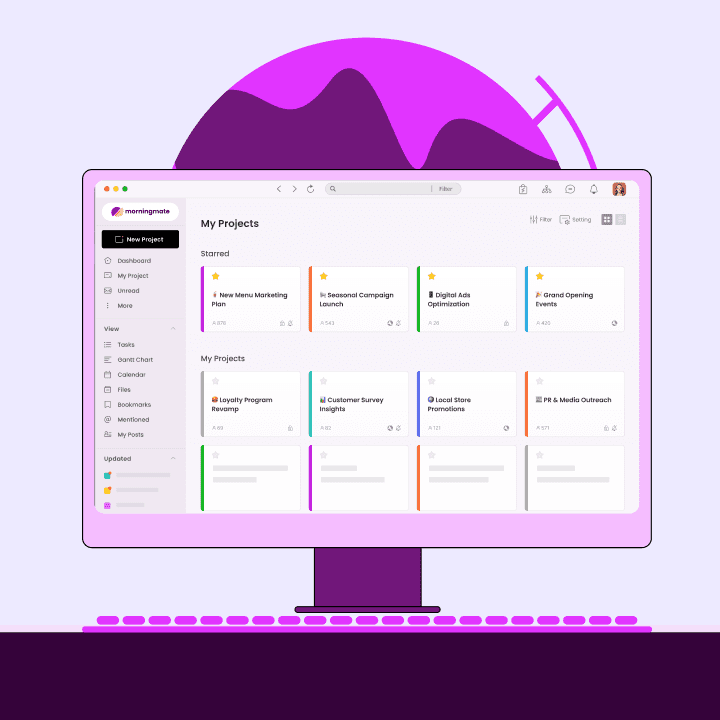
Here is where tool design genuinely matters. Morningmate is a lightweight work management platform used by over 550,000 teams globally, and it is built specifically for teams that need real task coordination without the complexity of enterprise tools like Jira or Asana. The interface uses a social feed-style view that most people instantly recognize — tasks and updates look more like a familiar social app than a spreadsheet — which dramatically lowers the barrier for non-technical team members and founders.
The built-in chat is integrated directly with tasks, meaning your team does not need to switch between a messaging app and a project board. Feedback, approvals, and file sharing all happen in the same thread as the task itself. For a marketing team juggling a founder, two in-house people, and a rotating cast of freelancers, that consolidation removes the main reason teams abandon their task management setup.
A Worked Example: The Q3 Campaign Launch
Imagine your team is running a product launch campaign. In Morningmate, you create a single campaign project. Each deliverable — email copy, social assets, landing page copy, paid ad creatives — becomes its own task with an owner and a due date. When the freelance designer uploads the hero image, they attach it directly to the design task and tag the founder for review. The founder sees the notification, opens the task from the same feed they check for messages, and leaves a comment: "Use version B." That comment is timestamped, visible to everyone, and attached to the task permanently.
On launch day, there is no archaeology. You open the task, see the approved asset, confirm the status, and ship. The entire decision trail — from brief to final approval — is in one place. That is what good task management for marketing teams actually looks like in practice.
Task Management Outcomes: Before and After Disciplined Adoption
When task coordination habits actually stick, the results are measurable. Here is a comparison of what teams typically report after 90 days of disciplined task management versus the scattered-tools approach:
Metric | Scattered Tools | Unified Task Workflow |
|---|---|---|
Time to locate approved asset | 15–25 minutes | Under 2 minutes |
Missed approval deadlines per campaign | 3–5 average | 0–1 average |
Freelancer onboarding time | 45–60 minutes of back-and-forth | 10 minutes with task brief |
Campaign retrospective accuracy | Based on memory | Full task history available |
Tool still in use at 90 days | Under 30% of teams | Over 70% with habit-first setup |
Team Confidence in Campaign Readiness: Scattered Tools vs. Unified Task Management
29%
Scattered tools
58%
Basic task tool
81%
Unified task + chat
Fig 2: Self-reported campaign readiness confidence by workflow type (illustrative)
Your Task Management Checklist for This Week
Task management only sticks when it becomes a reflex, not a resolution. Use this checklist to start building that reflex right now, with whatever campaign or project is already in flight.
Pick one active campaign and create a single project for it — everything in one place, not split by channel
Audit every open task: does it have a single named owner and a due date? Fix the ones that do not
Move the next approval request out of chat and onto a task — asset attached, deadline set, reviewer tagged
Brief your next freelancer entirely inside a task, not an email thread
Write down any verbal decisions from today as task comments before you close your laptop
Block ten minutes on Monday for a team task review — put it in the calendar now
Evaluate whether your current tool is simple enough for the founder to use without training
If your team has reverted to chat for task coordination, treat that as a signal to simplify — not to add more structure
Task management done right is not about having the most sophisticated system. It is about having a system that your actual team — founder, freelancers, and all — will open tomorrow morning without being asked. Tools that survive past 90 days are tools that fit the way your team already thinks, while gently pulling their work into a single, searchable, reviewable place. That is the whole game. Start there, stay consistent, and the chaos stays out.