Project Management

Good task management is one of those things you only notice when it breaks. You assigned something three weeks ago — verbally, in a message, maybe in an email — and today a client is asking where it is. Nobody dropped the ball on purpose. The work just had no home, no visible status, and no one place your team could check to see what was open, what was done, and what was falling through the cracks. That single gap costs small businesses more than most owners realize.
When your team is between five and thirty people, you can still get away with informal task tracking for a while. A shared spreadsheet here, a WhatsApp thread there, a sticky note on someone's monitor. But at some point, the business grows past what any one person can hold in their head. And the absence of a central place for open tasks stops being a minor annoyance and starts costing you real money, real clients, and real goodwill.
This article breaks down exactly what gets missed — and what you can do about it without adding another complicated tool to your stack.
The Hidden Tax of Scattered Task Management
Think about the last time a task got missed in your business. Someone assumed someone else was handling it. Or a message got buried in chat. Or a task was "assigned" in a meeting but never written down anywhere visible. When task management is scattered across email inboxes, chat threads, and memory, small teams pay a hidden tax on every project they run.
According to research from Atlassian, workers spend roughly 60% of their time on coordination work — chasing status updates, sitting in unnecessary meetings, searching for information — rather than doing the actual work they were hired to do. For a team of ten, that is six full-time salaries spent on coordination overhead instead of output.
The problem compounds when you have no central task workflow. Here is what typically breaks down.
What breaks | What it looks like day-to-day | Real cost to you |
|---|---|---|
Task visibility | Nobody knows what's open or who owns what | Missed deadlines, duplicate work |
Accountability | Tasks assigned verbally or in chat disappear | Owner becomes the fallback for everything |
Prioritization | Team works on what feels urgent, not what is | High-value work gets delayed |
Onboarding | New hires have no way to see what exists | Weeks lost getting people up to speed |
Owner time | You are the task management system | No time to lead or grow the business |
Why Task Management Breaks Down in Small Teams
The root cause is not laziness or poor discipline. It is that small teams default to the tools they already use. Email, WhatsApp, Slack — these are familiar, fast, and free. The problem is that none of them are built for task tracking. They are built for conversation.
A task buried in a chat thread has no owner, no due date, no status, and no way for anyone else on the team to see it unless they scroll back through hundreds of messages. That is not a task management system. That is a task graveyard.
Harvard Business Review research on overcommitted organizations found that when coordination happens informally, the most connected people in a team — typically the owner or manager — absorb a disproportionate share of the coordination burden. Sound familiar? You end up being the one person who remembers what was asked, who asked it, and whether it was ever done.
As your business grows past ten people, the informal system that worked when it was just you and three others collapses under its own weight. The answer is not a more complex tool. It is a consistent place where all open tasks live.
Where Open Tasks Get Lost in Small Teams (% of respondents)
61%
Email threads
74%
Chat / messenger apps
43%
Verbal / meetings only
29%
Spreadsheets
Fig 1: Common locations where task coordination breaks down in SMBs (illustrative, based on industry benchmarks)
What Actually Gets Missed Without Central Task Tracking
Let's be specific. When your team has no central place for open task management, these are the things that quietly fall apart.
Tasks that nobody owns
When a task is mentioned in a meeting or dropped in a group chat, it is technically "assigned" — but to the void. Without a task workflow that records who owns each item, you end up with everyone assuming someone else is handling it. Gallup's research on employee accountability consistently shows that unclear ownership is one of the top drivers of disengagement and dropped work. The task does not get done because nobody knows it was really theirs.
Priorities that shift invisibly
Without a shared task coordination system, your team members set their own priorities — usually based on who messaged them last. The most urgent-sounding Slack message wins, not the highest-value work. High-priority tasks that were quietly logged in an email two weeks ago get buried under the noise of whatever is happening today.
Work that gets duplicated
With no single view of open tasks, two people sometimes start working on the same thing independently. You only find out in a team meeting when both present their version. That is not just wasted hours — it is demoralizing, and it erodes trust in your systems (or lack of them).
Context that disappears when people leave
When someone quits or goes on leave, any task management they carried in their head — or their personal inbox — leaves with them. A central task tracking system preserves the work context regardless of who is in the seat. Without it, you are rebuilding from scratch every time there is a personnel change.
Your own time
This is the one that hurts most. When there is no trusted system for task coordination, you become the system. You are the one who remembers the status, chases the updates, spots the gap. Every hour you spend doing that is an hour not spent on sales, strategy, or any of the ten other things only you can do.
A Practical Fix: Building a Simple Task Management Habit
You do not need a full project management overhaul. You need a simple, consistent habit that your whole team can follow without a training course. Here is a five-step approach that works for teams of five to fifty.
Step 1: Pick one place for all open tasks. Commit to one tool. Not email, not WhatsApp, not a spreadsheet. One dedicated place where every task your team is working on is visible. The tool does not need to be complex — it needs to be consistent.
Step 2: Every task needs an owner and a due date. No exceptions. If a task has no owner, it belongs to nobody. If it has no due date, it is optional. Make these two fields mandatory for anything you post to your task tracking system.
Step 3: Status updates go on the task, not in chat. When someone has an update on a piece of work, they post it on the task itself — not in a separate message thread. This keeps the full history of any task in one place and eliminates the "where did we land on that?" question.
Step 4: Start every week with a five-minute task review. Not a long meeting. Just a quick look at what is open, what is overdue, and what needs to shift. This keeps your task workflow current without micromanaging anyone.
Step 5: Close tasks explicitly. A task is not done until it is marked done in your system. This sounds obvious, but it is the step most teams skip. Closing tasks creates a record, gives your team a sense of progress, and keeps your open task list accurate.
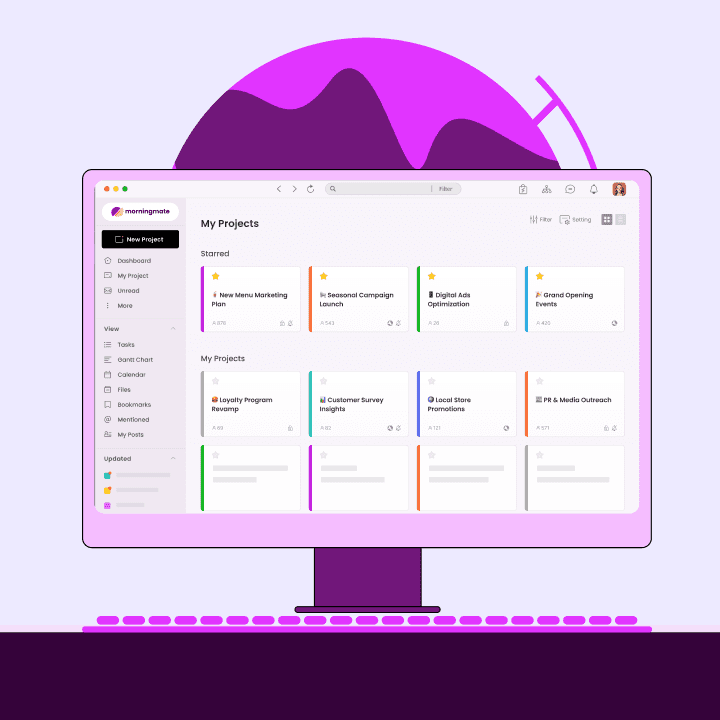
This is where a tool like Morningmate earns its place. It is a lightweight work management platform used by over 550,000 teams, built specifically so that non-technical teams can adopt it without a setup consultant or a week of training. Its task management features let you assign work with owners, due dates, and status updates — all in one feed that looks and feels like a social media timeline, which means your team already knows how to use it from day one.
One Hub vs. Five Tools: The Real Task Management Trade-off
Most small teams do not have a task management problem in isolation. They have a tool sprawl problem. Email for client work, WhatsApp for internal updates, a spreadsheet for tracking deliverables, and a shared drive for files. Each tool made sense when they added it. Together, they create a fragmented task coordination nightmare.
Morningmate consolidates task tracking, team chat, and file management into one place. The chat interface is intentionally built to feel like WhatsApp — familiar enough that your team does not resist adopting it. But unlike WhatsApp, tasks assigned in Morningmate do not disappear into a chat scroll. They live in a structured task workflow with owners, deadlines, and status visibility for everyone on the team.
For an SMB owner, that means fewer tools to pay for, fewer places to check, and fewer explanations when someone new joins. You also get the kind of team-wide visibility that lets you step back from day-to-day task chasing and actually lead.
Task management need | Scattered tools (email + chat) | One hub (Morningmate) |
|---|---|---|
See all open tasks at once | Impossible without chasing people | One feed, instant overview |
Know who owns what | Assumed, rarely confirmed | Assigned with named owner on every task |
Track progress without meetings | Requires manual status check-ins | Status visible on the task in real time |
Onboard a new hire quickly | Weeks of inbox archaeology | Full task and file history in one place |
Tool cost per user | Multiple subscriptions stacking up | Single affordable workspace |
Time Saved Per Week on Task Coordination After Centralizing Work Management
1.2 hrs
Email-only teams
2.5 hrs
Chat-to-task tools
5.8 hrs
Dedicated task hub
Fig 2: Estimated weekly hours saved on task coordination when teams move to a centralized task management system (illustrative benchmark)
The ROI of Getting Task Management Right
Here is a simple way to think about the return on fixing your task management. If your team of ten spends even three hours a week chasing updates, searching for task status, and redoing work that was already done — that is thirty hours of combined team time, every single week. At an average fully-loaded cost of $35 per hour, that is over $1,000 per week, or roughly $50,000 a year quietly disappearing into task coordination inefficiency.
A centralized task tracking system — one that your team will actually use because it is simple — is not an overhead cost. It is the cheapest hire you will ever make. Better task coordination means fewer dropped balls, fewer client escalations, and fewer nights where you are the one plugging the gaps at 10pm.
If you want to explore how a single lightweight hub can replace the scattered tools your team is currently juggling, Morningmate is worth a look. It is built for exactly this — teams that need solid task management without the learning curve or the enterprise price tag. You can also read more about building a work management system for small teams to see what a simple setup looks like in practice.
The next action is straightforward: count how many places your team's open tasks currently live. If the answer is more than one, that is where you start. Pick the single source of truth for task tracking, get your team using it this week, and watch how much quieter your inbox — and your evenings — become.