Project Management

Good task management is supposed to keep your business moving — but what happens when the knowledge behind every task, every client quirk, every process shortcut lives entirely in one person's head? You might not notice the problem on a Tuesday. You notice it on a Thursday when that person calls in sick, resigns, or simply goes on holiday — and suddenly your team is standing still, unable to answer a basic client question or complete a routine task without them.
This is one of the quietest and most expensive problems a small business can have. It's not dramatic. There's no system crash, no obvious failure. Just a slow, compounding drag on your team's ability to operate without you — or without that one indispensable employee — constantly in the loop. And the worst part? Most owners don't realize how badly it's affecting their task coordination until a real crisis hits.
If your business has five to fifty people, the odds are high that critical operational knowledge — how to handle a tricky client, where to find an approved vendor, what the sign-off process actually is — exists only in someone's memory or buried in a private inbox. That's not a team. That's a single point of failure wearing a company badge.
The Real Cost of Knowledge Trapped in One Person's Head
Let's put a number on it. Research from McKinsey found that employees spend nearly 20% of their working week searching for internal information or tracking down colleagues to get answers. In a ten-person team, that's the equivalent of two full-time employees doing nothing but chasing context. Every single week.
For small businesses running on tight margins, this isn't just an inconvenience — it's a real financial drain. Time spent asking "where is this?" or "who handles that?" is time not spent serving clients, closing deals, or finishing the work your customers actually pay for.
What Gets Dropped When Knowledge Isn't Shared
When task tracking relies on one person's memory, three things break down predictably. Deadlines slip because someone didn't know the right step. Clients get inconsistent answers because the team is guessing. And new hires take three times as long to get up to speed because there's nothing written down to learn from.
According to Harvard Business Review, the cost of losing a single knowledgeable employee — and with them, unrecorded institutional knowledge — can run between 50% and 200% of that person's annual salary, once you account for lost productivity, re-hiring, and retraining. For a small business, that can be existential.
Situation | Knowledge Trapped (No Task System) | Knowledge Shared (Structured Task Management) |
|---|---|---|
Key person goes on leave | Work halts, team waits for answers | Work continues using shared task context |
New hire onboarding | Weeks of shadowing and verbal hand-off | Refer to tasks, notes, and files from day one |
Client asks about past work | Scrambling through inboxes and chat history | Answer pulled from linked task in seconds |
Process decision is questioned | "I think we decided…" — no one is sure | Decision recorded in task thread, visible to all |
Why This Happens: The Root Cause in Plain Terms
Here's the honest answer: your team didn't set out to hoard knowledge. It happened because your tools let it happen. When task coordination runs through email, WhatsApp, or Slack, context stays locked inside those private conversations. No one else can see what was agreed, what files were shared, or what the next step is. It's not a people problem — it's a systems problem.
Small businesses typically grow fast and patch communication together with whatever's free and familiar. So you end up with decisions made in a WhatsApp thread, files saved to someone's personal Google Drive, and client instructions buried in a single employee's inbox. None of it is intentional. All of it is a ticking clock on your ability to scale without chaos.
A Gallup study on workplace engagement highlighted that unclear roles and lack of shared information are two of the top drivers of employee frustration and disengagement — especially in smaller teams where structure is informal. The person holding all the knowledge burns out. The team around them stays stuck. And the owner ends up managing the mess instead of growing the business.
How Teams Lose Work Time to Missing Context (% of weekly hours)
19%
Searching for files
24%
Chasing updates
31%
Re-explaining context
9%
With shared task system
Fig 1: Estimated weekly hours lost per category — illustrative based on McKinsey research
A Practical Fix: Five Steps to Get Knowledge Out of Heads and Into Your Task System
You don't need to build a company wiki or hire an operations manager. You need a simple habit shift that makes task management the place where knowledge lives — not email, not memory, not one person's laptop. Here's how to do it without adding complexity or cost.
Step 1: Pick One Place for All Task Tracking
Stop splitting task coordination across tools. Pick a single platform where every piece of work gets logged — from a quick client request to a multi-week project. The moment you create a task, that task becomes a container for all the knowledge related to it: files, decisions, updates, deadlines. If it's not in the task, it doesn't officially exist.
Step 2: Make Context Part of Every Task
When someone creates a task, require three things to be filled in: what the task is, why it matters or what the background is, and where any relevant files or links live. This sounds obvious. Most teams skip it because it feels like extra work. It pays back tenfold the first time someone needs to pick up a task mid-stream and can do so without asking anyone for help.
Step 3: Record Decisions Inside the Task, Not in a Side Chat
Every time your team makes a decision related to a piece of work — a client signs off on a revised scope, a delivery date changes, a vendor is swapped — that decision gets noted as a comment or update inside the task itself. Not in a WhatsApp group. Not in a follow-up email. This single habit is what transforms task tracking from a to-do list into a living record of how your business operates.
Step 4: Attach Files to Tasks, Not to People
Files saved to personal drives or emailed attachments are knowledge locked in the wrong place. Every document relevant to a task — briefs, contracts, reference images, approved templates — should be attached directly to that task. This is where a tool like centralized file management makes a measurable difference. When the file lives with the task, anyone who picks up the task has everything they need.
Step 5: Do a Monthly Knowledge Audit
Once a month, spend fifteen minutes as a team asking: what do we know that isn't written down anywhere? What would stop if one person left tomorrow? Those answers become new tasks, checklists, or process notes added to your task management system. This isn't a one-time fix — it's a habit that compounds over time into genuine operational resilience.
How One Tool Replaces the Scattered Mess
The practical problem most small business owners hit is that solving this with multiple tools creates a different problem: tool sprawl. You end up paying for a task tracker, a separate chat app, a file storage service, and a shared inbox — and information still scatters across all of them. The knowledge problem isn't solved. It's just moved.
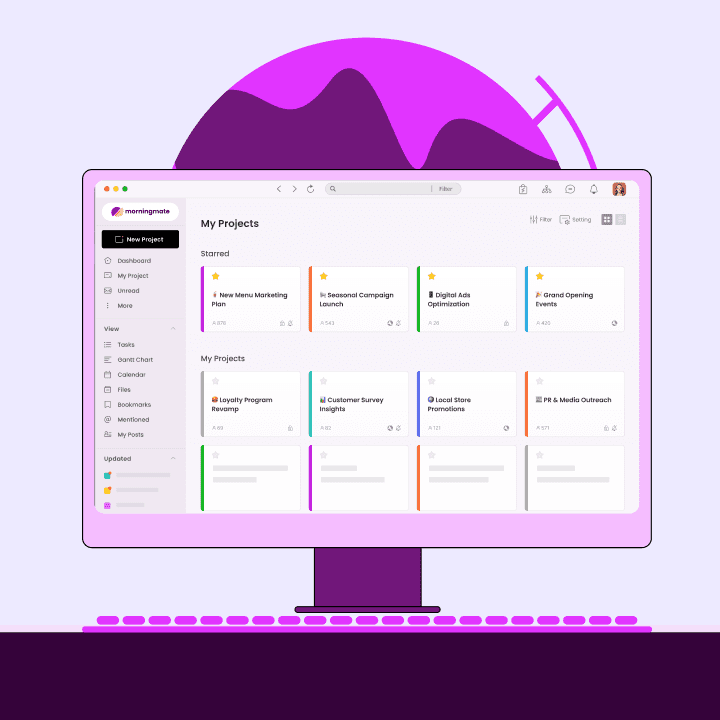
This is exactly what Morningmate was built to address. It's a lightweight work management platform used by over 550,000 teams that combines task management, built-in team chat, and file storage in one place — without the steep learning curve of tools like Jira or Asana. The interface feels like social media and messaging apps your team already uses, so adoption isn't a battle.
The key feature here is how Morningmate's task system works. Every task carries its own thread — comments, file attachments, status updates, and decisions all live directly inside the task. When someone joins a project mid-way or needs to hand off a task, there's no knowledge gap to fill. The context is already there. That's not just better task coordination — it's how you systematically get knowledge out of people's heads and into a place the whole team can access.
For an owner who's already wearing too many hats, having chat and task tracking in one tool also means you stop being the human relay between conversations and action items. Decisions made in chat can be turned into trackable tasks without switching apps or losing the thread. You can learn more about setting up simple task management for lean teams if you want a fuller breakdown.
Team Scenario | Without Structured Task Management | With Morningmate Task System |
|---|---|---|
Employee hands off a project | Long verbal briefing, context still lost | New person reads task thread and is up to speed |
Owner checks in on progress | Chase messages, wait for replies | Open task board, see status in real time |
Client file needed urgently | Search emails and drives for 20+ minutes | File attached to task, found in seconds |
Team runs without owner present | Frequent calls and interruptions | Tasks and context accessible — team self-directs |
What Shared Task Management Actually Does for Your Business
When task management becomes the place where knowledge lives — not just the place where to-dos get logged — something shifts in how your business operates. Your team stops being dependent on any one person. Onboarding gets faster. Handoffs get cleaner. You stop getting pulled into conversations that should have been handled without you.
Team Self-Sufficiency Score Before vs. After Structured Task Management Adoption
31%
Before (email + chat only)
58%
Basic task tool added
83%
Task + context + files unified
Fig 2: Illustrative self-sufficiency improvement when task management includes context and file attachment
Your Next Step: One Week to Better Task Management
Here's the ROI framing worth holding onto: every hour your team spends hunting for context, re-explaining decisions, or waiting for the one person who knows how something works is an hour they're not generating value. If your ten-person team loses even two hours a week each to this problem, that's twenty hours of paid time gone. Every single week. On something entirely fixable.
The fix doesn't require a big rollout or a budget conversation. Start this week. Pick one active project. Log every task in a single shared system. Attach the relevant files to the tasks. Write the context into the task description, not a follow-up chat message. Note decisions inside the task when they're made. Do that for one week and see how differently your team operates by Friday.
If you want a tool that makes this easy without adding complexity — one that combines task management, file storage, and team chat in a familiar interface your team will actually use — Morningmate is worth a look. It's designed specifically for teams that need structure without the overhead of enterprise software. The task management alone is enough to start moving your team's knowledge out of people's heads and into a shared, searchable, always-available system that keeps work moving regardless of who's in the office.
That's the real return: a team that can run, deliver, and grow — without everything depending on you or one indispensable employee being available at all times.