Project Management

Good task management is supposed to save your team time — but there is one quiet problem that undermines it in nearly every small business: your people keep rebuilding the same documents, templates, and checklists from scratch, over and over again. A proposal gets written, used once, and then lost in someone's email. A onboarding checklist gets assembled when a new hire joins, then disappears. The next time around, someone spends two hours recreating it. This is not a discipline problem. It is a system problem — and it is costing your business more than you think.
If you run a team of five to thirty people, this probably sounds familiar. You have smart, capable people who work hard. Yet somehow, basic task coordination keeps getting reinvented from scratch. A client brief gets written fresh each time. A process that someone figured out last quarter is nowhere to be found this quarter. The institutional knowledge your business depends on lives in individual heads, inboxes, and forgotten folders — not in one place where the whole team can use it.
The result is wasted hours, inconsistent output, and a team that is always busy but never quite building on what came before. Here is why this happens, what it actually costs, and how to fix it without adding new tools or headcount to the pile.
The Real Cost of Recreating Work Your Team Has Already Done
Most owners think of this as a minor annoyance. In reality, it is a recurring tax on your payroll. Research from McKinsey found that employees spend nearly 20 percent of their work week searching for internal information or tracking down colleagues to get it. For a ten-person team, that is two full-time equivalent hours lost every single day — not to bad work, but to work that has already been done and simply cannot be found.
When documents get rebuilt from scratch, three things happen simultaneously. First, your team spends time they do not have. Second, the output is inconsistent — each new version reflects whoever built it that week, not the best version your business has produced. Third, nobody ever improves the template because nobody knows a template exists. Your team is stuck on a treadmill, always starting from zero.
Document Type | Average Time to Rebuild From Scratch | Estimated Monthly Rebuild Frequency (SMB) |
|---|---|---|
Client proposal | 2–3 hours | 4–8 times |
Onboarding checklist | 1.5–2 hours | 2–4 times |
Project brief or scope | 1–2 hours | 6–10 times |
Status report or update | 45–60 minutes | 8–12 times |
Add those numbers up across a quarter and you are looking at dozens of hours burned on work that should take minutes to pull up and reuse. That is salary you are paying for zero forward progress.
Why Task Management Breaks Down When Knowledge Has No Home
Here is the root cause: most small teams have task coordination happening in too many disconnected places. Tasks live in one tool (or in someone's head). Files live in a shared drive, maybe. Conversations happen in WhatsApp or email. And the context that ties it all together — the decisions made, the process used, the template that worked — is scattered across all three and effectively irretrievable.
When task management is disconnected from the files and context around those tasks, institutional knowledge evaporates. Someone completes a project, the files sit in their personal drive, and when the next similar project comes around, the team starts fresh. It is not laziness. It is the natural outcome of a system that stores work in siloes instead of one shared, searchable space.
Harvard Business Review has noted repeatedly that small operational inefficiencies compound over time and are often invisible until they become expensive. Rebuilding documents is exactly that kind of invisible tax — each individual instance seems minor, but the pattern destroys productivity at scale.
Time Spent Per Week Recreating Existing Work (Hours, Average SMB Team Member)
4.5 hrs
No system
3.1 hrs
Shared Drive Only
0.8 hrs
Integrated Hub
Fig 1: Estimated weekly hours lost to document recreation by system type (illustrative, based on industry benchmarks)
The Three Reasons Your Team Keeps Starting From Zero
Understanding why this happens is the first step to stopping it. In most small businesses, there are three specific failure points in how task tracking and file management intersect.
1. Files Are Detached From Tasks
When someone completes a task — say, writing a client proposal — the output file goes into a shared drive or email attachment. But the task is marked done and archived. Next time a similar task comes up, the new assignee has no obvious trail leading back to what was produced. They do not know where to look, so they start fresh. Good task coordination means keeping the output attached to the task itself, in a place where anyone picking up similar work later can find it immediately.
2. There Is No Official "This Is Our Template" Moment
Even when a great document gets created, it rarely gets formally designated as the standard. It sits in a personal folder or a loosely organized drive. Nobody announces it as the go-to version. So the next person creates their own. The fix is simple: your task management process needs to include a step where finished deliverables get tagged or saved as reusable references — not just filed away.
3. Context Lives in the Chat Thread, Not the Work Record
The decisions and rationale behind documents often get discussed in WhatsApp or email — and then vanish. Six months later, when someone is rebuilding something similar, all that context is gone. Effective task management keeps the conversation tied to the work, so the reasoning is there when it is needed again. Atlassian's State of Teams research points to context-switching and fragmented communication as among the biggest drags on team productivity — exactly this problem in action.
A Practical Fix: Four Steps to Stop the Rebuild Loop
You do not need a complicated knowledge management system or a new hire to own this. You need a simple, consistent process that your lean team can actually follow. Here is a four-step sequence that works for businesses with five to fifty people.
Step 1: Audit What Gets Rebuilt Most Often
Spend twenty minutes with your team this week and ask one question: "What documents do we recreate from scratch most often?" Write down the top five. These are your highest-value targets for standardization. Common answers include proposals, briefs, onboarding docs, meeting agendas, and status reports. Now you have a specific list to work from instead of a vague intention to "get more organized."
Step 2: Designate One Location as the Single Source
Pick one place — not two, not three — where your team's reusable documents and templates live. It does not matter whether it is a folder in a project tool or a pinned post in a shared workspace, as long as everyone on the team knows it exists and knows how to find it. The key is consensus. If half your team saves to Drive and the other half saves to a task tool, you have two siloes instead of one system.
Step 3: Build "Save as Template" Into Your Task Workflow
This is where task management discipline pays off. When someone completes a task that produces a reusable output, closing that task should include one extra step: upload the final version to your single source location and label it clearly. It takes two minutes. Over time, this creates a living library of your best work — built by the team, for the team, without any extra effort.
Step 4: Attach Files Directly to Tasks, Not Just to Drives
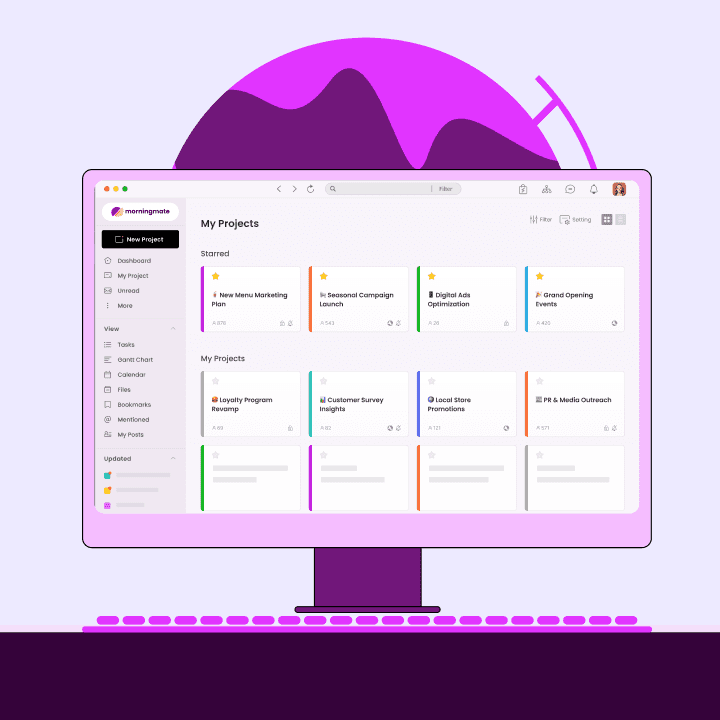
Whenever a task involves creating or referencing a document, attach that file directly to the task record. This is where a tool like Morningmate becomes genuinely useful. Morningmate is a lightweight work management hub — used by over 550,000 teams worldwide — that keeps tasks, files, and team conversations all in one place. When a task is created, files attach directly to it. When someone picks up similar work months later, the context, the previous version, and the team discussion are all right there. No digging, no rebuilding.
How One Hub Solves the Task Management and Document Problem Together
The instinct for most owners is to try adding a document management tool on top of an existing task tracking setup. That just creates more tool sprawl — another login, another subscription, another thing the team half-adopts and then ignores. The smarter move is to use a single platform where task coordination and file management are already integrated.
Morningmate is built specifically for this. Its interface looks and feels like a social feed — familiar enough that even non-technical team members adopt it without training. You can post updates, attach files, assign tasks, and have the discussion all in the same thread. There is no jumping between a task app, a chat app, and a shared drive. Everything your team produces is linked to the work it came from, making it findable the next time around.
The built-in chat functions similarly to WhatsApp — so your team does not face a learning curve — but unlike WhatsApp, conversations are tied to projects and tasks rather than disappearing into a general group thread. That means when someone is doing similar task coordination six months from now, the context is still there and retrievable.
What Your Team Needs | Scattered Tools Approach | Morningmate (Integrated Hub) |
|---|---|---|
Find a past proposal | Search Drive, email, Slack — 15+ min | Attached to original task — seconds |
Understand why a decision was made | Lost in WhatsApp thread or email chain | Conversation tied to the task record |
Onboard a new team member | Rebuild checklist, track down SOPs manually | Reuse pinned templates from previous projects |
Track task progress with files attached | Task in one tool, file in another, update in chat | All in one view, one place |
What the Numbers Look Like After You Fix the System
Teams that move from scattered tools to an integrated task management and file workflow see measurable improvements quickly. The gains are not dramatic in any single week — they compound. Each time a team member finds a past document instead of rebuilding it, they save two hours. Each time a process note attached to a task prevents a repeated mistake, you save a client relationship. Over a quarter, those savings add up to real money and real capacity.
Team Productivity Improvement After Adopting Integrated Task + File Management (%)
+12%
Shared Drive Only
+27%
Task Tool + Drive
+41%
Fully Integrated Hub
Fig 2: Estimated productivity gains by system type after 90-day adoption (illustrative)
Your Next Move: Make Task Management Pay for Itself
Strong task management is not just about knowing who is doing what by when. It is about making sure everything your team learns and produces is preserved and reusable — so your business gets smarter over time instead of starting over every quarter. That is what separates teams that scale from teams that stay stuck.
This week, do three things. First, ask your team what they rebuilt from scratch in the last month. Second, pick one document type and designate a single home for it — a pinned post, a folder, a task template. Third, make attaching files to tasks a standard part of how your team closes work. If you want a tool that makes all of this frictionless without adding another subscription to the pile, Morningmate's integrated task tracking, file management, and built-in chat give you everything in one place — at a price point built for teams your size.
The ROI is straightforward: every hour your team stops spending rebuilding what already exists is an hour they can spend on work that actually grows your business. That is what good task management — done right — actually delivers.