Project Management

Good task management should mean your team hits the ground running on Monday morning — not spending the first hour piecing together what happened last week. Yet for most small business owners, that painful ritual of "where did we leave off?" is eating real money every single week. If your team of ten is burning 45 minutes every Monday re-orienting themselves before a single productive minute happens, you are losing roughly 7.5 hours of paid time before the week even starts. Multiply that across 52 weeks and you have nearly 400 hours a year spent on confusion, not work.
This is not a discipline problem. It is a systems problem. And the fix does not require hiring a project manager or buying expensive software. It requires understanding why task tracking breaks down at the start of every week — and putting one simple habit in place to stop it. The good news is that small teams can solve this faster than large ones, precisely because there are fewer moving parts.
Below, you will find the real cost of this weekly reset, why it keeps happening, and a practical step-by-step approach your team can adopt starting this Monday — without adding overhead or learning a complicated new tool.
The Real Cost of Your Monday Morning Status Hunt
Let's put hard numbers on this. Research from Atlassian found that employees spend an average of 31 hours per month in unproductive meetings — and a significant chunk of that is pure status-gathering that could be replaced by visible task management. For a small team, that figure hits differently because every person lost to admin work is a person not serving customers, closing deals, or building product.
Here is what the Monday morning status hunt actually costs a 10-person team earning an average of $30 per hour:
Team Size | Time Lost Per Week | Annual Hours Wasted | Annual Cost @ $30/hr |
|---|---|---|---|
5 people | 3.75 hrs | 195 hrs | $5,850 |
10 people | 7.5 hrs | 390 hrs | $11,700 |
20 people | 15 hrs | 780 hrs | $23,400 |
50 people | 37.5 hrs | 1,950 hrs | $58,500 |
These numbers assume just 45 minutes per person. In reality, if your task workflow involves digging through old messages, emailing people for updates, or waiting on someone to respond before you can move forward, the actual time lost is likely higher. And none of this accounts for the momentum killed when a team spends its sharpest morning hours on re-orientation rather than real work.
Why Task Management Breaks Down at the Weekly Reset
The root cause is simple: work gets done in one place, but task tracking lives somewhere else entirely — or nowhere at all. Conversations happen in WhatsApp. Files land in email. Decisions get made verbally in a Friday meeting. By Monday, none of that is findable without asking someone.
Harvard Business Review notes that coordination failures — not skill gaps — are the primary reason teams lose time and miss handoffs. For small business owners, this is painfully recognizable. You are not failing because your people are bad at their jobs. You are failing because the system for tracking task status was never built — it evolved by accident from whatever tools were already on everyone's phone.
Three specific patterns drive this breakdown in small teams:
Tasks live in conversations, not records. "Can you follow up on that client?" sent via chat is not a task — it is a message. It gets buried. It has no due date, no owner, no way to check its status without scrolling back.
No standard end-of-week close-out. Most small teams finish Friday by rushing to complete work, not by documenting what is done, what is pending, and what is blocked. Monday becomes the de-briefing session that Friday never had.
Status updates require a human to generate them. If knowing where a project stands requires asking a person, your task coordination is entirely dependent on that person being available, remembering, and responding quickly. That is a fragile system.
Where Small Teams Lose Time on Monday Mornings (%)
47%
Chasing status updates
31%
Finding files & context
22%
Re-prioritizing work
Fig 1: Primary time sinks during the Monday morning status reset (illustrative, based on team productivity research)
A Practical Fix: Five Steps to Kill the Monday Morning Status Hunt
This does not require a full process overhaul. It requires one consistent habit built around visible task management — meaning every task has an owner, a status, and a home that anyone on the team can check without asking anyone.
Step 1: Stop Creating Tasks Inside Chat
Any request made in a messaging thread that is not converted into a formal task is a task at risk. The rule is simple: if it needs to be done by someone by a certain time, it needs to exist as a trackable task — not as a WhatsApp message. Enforce this consistently for two weeks and your team's task coordination will improve visibly.
Step 2: Assign Every Task an Owner and a Due Date — No Exceptions
Unassigned tasks die. Tasks with vague timelines slip. If a task does not have exactly one owner and a specific due date, it is not a task — it is a wish. This single change in your task workflow removes the most common source of Monday confusion: "I thought you were handling that."
Step 3: Build a Friday Close-Out Ritual (15 Minutes Max)
Every Friday, each person updates their tasks with current status before logging off. Done, in progress, blocked — three options, nothing more. This takes less than 15 minutes and makes Monday's task tracking effortless. The team arrives Monday to a dashboard of current states, not a fog of unknowns.
Step 4: Make Task Status Visible Without Asking
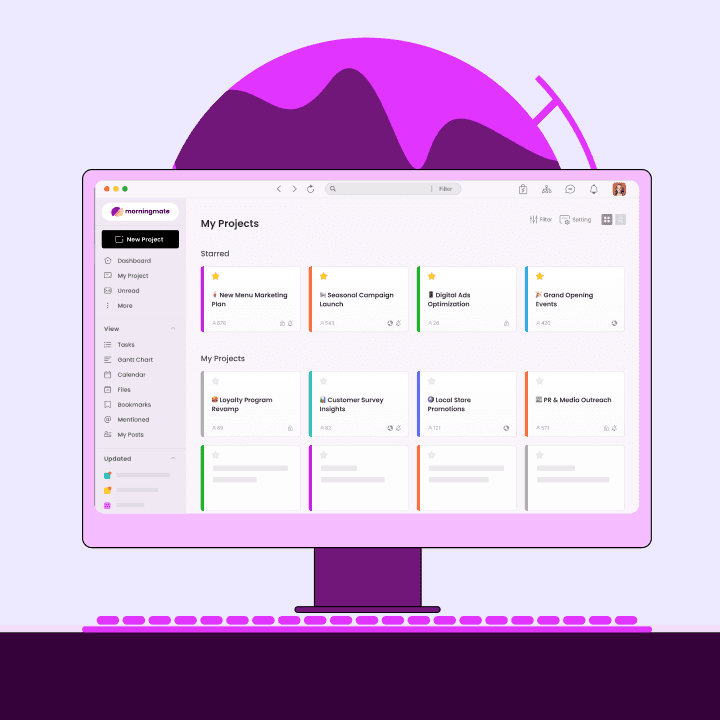
This is where the right tool matters. Tools like Morningmate — a lightweight work management platform used by over 550,000 teams — give every task a visible status that anyone can check in seconds. Its Feed view works like a social media timeline, so even non-technical team members pick it up immediately without training. Instead of asking "where does X stand?", your team opens one screen and sees exactly what is done, what is due today, and what is blocked. That is task management that actually removes the Monday reset.
Step 5: Replace the Monday Status Meeting with a Monday Scan
Once task tracking is visible, a 60-minute Monday status meeting collapses to a 10-minute scan. Each person reviews open tasks, flags anything blocked, and the team addresses only the exceptions — not every item from scratch. McKinsey research consistently shows that structured, async-first information sharing cuts meeting time significantly while improving team clarity. This is that principle applied at small business scale.
Task Management Without the Tool Sprawl
The objection most small business owners have to fixing task tracking is adding another tool — and that concern is valid. You already have chat apps, email, maybe a shared drive. The last thing a lean team needs is a sixth platform nobody uses after week two.
The right answer is not more tools. It is replacing scattered tools with one hub that handles task management, team communication, and file sharing in a single place. Morningmate is built specifically for this. Its built-in chat works like WhatsApp — so your team does not feel like they are learning something foreign — but tasks and conversations live together. When someone sends a message about a project, you can convert it to a tracked task without switching apps or losing context. Files attach directly to tasks. Deadlines are visible. Status updates themselves.
For a small business owner who is wary of complexity, that matters. You are not managing a system — you are replacing scattered friction with one place where work actually lives. See how Morningmate compares to running task coordination across multiple disconnected tools:
Situation | Scattered Tools (Chat + Email + Drive) | Morningmate (One Hub) |
|---|---|---|
Checking task status Monday morning | Ask a person, wait for reply | Open task board, see status instantly |
Finding a file linked to a project | Search email, Drive, chat history | Attached directly to the task |
Knowing who owns what | Memory, or ask in the group chat | Every task shows assignee and deadline |
Onboarding a new team member | Walk them through multiple platforms | One login, familiar interface, no training needed |
Friday close-out update | Email, verbal, or forgotten entirely | Update task status in one tap |
The difference is not feature count. It is whether your task tracking system requires human intervention to reveal what is happening — or whether it just shows you. You can learn more about choosing the right lightweight work management approach for small teams to find what fits your stage.
What Teams See After Fixing Task Management (The Numbers)
Small teams that shift from scattered task coordination to a single visible system consistently report the same outcome: Monday mornings get shorter and the work that matters starts earlier. Here is how that improvement typically maps across different team setups:
Average Reduction in Monday Re-Orientation Time After Adopting Structured Task Tracking
15%
Email-only teams
38%
Basic task tools added
72%
Unified hub + Friday ritual
Fig 2: Estimated time reduction in Monday re-orientation across task management approaches (illustrative)
The biggest gains come not from the tool alone, but from combining a visible task management system with the Friday close-out habit. One without the other only gets you partway there. Both together eliminate the Monday scramble almost entirely.
Your Next Step: One Change, This Week
Fixing task management does not have to be a project. It starts with one decision this week: stop treating chat messages as tasks. Pick one active project and move every open item in it to a tracked task with an owner, a status, and a due date. Run the Friday close-out at the end of this week. Show up Monday and see what the morning looks like when the answers are already there.
If you want the task coordination and communication in one place without juggling multiple tools, Morningmate is worth a look. It is free to start, designed for teams that do not have time to learn complex software, and built around the simple idea that everyone on your team should be able to see what is happening without asking anyone. That is what real task management delivers — not just a list of to-dos, but a business that runs with less of you in the middle of every status conversation.
The ROI is straightforward: if you recover even 30 minutes per person per week, a 10-person team gets back over 260 hours a year. At $30 per hour, that is nearly $8,000 — returned to actual work, not weekly re-orientation. The Monday morning status hunt is optional. You just have to decide to stop paying for it.