Project Management

Good task management is supposed to bring clarity — who does what, by when, and why. But there's a specific failure mode that even well-organized small marketing teams run into constantly: tasks that exist, that everyone knows about, but that nobody technically owns. They float. They drift. And then, three days before your campaign launches, someone realizes the thing never got done.
This isn't a laziness problem. It's a structure problem. When your team spans time zones, mixes freelancers with in-house staff, and coordinates across Slack threads, email chains, and voice notes to the founder, task tracking becomes a game of telephone — and the message always gets dropped somewhere. According to Gallup's research on team accountability, unclear ownership is one of the top drivers of disengagement and missed deliverables in distributed teams.
If you're a marketing manager running campaigns with a tiny crew — a few in-house people, a founder who reviews things whenever, and a rotating cast of freelancers — this article is for you. Here's how ownerless tasks happen, what they cost you, and a repeatable play to close that gap for good.
The Campaign That Almost Launched Without a Landing Page
Picture this: it's 8 a.m. on launch day. Your paid ads are scheduled, your email is queued, your social posts are lined up. Then someone asks, casually, "Hey, did the landing page copy ever get approved?" Silence. You check Slack. You check email. You check the shared Google Doc with seventeen comment threads. The copy was written. Your freelancer sent it over two weeks ago. The founder said he'd look at it. But no one formally approved it, no one moved it to "ready," and no one flagged it as blocked.
This is the ownerless task problem in action — and it happens because task coordination in small teams usually lives inside communication tools rather than actual task management systems. Messages scroll away. Verbal handoffs evaporate. The task workflow was never formalized in the first place.
Where Task Management Actually Breaks Down
The breakdown isn't usually at the point of doing the work. Most people on your team are capable and willing. The breakdown happens at the handoff points — those invisible moments where one person finishes their part and assumes someone else picks it up.
The "Someone Else's Job" Gap
In distributed marketing teams, task tracking suffers from what organizational psychologists call "diffusion of responsibility." When a task touches multiple people — writer, designer, approver, publisher — each person assumes someone else is minding the finish line. Harvard Business Review has documented how even high-performing teams fail on cross-functional tasks when ownership handoffs aren't explicit.
Freelancers Live Outside Your System
Freelancers submit work and then disappear from your task workflow entirely. They're not in your Notion board. They don't see your Monday.com updates. They sent the file to your email at 6 p.m. on a Friday, and that's the last record of it anywhere. Meanwhile, task coordination inside your team assumes the freelancer's deliverable is "done" — even though it hasn't been reviewed, approved, or published.
Founder Approval Is a Black Hole
The founder review step is where task management goes to die in most small businesses. Founders are busy. Approvals get pinged over WhatsApp, buried in email, or mentioned verbally in a hallway conversation. There's no formal record. There's no due date. And unless someone is explicitly tracking that step as an open task, it simply falls out of the task workflow.
The Ownerless Task Problem: By the Numbers
Before diving into the fix, it's worth understanding how widespread this is. The data paints a clear picture of what poor task tracking costs distributed teams.
Failure Point | Where It Happens | Typical Impact |
|---|---|---|
No assigned owner | Tasks created in chat or email | Task never completed |
Approval not tracked | Founder/manager review step | Launch delays, rework |
Freelancer handoff lost | Email or DM delivery | Asset missed at go-live |
Status unknown to team | No shared task tracking view | Duplicated effort, confusion |
% of Distributed Marketing Teams Reporting Ownerless Task Failures Per Campaign
71%
Chat-only teams
58%
Email + spreadsheet
23%
Structured task system
Fig 1: Ownerless task failure rates by coordination method (illustrative, based on industry trends)
A Repeatable Task Management Play for Small Marketing Teams
Here's a lightweight workflow you can implement this week. It works whether you're using a purpose-built task coordination tool or starting with something simpler — the key is consistency, not complexity.
Create the task before the conversation. Any time work is discussed — in a meeting, a message, or a call — someone creates a formal task immediately. Not a note, not a starred message. A task with a name, an owner, and a due date. This single habit eliminates most ownerless task situations.
Assign one owner per task, always. Not a team. Not "marketing." One named person is accountable. If multiple people are involved, create subtasks with individual owners. The parent task owner is responsible for making sure all subtasks close.
Make approvals their own task. "Get founder to approve landing page copy" is a real task. Assign it to yourself. Set a due date two days before launch. Ping inside the task — not in WhatsApp — so there's a paper trail.
Give freelancers a task, not just a brief. When you hire a freelancer, create a task for their deliverable. Set them as the assignee if your tool allows external contributors, or assign it to yourself with a note that it's awaiting their submission. When it arrives, update the task status.
Do a 10-minute task audit every Monday. Before the week starts, scan every open task. Anything without an owner gets assigned in that session. Anything overdue gets a new date or escalated. Nothing survives the audit in a gray zone.
Common Failure Points in Task Tracking — and How to Dodge Them
Even teams that adopt a task workflow hit the same walls. Here's where things go wrong and what to do instead.
Failure: Tasks Created But Never Updated
Task management only works if statuses are maintained. If tasks stay "In Progress" forever because nobody updates them, you lose visibility instantly. Fix: make status updates part of the definition of done. Before a task is closed, the assignee adds a one-line note: what was completed, where the file lives, what comes next.
Failure: The Approval Step Has No Deadline
Approvals without deadlines drift indefinitely. When you create an approval task, give it a hard due date and make the blocker explicit: "Campaign cannot go live until this is approved." That urgency lives inside the task — not buried in a Slack thread that gets scrolled past.
Failure: Too Many Tools, Split Attention
According to Asana's Anatomy of Work report, knowledge workers switch between apps more than 25 times per day. Every tool switch is a chance for context to fall through the cracks. The more your task coordination is separated from your communication, the more likely tasks are to go orphaned. The fix isn't more tools — it's fewer, better-connected ones.
How Morningmate Brings Task Management and Approvals Into One Place
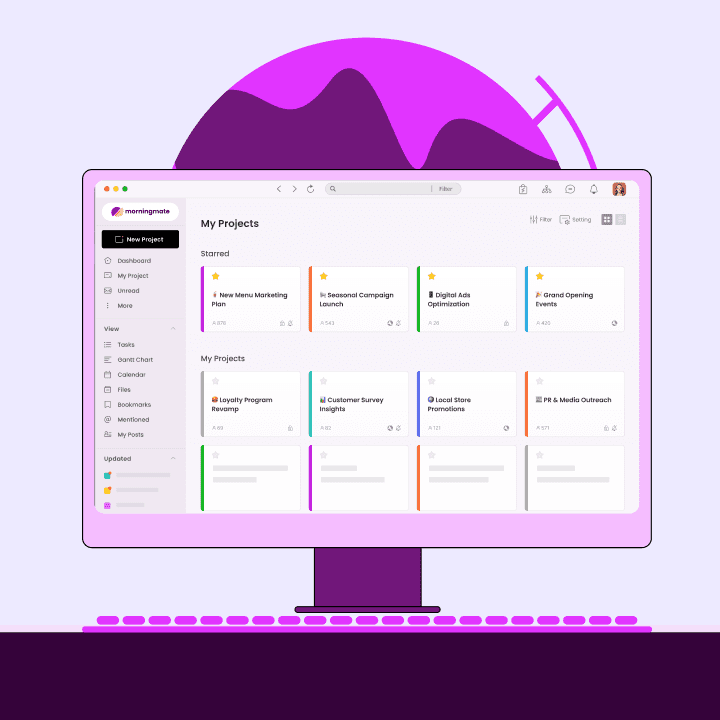
This is exactly the problem Morningmate was designed to solve for small teams. It's a lightweight work management tool that combines task tracking, built-in chat, and file management in a single workspace — so the conversation about a task and the task itself live in the same place. No more approval buried in WhatsApp. No more freelancer deliverable lost in email.
A Worked Example: Campaign Launch With a Founder Approval Gate
Say you're launching a product announcement campaign. Here's how the task workflow plays out in Morningmate:
You create a project called "Q2 Product Launch" in Morningmate's Feed — which looks like a familiar social-style stream, so even non-tech founders find it easy to use without training.
You create individual tasks: "Write landing page copy" (assigned to your freelance copywriter), "Design hero banner" (assigned to your designer), "Approve landing page copy" (assigned to the founder, due 5 days before launch).
When the freelancer submits the copy, they drop it directly into the task as a comment with the file attached. No email. The file and the task are the same thing.
The founder gets a notification inside Morningmate's built-in chat, reviews the copy, and marks the approval task complete. You see the status update in real time.
You run your Monday task audit inside the same tool — filter by "unassigned" or "overdue" — and nothing slips.
The entire task management chain — creation, execution, approval, closure — happens in one place. That's how you stop ownerless tasks before they become launch-day crises.
Task Type | Without a Task System | With Morningmate |
|---|---|---|
Freelancer deliverable | Arrives by email, gets buried | Attached to task, always findable |
Founder approval | WhatsApp ping, no record | Tracked task with due date + status |
Campaign status check | Manual update meetings | Real-time view of all open tasks |
Cross-team handoff | Assumed, not recorded | Subtask reassignment with notification |
Campaign Task Completion Rate Before vs. After Structured Task Coordination
41%
Before: Chat & Email
63%
After: Basic PM Tool
89%
After: Integrated System
Fig 2: Task completion rates improve significantly when task tracking is paired with built-in communication (illustrative)
Your Task Management Checklist to Apply This Week
Solid task management doesn't require a big rollout or an all-hands training session. Start with these six moves and build from there. Each one directly closes the ownerless task gap that's costing your campaigns right now.
✅ Convert every verbal or chat-based action item into a formal task — with an owner and due date — before the conversation ends.
✅ Audit your current open tasks today. Anything without a named owner gets assigned in the next 30 minutes.
✅ Create an explicit approval task for every piece of content or campaign asset that needs founder or stakeholder sign-off.
✅ Build a freelancer task protocol: every engagement gets a task, every deliverable gets attached to that task.
✅ Set up a weekly 10-minute task review — every Monday, scan for unassigned, overdue, or stalled tasks before they become launch-day surprises.
✅ Use a tool that keeps task tracking and team chat in the same place — so approvals, updates, and files don't scatter across five different apps. Morningmate's built-in task and chat system is built exactly for this kind of lean, high-velocity team.
Ownerless tasks don't survive in a team where task management is treated as a first-class habit — not an afterthought. The play is simple: name it, assign it, track it, close it. Do that consistently and your next campaign launch will be the one where everything was actually ready.