Project Management

Proper task management starts long before anyone opens a spreadsheet or assigns a deadline — it starts the moment someone gives feedback on a piece of work. And if that feedback lands in a chat thread, you've already lost control of it. Most small business owners don't realize how much time evaporates every week because feedback gets buried in messages, misread without context, or acted on by the wrong person at the wrong time. What feels like a quick, efficient exchange in chat almost always creates more follow-up work than it saves.
Here's a scenario that plays out in small teams every single day. Your designer shares a draft. You reply in chat: "Love the direction — just tweak the colors and tighten the headline." Two days later, the "updated" version comes back with different colors but the same headline. Why? Because your message was sandwiched between twelve other notifications. Someone read it, someone else acted on it, and the nuance was lost somewhere in the scroll. Now you're doing a third round of revisions on a job that should have been done.
This isn't a people problem. It's a task management problem. When feedback lives in chat, it has no structure, no owner, and no clear connection to the actual work. The fix isn't telling your team to "read more carefully." It's changing where feedback happens in the first place.
The Real Cost: Why Chat Feedback Drains a Small Business
For a team of five to fifty people, every hour wasted on unnecessary revision cycles, clarification pings, and dropped feedback is money you're not getting back. Task management done poorly doesn't look like a crisis — it looks like a slow leak. And slow leaks are the ones that sink businesses.
Research published in Harvard Business Review found that vague or poorly delivered feedback is one of the leading causes of repeated work cycles. When feedback lacks context — who said it, what it refers to, and what action is expected — teams default to guessing. In a small business, that guessing costs you real money in labor hours.
Consider the compounding effect. One unclear chat comment triggers one follow-up question. That question gets missed. A deadline slips. Someone escalates to you. Now you're involved in a problem that should have been resolved at the first feedback touchpoint. Task coordination breaks down not in big dramatic moments — it breaks down one ambiguous chat message at a time.
Feedback Scenario | Where It Happens | Typical Outcome |
|---|---|---|
Vague comment on a deliverable | Chat message | 1–3 extra revision rounds |
Clear, structured feedback with action items | Task comment / task card | Work completed in 1 round |
Feedback buried in group chat | Team messaging thread | Missed or partially actioned |
Feedback with deadline and assigned owner | Work management tool | Delivered on time, traceable |
Why It Happens: The Root Cause Is Convenience, Not Laziness
Chat feels fast. That's the whole trap. When you're juggling sales calls, supplier issues, and a staff question all before noon, firing off a quick message feels like the most efficient option. And it is — for you, in that moment. The problem is what happens on the receiving end.
Chat tools are built for conversation, not task coordination. A message thread has no due date, no assigned owner, no attachment to a specific piece of work. When feedback gets dropped into that environment, it inherits none of the structure that makes task management actually work. The person receiving it has to do all the interpretive work themselves — and that's where errors creep in.
McKinsey's research on workplace productivity found that employees spend nearly 20% of their workweek searching for internal information or tracking down colleagues for clarification. In a small team, that's one full day per person per week — almost entirely preventable with better task workflow habits.
Where Work Hours Go When Feedback Lives in Chat
41%
Rework & Revisions
31%
Chasing Clarification
28%
Finding Old Feedback
Fig 1: Estimated weekly time lost by small teams due to unstructured chat feedback (illustrative, based on McKinsey productivity research)
A Practical Fix: Simple Task Management Steps for Lean Teams
You don't need a complex system. You need a consistent habit. Here's a straightforward approach any small team can adopt, starting this week.
Step 1: Give Feedback on the Task, Not in a Side Chat
Every piece of feedback should live on the actual work item — the task card, the document, the project thread. If someone shares a deliverable, your response should be attached to that deliverable, not floating in a group message. This single change eliminates the most common cause of misconnected feedback in task tracking.
Step 2: Make Every Feedback Comment Actionable
Vague feedback creates vague results. Before you hit send on any comment, ask: does this tell the person exactly what to change, and by when? If the answer is no, rewrite it. "Great start, just polish it up" is not actionable. "Please shorten the intro paragraph to two sentences and update the CTA button color to match the brand guide — by Thursday noon" is.
Step 3: Assign Ownership to Every Feedback Point
In small teams, "we" means no one. When feedback requires action, name the person responsible. This is where task management discipline pays off directly — one named owner per feedback item means no dropped balls, no duplicate effort, and no ambiguity when checking in.
Step 4: Close the Loop in the Same Place
When a revision is done, the confirmation should go back on the task — not in a separate chat message. Keeping the thread whole means anyone can open a task six weeks later and understand exactly what happened, what changed, and why. That's the kind of task coordination that makes a small business feel professional without adding overhead.
Step 5: Reserve Chat for Conversations, Not Decisions
Chat is great for quick questions, scheduling, and informal updates. It's terrible for feedback that needs to be acted on, tracked, and referenced later. Draw a clear line in your team: if it requires action, it goes in the task. If it's a conversation, chat is fine. This one boundary change alone will cut your task management noise dramatically.
How Morningmate Handles Task Management Without Adding Complexity
Most small business owners avoid project management tools because they've tried one before and it felt like a second job to maintain. That's a fair concern — but it's also a sign they tried the wrong tool for their team size.
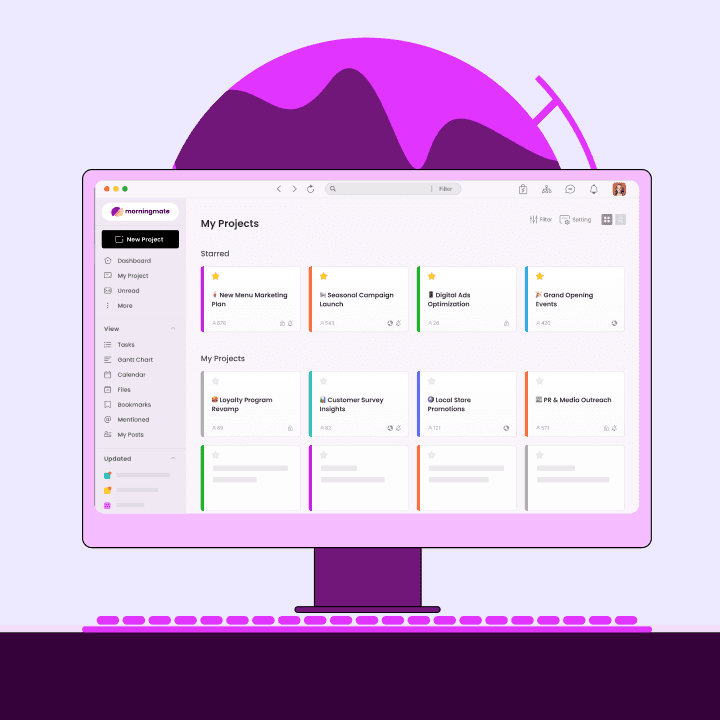
Morningmate is built for exactly this problem. It's a lightweight work management platform used by over 550,000 teams worldwide that combines task tracking, built-in chat, and file management in a single workspace. The interface is deliberately simple — the Feed view looks like a social media timeline, so even non-technical team members adopt it without training. There's no steep learning curve, no consultant required, and no six-month rollout plan.
The key feature for feedback-heavy teams is that every task has a comment thread attached directly to it. When you give feedback in Morningmate, it lives on the task — not in a separate message chain that will scroll out of view. You can tag a team member, attach a file, set a deadline, and track whether the update has been made, all from the same place. That's what proper task management for small teams actually looks like in practice.
And because Morningmate also has a built-in chat that works like WhatsApp — familiar interface, no new habits to force — your team doesn't have to choose between communication and task coordination. Both live in one place, which means no tool sprawl, no extra subscriptions, and no time lost switching between apps.
Task Management Area | Chat-Only Workflow | Morningmate Workflow |
|---|---|---|
Feedback location | Scattered across threads | Attached to the task card |
Task ownership | Implied, often unclear | Named, assigned, tracked |
Revision history | Must scroll back through chat | Always visible on the task |
Deadline visibility | Easy to miss or forget | Set on task, auto-notified |
Tool count | Chat + email + file storage | One platform, all-in |
The Before-and-After: Task Management With Structured Feedback
Teams that shift feedback out of chat and into structured task workflows consistently report fewer revision cycles, fewer missed deadlines, and less time spent by owners and managers chasing updates. Asana's Anatomy of Work report found that employees spend nearly 60% of their time on "work about work" — status updates, searching for files, and clarifying instructions — rather than the actual work they were hired to do. Better task management is the direct antidote to that waste.
Average Revision Rounds Per Deliverable — Before vs. After Structured Task Feedback
3.8x
Chat-Based Feedback
2.4x
Email Feedback
1.2x
Task-Attached Feedback
Fig 2: Fewer revision rounds when feedback is tied directly to task workflow (illustrative, based on industry productivity benchmarks)
Your Next Move: One Task Management Change That Pays for Itself
Task management isn't just about assigning work — it's about making sure the feedback loop around that work is tight, traceable, and fast. Every time feedback escapes into chat, you're creating hidden labor: re-reads, clarifications, missed revisions, and owner escalations back to you. Multiply that across five open projects and ten team members, and you're looking at real money being burned every week.
The good news is the fix doesn't require a big system overhaul. Start with one simple rule: if it's feedback that requires action, it goes on the task. Not in a message. Not in an email. On the task. Hold that line for two weeks and measure how many revision rounds drop and how often you stop getting pulled into issues that should have been resolved at the working level.
If your team needs a tool that makes this frictionless, Morningmate gives you structured task tracking with threaded comments on every work item, plus built-in chat so nothing has to move to a separate platform. It's designed for teams that need real task coordination without the complexity of enterprise software. Try it free and see how much cleaner your task management workflow can actually be.