Project Management

Effective task management starts long before anyone opens a project board — it starts with the person who already knows where everything lives. In most growing SMBs, that person is you: the ops manager who fields fifteen questions a day about process docs, onboarding checklists, approval chains, and project status. That invisible workload has a real price tag, and it compounds faster than most leaders realize.
A McKinsey Global Institute report found that employees spend nearly 20% of their working week searching for internal information or tracking down colleagues who have it. For a 30-person team, that is six full-time salaries spent on organizational hide-and-seek every single year. And the burden does not fall evenly — it concentrates on the one or two people at the center of every cross-team workflow: people exactly like you.
The frustrating part is that this is not a people problem. Your team is not disorganized by choice. It is a systems problem — and systems problems have systems solutions. This article gives you a concrete framework to diagnose where your task coordination is leaking, standardize the workflows that matter most, and redistribute the knowledge load so it stops living in one person's head.
The Compounding Cost of Being the Human Filing Cabinet
The invisible workload of being the person who knows where everything lives grows exponentially as your company scales. At ten people, answering "where is the onboarding doc?" costs you thirty seconds. At fifty people, that same question comes in twelve times a day from three different teams, each with a slightly different variant — and your answer is the only thing standing between them and a stalled task workflow.
Harvard Business Review research on collaborative overload shows that in most organizations, 20 to 35% of value-added collaboration comes from only 3 to 5% of employees. Those employees are routinely rated as high performers right up until they burn out or leave — taking every undocumented process with them. For ops managers, this is not an abstract risk. It is next quarter's onboarding disaster waiting to happen.
Before you can fix the system, you need to see it clearly. The table below maps the most common knowledge-silo symptoms against their downstream task management cost.
Symptom | What it looks like day-to-day | Task management cost |
|---|---|---|
Knowledge in one person's head | Team waits for that person to be online before acting | Delayed task starts, missed deadlines |
Process lives in email threads | New hires ask the same onboarding questions repeatedly | Repeated rework, inconsistent outputs |
Status lives in chat apps | Managers manually chase updates in DMs | 2–4 hrs/week per manager lost to status chasing |
No cross-team handoff standard | Tasks fall through the gap between departments | Accountability gaps, finger-pointing |
Introducing the STORE Framework for Task Management
Most process improvement efforts fail because they tackle symptoms — a new template here, a weekly standup there — without addressing the structural reason knowledge stays siloed. The STORE Framework gives you a repeatable model for systematically externalizing tacit knowledge and embedding it directly into your task tracking workflows. STORE stands for: Standardize, Tether, Own, Replicate, Evolve.
Each component targets a specific failure mode that ops managers encounter as teams grow. Work through them in order and you will end up with a task coordination system that does not depend on any single person — including you.
Where Knowledge-Silo Time Goes Each Week (% of working hours)
20%
Searching for information
14%
Chasing status updates
11%
Duplicating rework
45%
Total recoverable hours
Fig 1: Estimated weekly hours lost to knowledge-silo behaviors in a 30-person SMB (illustrative, based on McKinsey research)
S — Standardize: Give Every Task Workflow a Single Shape
Inconsistency is the engine of invisible workload. When every team member runs a slightly different version of the same process — different file-naming conventions, different approval steps, different places to log completion — you become the person who resolves the discrepancies. Standardizing your task management templates eliminates that arbitrage role.
In practice, this means defining a canonical task structure for your most frequent workflow types. A vendor onboarding task, for example, should always include: a due date, an assigned owner, a linked brief or scope doc, a defined approval step, and a completion confirmation. Not sometimes. Every time. When that shape is consistent, any team member can pick up the task without asking you what is missing.
T — Tether: Attach Context Directly to the Task
The most common reason people interrupt ops managers is not laziness — it is that the context for a task lives somewhere else. The brief is in a Google Doc. The approval criteria are in an old email. The relevant decision was made in a Slack thread nobody can find. Tethering fixes this by making the task itself the source of truth.
Every task in your task tracking system should carry its own context: a short description of the objective, links to relevant files, the name of the decision-maker, and any blockers already identified. This is where a tool like Morningmate's task management feature becomes practically useful. Morningmate lets you attach files, leave threaded comments, and tag teammates directly inside a task card — so the conversation about the work stays attached to the work itself, rather than scattered across four different apps. With 550,000 teams already using this approach, it is a proven method for cutting context-switching costs.
O — Own: Every Task Has One Named Human
Shared ownership is no ownership. When a task is assigned to "the marketing team" or "ops," it will wait on someone's desk indefinitely — and eventually land back on yours. The Own component of the STORE framework is simple but non-negotiable: every task in your task workflow must have exactly one named individual responsible for moving it forward.
This does not mean one person does all the work. It means one person is accountable for the task reaching its next stage. Collaborators can be added, but the owner is the single point of coordination. When this rule is enforced consistently, the number of "hey, where does this stand?" messages you receive drops sharply within the first two weeks.
R — Replicate: Turn Completed Tasks into Reusable Task Management Templates
Every time your team runs a process well, you have a free template for the next time. Replication means systematically converting successful task completions into repeatable structures. After your next smooth new-hire onboarding, do not move on — spend twenty minutes turning that task list into a standard template. Next time, the process runs itself.
Gallup research on workplace engagement consistently shows that employees perform better when they have clear expectations and the tools to meet them. Reusable task templates deliver both — they set expectations through structure and give team members the information they need without requiring a human guide every time. This is especially powerful during onboarding, where knowledge silos cause the most damage in a growing SMB.
E — Evolve: Build a Review Loop Into Your Task Coordination System
A standardized system that never changes becomes a bureaucracy. The Evolve component schedules a lightweight review — quarterly works well for most SMBs — where you audit your task tracking templates against current reality. Have approval chains changed? Did a new tool replace an old one? Is a particular task type always getting stuck at the same stage?
These reviews take less than an hour and prevent the slow rot that makes ops managers the "patch layer" between broken processes. The goal is not perfection on day one — it is a system that gets incrementally better without requiring heroic effort from any individual.
Before vs. After: Manual Task Management vs. Standardized Task Workflows
The operational difference between manual task coordination and a standardized task management system is not subtle. The table below shows what the same workflow looks like under each model across four critical dimensions.
Workflow dimension | Manual / ad-hoc | Standardized task management |
|---|---|---|
Onboarding a new hire | Ops manager assembles steps from memory and email | Template launched in minutes; manager reviews milestones only |
Cross-team handoff | Verbal or chat-based; easily missed or misunderstood | Task reassigned in system with full context attached |
Status visibility | Manager asks in chat; waits for response | Real-time task board visible to all stakeholders |
Process knowledge | Lives in ops manager's head; leaves when they do | Embedded in templates; available to any team member |
Approval tracking | Chased manually via email or message | Approval step built into task workflow with auto-notification |
Applying the STORE Framework in Morningmate: A Worked Example
Let us make this concrete. Your company is onboarding a new operations coordinator. Historically, this has meant you spending half a day pulling together instructions from old emails, forwarding documents, and answering the same questions for the third time this year. Here is how the STORE framework plays out inside Morningmate — a lightweight work management tool that combines task management with built-in team communication in one simple workspace.
Standardize: Create a project in Morningmate called "New Hire Onboarding — Ops." Define a fixed task list: IT setup request, tool access grants, policy document review, first-week check-in, 30-day goal setting. Each task has a defined structure: owner, due date, and linked file.
Tether: Attach the relevant SOP documents directly to each task card using Morningmate's built-in file management. The IT setup task links to the access request form. The policy review task embeds the current handbook PDF. No searching required.
Own: Assign each task to a specific person. The IT lead owns the access task. The new hire's direct manager owns the 30-day goal task. You own only the final sign-off step — not every stage in between.
Replicate: Once the onboarding completes successfully, duplicate the project as a saved template. Next new hire, you launch the template in under five minutes and update the name. The process runs without you narrating it.
Evolve: At your quarterly ops review, open the template and check whether any tools, policies, or owners have changed. Update accordingly. The system stays current without a complete rebuild.
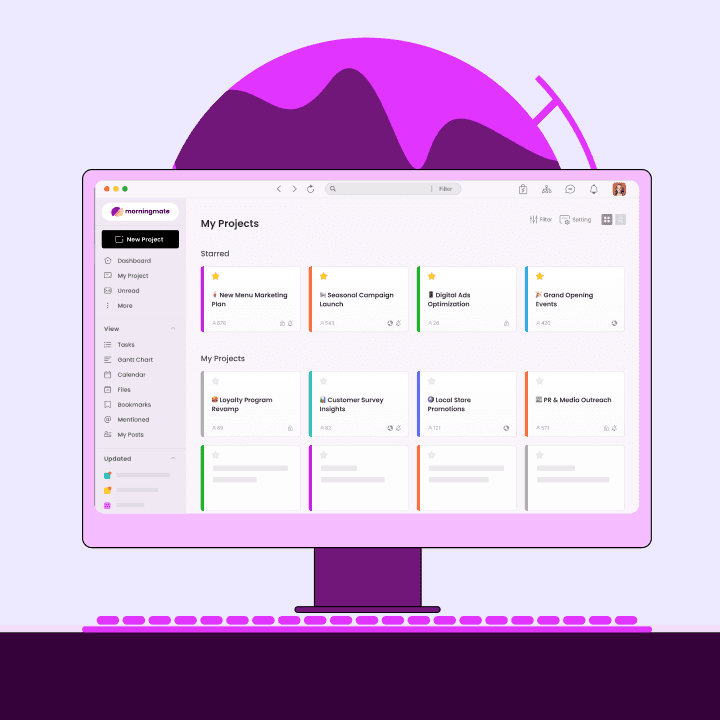
Morningmate's Feed view — which looks and feels like a familiar social media interface — means your non-technical team members adopt it quickly without training overhead. The task coordination happens in the same place as team communication, so context never gets lost between a chat message and an action item.
The Measurable Impact of Standardized Task Tracking
Teams that move from ad-hoc task coordination to standardized task management systems report consistent improvements across three metrics: time spent on status chasing, onboarding speed, and cross-team handoff accuracy. The bar chart below illustrates what a typical SMB can expect after a full STORE implementation over a 90-day period.
Ops Manager Time Recovered After Standardizing Task Management (hours/week)
1.5 hrs
Status chasing recovered
2.5 hrs
Onboarding time saved
3.0 hrs
Cross-team handoffs
7+ hrs
Total weekly recovery
Fig 2: Estimated weekly hours recovered per ops manager after STORE framework implementation (illustrative)
Your Task Management Implementation Checklist
Use this checklist to move from the STORE framework on paper to an operating system your team actually uses. The goal is to distribute the invisible workload of task coordination so no single person carries it alone — and so your task management system scales with your team rather than against it.
Audit your current task workflows. List the five most frequent process types your team runs. Note which steps currently live only in someone's head or inbox.
Define your standard task structure. For each workflow type, agree on the required fields: owner, due date, linked context, approval step, completion confirmation.
Build your first three task templates. Start with onboarding, cross-team handoffs, and your most repeated recurring process. Keep them simple — five to eight steps maximum.
Tether all context to the task. Audit existing tasks and attach the files, decisions, and links that currently live elsewhere. If it cannot be found from the task, it does not exist for your team.
Assign one owner to every open task. Remove group assignments. Every task gets a named individual by end of week one.
Choose a single task tracking platform. If your task management is currently split across email, chat, and spreadsheets, consolidate. A tool like Morningmate — which keeps tasks, files, and team communication in one place — is a practical starting point for non-technical teams that need fast adoption without heavy configuration.
Schedule a quarterly template review. Block one hour per quarter to update your task templates against current process reality. Put it in the calendar now.
Measure the shift. Track how many status questions you receive in week one vs. week six. That number is your leading indicator that the task coordination system is working.
The invisible workload of being the person who knows where everything lives is not a badge of honor — it is a signal that your task management infrastructure has not kept pace with your team's growth. The STORE framework gives you a structured way to change that: standardize your task workflows, tether context to every task, assign clear ownership, replicate what works, and build in the evolution loops that keep the system honest. Start with one process this week. The compounding cost of inconsistency works both ways — and a standardized task coordination system pays dividends every single quarter.