Project Management

Inconsistent task management doesn't just slow your team down — it compounds silently until the cost becomes impossible to ignore. Research from McKinsey estimates that knowledge workers spend nearly 20% of their working week searching for information or tracking down colleagues for status updates. Multiply that across a 30-person operations team and you're hemorrhaging the equivalent of six full-time salaries in wasted effort every single year. The root cause, more often than not, is fragmented task tracking that lives in different tools, different heads, and different habits — with no standardized process tying any of it together.
For an operations manager trying to scale a growing SMB, this is the defining friction point. Onboarding takes longer because no one agrees on how work should be handed off. Cross-team coordination breaks down because task workflows are person-dependent rather than system-dependent. Status updates require manual chasing because there's no single source of truth. The problem isn't that your team lacks competence. The problem is that your task management architecture was never designed to scale.
This article introduces a practical framework — the SCOPE Model — that gives operations managers a replicable structure for standardizing task coordination, eliminating knowledge silos, and building workflows that work just as well at 15 people as they do at 150.
The Real Cost of Non-Standardized Task Management
Before building a solution, it's worth quantifying exactly what inconsistency is costing you. Asana's Anatomy of Work Index found that 58% of workers report spending more time on status communication than on the actual work itself. That's not an anomaly — it's the predictable outcome of task tracking that relies on memory, chat threads, and ad-hoc check-ins rather than structured workflow systems.
The compounding effect matters here. Every new hire who doesn't understand the process adds coordination overhead. Every cross-team handoff without a standardized task workflow creates a gap where work falls through. Every missed deadline that triggers a post-mortem is costing you not just time, but trust — from leadership, from clients, and from your own team.
Operational Area | Without Standardized Task Management | With Standardized Task Workflows |
|---|---|---|
Onboarding time | 3–4 weeks to reach productivity | 1–2 weeks with clear task templates |
Status update frequency | Daily manual chasing via chat or email | Real-time visibility, on-demand |
Cross-team handoffs | Person-dependent, frequently dropped | System-dependent, tracked automatically |
Process documentation | Siloed, inconsistent, or nonexistent | Centralized, reusable, always current |
Deadline adherence | Reactive, deadline misses common | Proactive, blockers surfaced early |
Introducing the SCOPE Model for Task Management Standardization
The SCOPE Model is a five-component framework designed specifically for operations managers who need to standardize task tracking across a growing team without introducing heavyweight enterprise tooling. Each letter maps to a concrete operational lever you can pull right now.
S — Structure: Define how tasks are created and categorized.
C — Clarity: Establish what "done" looks like before work begins.
O — Ownership: Assign single-threaded accountability for every task workflow.
P — Progress Visibility: Build real-time status into the system, not the meeting.
E — Escalation Paths: Create standardized triggers for when tasks need intervention.
What makes SCOPE different from generic productivity advice is that it's designed to survive team growth. Each component is system-driven rather than personality-driven — meaning the workflow functions regardless of who is doing the work.
S — Structure: Build a Consistent Task Management Architecture
Inconsistent task creation is the first place task management breaks down. When one team member creates a task with a full description, due date, and assignee — and another creates it as a one-line note with no context — your system is already unreliable before anyone has started working.
Structure means defining a mandatory task template for your team. At minimum, every task in your task tracking system should include: a clear action-oriented title, a description with enough context for someone new to execute it, an owner, a due date, and a priority level. This sounds basic, but most SMBs skip it entirely — and pay for it every time someone new joins the team.
Operationally, structure also means consistent naming conventions and categorization. If your sales ops team calls a recurring deliverable "client report" and your account team calls it "monthly review," your task workflow data becomes unfilterable and unusable at scale.
C — Clarity: Define "Done" Before Task Tracking Begins
Ambiguity is expensive. Harvard Business Review has consistently highlighted that unclear expectations are one of the leading causes of rework, missed deadlines, and employee frustration. In a task workflow context, this translates directly: if a task doesn't have a defined completion criterion, it will be interpreted differently by every person who touches it.
Before any task enters your task management system, the person creating it should be able to answer: what does the output look like when this is complete? For a vendor onboarding task, "done" might mean the vendor contract is signed, stored in the shared drive, and the payment terms are logged in the finance tracker. Spell that out in the task description — not in a separate Slack message that gets buried in 48 hours.
Where Task Management Time Is Actually Lost (% of work week)
20%
Searching for info
58%
Status communication
34%
Rework from ambiguity
Fig 1: Common sources of productivity loss in non-standardized task workflows (illustrative, based on industry research)
O — Ownership: Single-Threaded Accountability in Task Coordination
Shared ownership is a polite fiction. When a task is assigned to "the marketing team" or "everyone on the project," it belongs to no one. Effective task coordination requires one named owner per task — not a group, not a cc list, not a channel.
This doesn't mean one person does all the work. It means one person is accountable for the task reaching completion. They can delegate subtasks, pull in collaborators, and request resources — but the status of that task is their responsibility to update and escalate if blocked.
For operations managers running cross-team workflows, single-threaded ownership is especially critical during handoffs. If the task transitions from ops to finance at a specific milestone, that transition itself should be a defined task step — with a named owner on each side and a clear handoff trigger.
P — Progress Visibility: Real-Time Task Tracking Without the Status Meeting
The status meeting exists because the task management system isn't doing its job. If your team's task tracking is current and visible to everyone who needs it, you should be able to see the state of every active workflow without sending a single follow-up message.
Progress visibility means building status updates into the task itself — not into a separate report or a weekly check-in. Task statuses like "Not Started," "In Progress," "Blocked," and "Complete" should be updated by the task owner in real time, and those updates should be visible to managers without requiring a meeting or a message.
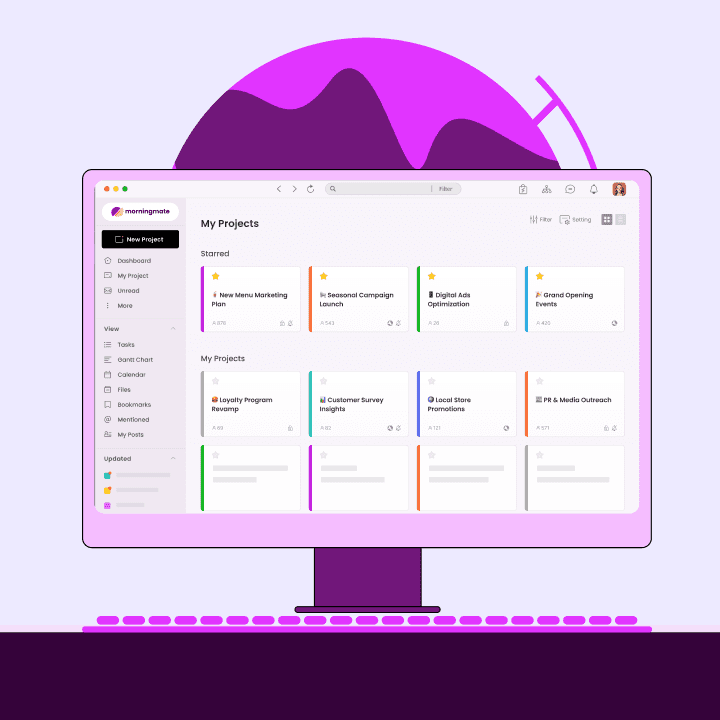
This is where purpose-built task management tools create a genuine structural advantage over general-purpose chat apps. Morningmate, for example, combines task tracking with a built-in feed view that surfaces task updates contextually — so managers see progress without needing to ask, and team members update status without switching tools. For operations teams managing dozens of concurrent workflows, that passive visibility eliminates hours of weekly overhead.
E — Escalation Paths: Standardizing When and How Blocked Tasks Surface
Even well-structured task workflows hit blockers. The difference between teams that resolve them quickly and teams that spiral into delays is whether the escalation path is defined in advance or improvised in the moment.
Standardized escalation means every task type in your system has a documented answer to: "If this is blocked for more than X hours, who gets notified, and through what channel?" For routine operational tasks, that might be a 24-hour threshold before the ops manager is tagged. For client-facing deliverables, it might be four hours. The threshold and the path should be written into your task workflow documentation — not left to individual judgment.
This single element alone can cut average task resolution time significantly. When team members know exactly how to escalate, they do it faster. When managers know what an escalation signal means, they act on it faster. The ambiguity cost evaporates.
Applying the SCOPE Model with Morningmate: A Worked Example
Let's make this concrete. Your company is onboarding a new vendor. Historically, this process has lived across email threads, a shared spreadsheet, and whoever remembers which step was last completed. Here's how SCOPE changes that in Morningmate — a lightweight work management platform used by 550,000 teams worldwide that combines structured task management with built-in team chat.
Structure: A standardized "Vendor Onboarding" task template is created in Morningmate with predefined subtasks: NDA signed, vendor contract reviewed by legal, payment terms confirmed with finance, vendor added to approved supplier list, and onboarding confirmation sent. Every new vendor goes through this identical task workflow — no steps invented on the fly.
Clarity: Each subtask has a description that defines exactly what completion looks like. "NDA signed" means: both parties have signed, the executed document is uploaded to the task file attachment, and the vendor contact is stored in the CRM. No interpretation required.
Ownership: The procurement coordinator is the task owner. Legal owns the contract review subtask. Finance owns the payment terms subtask. Each person's responsibility is explicit and tracked individually in the task coordination view.
Progress Visibility: The ops manager can open Morningmate's feed view at any point and see the current status of all active vendor onboarding workflows — which subtasks are complete, which are in progress, and which are blocked — without sending a single message or scheduling a call.
Escalation: Any subtask marked "Blocked" for more than 24 hours automatically triggers a notification to the ops manager via Morningmate's built-in chat. The escalation path is baked into the system — not dependent on someone remembering to speak up.
SCOPE Component | Manual / Ad-Hoc Approach | Standardized with SCOPE |
|---|---|---|
Structure | Tasks created differently by each person | Mandatory template, consistent fields |
Clarity | Completion criteria in someone's head | Defined in the task before work starts |
Ownership | Assigned to a team, often falls through | One named owner per task and subtask |
Progress Visibility | Requires meetings or manual follow-up | Real-time, on-demand, no chasing |
Escalation | Person-dependent, often delayed | Defined trigger, system-notified |
Operational Improvement After Standardizing Task Workflows (% reporting improvement)
41%
Faster onboarding
67%
Fewer missed deadlines
79%
Reduced status chasing
Fig 2: Self-reported improvements in teams that standardized task management processes (illustrative, based on industry benchmarks)
Implementation Checklist: Start Standardizing Task Management This Week
The SCOPE Model only works if you implement it systematically rather than selectively. Here's a practical checklist to get your task management standardization off the ground in the next five business days.
Day 1 — Audit your current task tracking: List every place work is currently tracked (chat, spreadsheets, email, memory). Map the gaps.
Day 1 — Choose one task management platform: Pick a tool your full team will actually use — prioritize ease of adoption over feature depth.
Day 2 — Build your first task template: Start with your most frequent recurring workflow (onboarding, vendor management, client delivery). Define required fields.
Day 2 — Write completion criteria: For each template subtask, write one sentence defining what "done" looks like. No exceptions.
Day 3 — Assign single owners: Review all active tasks and ensure every one has exactly one named owner. Reassign any assigned to teams or groups.
Day 3 — Set status conventions: Define your four standard task statuses and communicate them to the team. Make updating status a non-negotiable expectation.
Day 4 — Define escalation thresholds: For each task type, document: if blocked for X hours, notify Y person via Z channel.
Day 4 — Brief your team: Run a 30-minute walkthrough of the new task workflow system. Focus on the "why" — not just the mechanics.
Day 5 — Review and iterate: Check task compliance at the end of the week. Where did the template break down? Refine before expanding to other workflows.
Standardized task management isn't a one-time project — it's an operating discipline. The teams that scale without chaos are the ones who treat task coordination as infrastructure, not afterthought. Start with one workflow, prove the model, and expand systematically. That's how you move from manually chasing status to leading with actual clarity.