Project Management

Good task management is the backbone of any marketing operation — but it gets stress-tested hardest not during a campaign, but the moment your team structure shifts. A freelancer wraps up. The founder pulls a contractor onto a new priority. You bring in a part-time social hire for the summer. Suddenly half the context for your current campaigns lives in someone else's head, an old email thread, or a folder nobody can find.
This is the quiet crisis that small marketing teams face constantly. It is not a people problem. It is a structure problem — and fixing it means rethinking how your task workflow, your decisions, and your project context get stored between team changes.
This article walks you through a repeatable play for keeping work continuity intact every time your team reshuffles — so your campaigns do not lose momentum every time your roster does.
When Campaign Day Goes Wrong Before It Even Starts
Picture this. It is a Thursday morning and your seasonal email campaign is supposed to go live. Your copywriter — a freelancer you worked with for three months — wrapped up last week. The new freelancer you brought in is asking for the brief. You cannot find it. The brief lived in a Google Doc that was shared directly with the previous writer, and the approval comments from your founder are somewhere in an email chain with a subject line that says "Re: Re: Fwd: Campaign thoughts."
You spend ninety minutes reconstructing context that already existed. The campaign goes out two days late. Sound familiar? That is not a one-off disaster — that is what happens when task management is built around people rather than process.
Where Task Management Actually Breaks Down During Restructures
The problem is not that your team changed. Teams always change. The problem is that your task tracking lived inside relationships and conversations instead of inside a shared system. When those relationships shift, the tracking disappears with them.
Context Is Stored in the Wrong Places
When task management happens across email, a shared drive, and a chat app, context gets fragmented across platforms. Each person holds a piece of the puzzle. The moment that person is off the team, their piece goes with them. The next person inherits a task with no background, no decisions recorded, and no clear sense of what was already tried.
Approvals Have No Paper Trail
In small teams, approvals often happen verbally, in a quick message, or in a one-on-one call. When the task changes hands, there is no record of what was approved, what was pushed back, or what the rationale was. The new assignee starts guessing — or worse, redoing work that was already done.
Task Ownership Is Not Built Into the Workflow
Lots of small teams run task coordination through informal relationships. You know that Priya handles paid social and Marcus handles copy. But if Priya leaves and Marcus picks up her tasks, the system has no mechanism to surface what she was working on, where things stand, or what still needs sign-off. The task workflow was never designed to survive a handoff.
What Breaks Down vs. What Should Happen: A Task Management Comparison
Before building the fix, it helps to see clearly where the gap is. Here is what unstructured task management looks like during a team restructure, versus what a continuity-ready workflow does differently.
Situation | Unstructured task management | Continuity-ready task workflow |
|---|---|---|
Team member leaves | Context disappears with them | Task history and notes stay in the workspace |
New freelancer onboards | Scramble to send briefs and background | Assignee gets added to the task; all context is already there |
Approval decision made | Lives in a message thread or call | Recorded in the task comment thread with a timestamp |
Campaign context needed mid-project | Search across email, chat, and drive | One search in one workspace returns it with source |
Role reassigned mid-campaign | New person starts from zero | New assignee reads task history and picks up from where it stopped |
A Repeatable Task Management Play for Team Transitions
This is not about adding overhead. This is about building five habits into your task workflow so that restructures stop burning campaign momentum. Run this play every time someone joins, leaves, or shifts roles on your team.
Step 1: Make Every Task Self-Explaining
Every task in your system should include the brief, the relevant links, the decision rationale, and the current status — not in a separate document, but inside the task itself. If a new person can read the task and understand what is needed without asking you a single question, you have done this right. Think of each task as a handoff packet, not just a to-do line.
Step 2: Record Approvals Inside the Task, Not Outside It
When your founder reviews a campaign asset and says "looks good, go ahead," that decision needs to land in the task thread — not in a side message. Make it a team norm: every approval, every revision request, and every "hold on this" gets typed as a comment on the relevant task. This takes twenty seconds and saves hours of reconstruction later.
Step 3: Run a Transition Audit Before Anyone Leaves
Before a freelancer wraps up or a team member hands off responsibilities, run a quick task audit together. Go through every open task they own. For each one: update the status, add a "where things stand" note, and confirm the next owner. Do not do this the day they leave — do it five days before.
Step 4: Assign New Owners Immediately, Not Eventually
When a restructure happens, unassigned tasks are the biggest risk to your campaign continuity. As soon as a role shifts, go into your task management system and reassign every open task. Even if you are temporarily the owner while you find the right person, do not leave tasks without a name attached. Unowned tasks do not get done.
Step 5: Run a New Hire Read-Through Before the First Meeting
Before a new freelancer or team member joins a project, send them to the task board rather than scheduling a ninety-minute catch-up call. Ask them to read through the open tasks, leave a comment on anything they have questions about, and come to your first call with specific questions. This cuts onboarding time significantly and signals immediately what kind of structure they are working in.
Common Failure Points in Task Management Continuity
Even teams with good intentions hit the same failure points when they try to build this kind of continuity. Here are the most common ones — and what to do instead.
Treating tasks as reminders, not records. A task that just says "write email copy" is useless to a new assignee. Fix it: require a description, a link to the brief, and the campaign goal on every task before it gets assigned to someone new.
Letting status updates happen only in meetings. If the only place where status lives is in someone's verbal update during a weekly call, it evaporates. Fix it: make status updates a written comment on the task itself after every meaningful development.
Skipping the transition audit under time pressure. When things are busy, the offboarding conversation gets squeezed. Fix it: block thirty minutes for a task handoff review whenever a team change is coming. Put it on the calendar when you know the change is happening, not when it has already happened.
Keeping briefs and task boards in separate systems. If the brief lives in Google Drive and the task lives in a project tool, someone will always only check one of them. Fix it: link the brief inside the task, or use a tool where documents and tasks live together.
Assuming the new person will ask if they need something. New freelancers and junior hires rarely ask for context they do not know is missing. Fix it: build a "context included" norm into your task management culture — if it is not in the task, it does not count as communicated.
How Morningmate Keeps Task Management Intact Through Team Changes
The playbook above works best when your task management system is built to support it — meaning tasks, approvals, files, and conversation all live in one place rather than scattered across tools. That is exactly where Morningmate fits in.
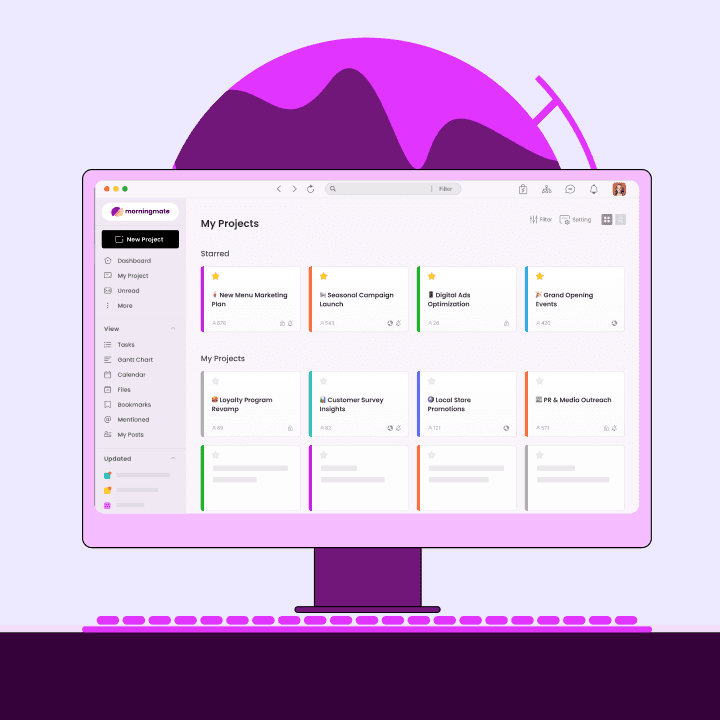
Morningmate is a lightweight work management platform used by over 550,000 teams. Its design keeps tasks, built-in chat, and files inside a single shared workspace — so when someone new joins a project, they do not need to be handed a folder or CC'd on a thread. Everything is already there.
A Worked Example
Say your content freelancer finishes a brand awareness campaign and hands off to a new hire. In Morningmate, every task in that campaign already contains the brief as an attachment, the comment thread with your founder's approval notes, and the status history showing what moved from draft to review to approved. The new hire gets added as the assignee, reads the task thread, and is productive within an hour — no reconstruction call needed.
When the new hire has a question about a decision made two months ago, Morningmate's AI Smart Search — part of the Repattern AI suite — lets them ask in plain language, like "what did we decide about the campaign tone?" and returns the exact comment where that decision was recorded, with the date and the source. Nobody has to dig through old threads or guess at history.
Approvals happen in the task comment thread. The founder can review an asset, leave a comment, and the task status updates — all in one view. Nothing escapes into a side conversation and nothing gets lost when the team changes shape again next month.
Your Task Management Continuity Checklist — Apply This Week
Use this checklist the next time your team shifts, or run it now on your current open campaigns to see where your task management has gaps.
Action | When to do it | Done? |
|---|---|---|
Add brief + goal to every active task | This week | ☐ |
Confirm every open task has a named owner | This week | ☐ |
Record your last three approvals as task comments | This week | ☐ |
Schedule a 30-min transition audit before next team change | Before next offboarding | ☐ |
Point next new hire to the task board before your first call | Next onboarding | ☐ |
Move briefs and files inside the task, not in a separate folder | Ongoing | ☐ |
Ensure task management and team chat live in the same platform | Tool audit this month | ☐ |
Team restructures are not going to stop. Freelancers wrap up, founders pull people in new directions, and headcount shifts with the season. The teams that keep campaigns moving through all of it are not the ones with the most stable rosters — they are the ones whose task management system holds the context even when the people change. Build that system now, and the next restructure will feel like a handoff instead of a fire drill.
If you want to see what a lightweight task management setup looks like for a small marketing team, or how to structure approvals so they do not fall through the cracks, those are good next reads.