Project Management

Good task management is supposed to make your campaigns run smoother — but if your team is buried in chat threads, scattered approval requests, and duplicate status updates, you already know that communication alone does not equal progress. There is a critical difference between a team that talks about work and a team that actually moves work forward. And for a small marketing team juggling a product launch, a social calendar, and a founder who drops feedback at 11pm, that gap can cost you a deadline — or a client.
This is not another article about fixing your chat app or switching tools. This is about diagnosing something more specific: whether your team's daily interactions are generating real output, or just generating more noise. Understanding that distinction is the first step toward building a task management system that actually works for a lean, fast-moving marketing team.
Here is how to tell the difference — and what to do when you realize your team is mostly just communicating.
The Campaign Morning That Went Sideways
Picture this: it is 8:45am on launch day. Your email campaign goes live at 9. The designer sent the final banner to the group chat last night, the copywriter approved it in the thread, and the founder left a comment somewhere — maybe email, maybe a voice note. You are not sure which version is live. You are not sure if the CTA link was updated. And the freelancer who owns the landing page is in a different time zone and offline for two more hours.
Everyone communicated. Nobody collaborated. The messages flew, the approvals were implied, and the task coordination was basically vibes. This is exactly the kind of moment that exposes whether your team has a real task management workflow or just a very active group chat.
The Real Bottleneck in Marketing Task Management
The bottleneck is almost never effort. Your team is working hard. The bottleneck is structural: work lives in too many places, decisions are invisible, and there is no single source of truth for what is done, in review, or blocked.
Communication That Does Not Create Accountability
Sending a Slack message saying "can someone check the landing page?" is communication. Assigning a task to a specific person with a due date and attaching the brief is task coordination. The first one disappears in the scroll. The second one creates a paper trail, a deadline, and a clear owner.
According to Asana's Anatomy of Work report, employees spend 58% of their time on work about work — status updates, chasing approvals, searching for files — rather than on skilled work. For a two-person marketing team supporting a founder, that percentage can feel even higher.
Approvals That Live Nowhere
Marketing work is approval-heavy by nature. Copy needs sign-off. Creative needs review. The founder needs to see the ad before it goes live. When those approvals happen in WhatsApp, email, or a comment buried in Google Drive, they become invisible to everyone else on the team. The next person in the workflow does not know if they can move forward.
That is not a communication problem. That is a task workflow problem. And it is fixable.
Here is a quick comparison of what communication-only teams experience versus teams with real task tracking in place:
Signal | Just Communicating | Actually Collaborating |
|---|---|---|
Approvals | Scattered across chat, email, voice notes | Logged against a specific task with a timestamp |
Task ownership | Assumed or implied in conversation | Explicitly assigned with a due date |
Status updates | Require a follow-up message or meeting | Visible in a shared task board at a glance |
File versions | Exist in three different places, unclear which is final | Attached directly to the relevant task |
Missed deadlines | Noticed after the fact | Flagged early with task status changes |
How Bad Is the Task Management Gap? (The Numbers)
This is not a minor friction problem. Gallup research consistently finds that unclear roles and unclear expectations are among the top drivers of disengagement — and for marketing teams, unclear task ownership is exactly that. When you ask "who is handling this?" three times in one week, morale takes a hit alongside productivity.
Where Marketing Team Time Gets Lost Without Proper Task Tracking
58%
Chasing status updates
43%
Hunting for files & approvals
31%
Duplicate communication
Fig 1: Estimated time lost weekly on coordination overhead in teams without centralized task management (illustrative, based on industry benchmarks)
A Repeatable Play: The 5-Step Campaign Task Workflow
You do not need a complex project management system. You need a repeatable, lightweight task coordination routine that your entire team — including the founder and the freelancer who is only around two days a week — can actually follow without a training session.
Here is a five-step play you can implement this week:
Create one task per deliverable, not per conversation. Every piece of output — a blog post, a social graphic, an email subject line test — gets its own task. Not a bullet in a doc. Not a message in chat. A task, with a name, an owner, and a due date.
Attach the brief to the task, not to an email. When you create the task, drop the creative brief, reference links, and any relevant files directly into it. Future you will not have to search three apps to find the context.
Set a clear approval step inside the task workflow. Before anything goes live, there is one defined review step. The reviewer is named. The deadline for their feedback is set. If feedback is not received by that deadline, the task is escalated — not ignored.
Move the status, not just the conversation. When a task is in review, change the status to "In Review." When it is done, mark it done. This is the signal that replaces the "hey, did you finish that?" message.
Run a 10-minute end-of-week task sweep. Every Friday, scan your active tasks. Anything overdue gets a one-line note explaining why. Anything completed gets closed. This keeps your task board honest and your team accountable without a full meeting.
Common Failure Points in Team Task Management (And How to Avoid Them)
Even teams with the best intentions fall back into old habits. Here are the four most common failure points in small team task tracking — and the fix for each.
Failure Point 1: The Founder Bypass
The founder drops feedback in a WhatsApp message at 10pm. Your designer sees it and makes the change. Nobody updates the task. Now the task board is wrong and the rest of the team does not know the asset changed. Fix: establish a standing rule that all feedback — even from the founder — gets logged as a task comment or triggers a task status update. No exceptions.
Failure Point 2: The Freelancer Black Hole
Freelancers live outside your internal tools. They communicate by email. They deliver by Dropbox link. Their work becomes invisible to your task workflow the moment they are involved. Fix: bring freelancers into your task management system as guests or external collaborators. Assign them tasks. Require them to update status when they deliver. Their output should live in your system, not in their inbox.
Failure Point 3: The "We Already Discussed This" Trap
Decisions made in meetings or chats vanish. Two weeks later, nobody remembers what was agreed. Fix: any decision that affects a deliverable gets documented as a task note or comment immediately. If it was decided, it should be written where the work lives.
Failure Point 4: Tool Overload Abandonment
Teams adopt a task management tool, find it too complex, and quietly go back to chat within three weeks. Harvard Business Review notes that accountability systems fail when they create more overhead than they remove. Fix: choose a tool that is genuinely lightweight. If your team has to learn a new mental model just to create a task, it will not stick.
How Morningmate Brings Task Management and Approvals Into One Place
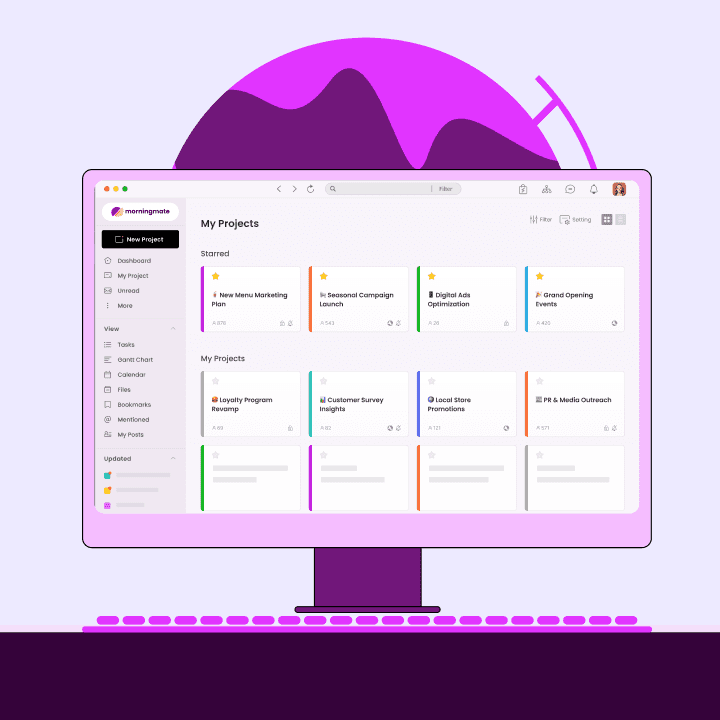
This is where a tool like Morningmate becomes genuinely useful for a small marketing team. Morningmate is a lightweight work management platform that combines task management, built-in chat, and file sharing in a single workspace — without the complexity of enterprise tools like Jira or Asana that your freelancer will never actually open.
The interface is deliberately familiar. The feed view looks like a social media timeline, so your team adopts it fast. The chat is built in and feels like the messaging apps everyone already uses — but it is connected directly to tasks and projects, so conversations do not disappear into a separate inbox.
A Worked Example: The Email Campaign
Let's go back to that campaign morning. Here is how the same scenario plays out with a proper task coordination setup in Morningmate.
On Monday, you create a task called "July Newsletter — Final Send." You assign it to yourself, attach the brief, and create subtasks: copywriting (assigned to your writer, due Wednesday), design (assigned to your designer, due Thursday), founder review (assigned to the founder, due Friday 5pm), and final send (assigned to you, due Monday 9am). Every file gets attached to its relevant subtask. Every approval step is a named subtask with a deadline.
When the founder leaves feedback on Friday, they add it as a comment directly on the "founder review" subtask inside Morningmate — not in WhatsApp. The designer gets notified, makes the change, and marks the subtask done. You can see all of this on Monday morning without sending a single "quick check-in" message. The campaign goes live on time, with the right asset, and you have a full audit trail of every decision made.
That is task management that actually produces collaboration — not just conversation.
Collaboration vs. Communication: A Task Management Comparison
Workflow Area | Chat/Email Only | Centralized Task Management |
|---|---|---|
Creative approvals | Buried in threads, easy to miss | Attached to the task, timestamped |
Freelancer handoffs | Email + Dropbox, invisible to team | Assigned task, file attached, status visible |
Founder feedback | WhatsApp at 10pm, context lost by morning | Comment on task, notifies relevant team member |
Campaign progress | Requires a meeting or status email | Visible in task board at a glance |
Post-campaign review | Piecing together a scattered history | Full task history with comments and files |
Improvement in On-Time Campaign Delivery After Adopting Structured Task Management
34%
Chat/email only teams
61%
Basic task tool users
87%
Integrated task + chat
Fig 2: On-time delivery rate improvement by workflow setup type (illustrative, based on industry benchmarks)
Your Task Management Checklist to Apply This Week
You do not need to overhaul everything at once. Start with this checklist and apply it to your next active campaign. Real task management improvements happen one workflow at a time.
☐ Audit your current campaign: are all deliverables listed as named tasks with owners and due dates, or are they living in chat?
☐ Identify the one approval bottleneck that slowed your last campaign and create an explicit task step for it going forward.
☐ Set a rule that all feedback — including from the founder — goes into the task, not into WhatsApp or email.
☐ Bring your most active freelancer into your task management system with at least one assigned task this week.
☐ Run a 10-minute Friday task sweep with your team this week. Close what is done, flag what is overdue, move one blocked task forward.
☐ Pick one tool where all your marketing task tracking lives. If you are still using three apps for task coordination, consolidate. Morningmate's combined task management and built-in chat is worth testing — it is free to start and built for exactly this kind of small, fast-moving team.
☐ After your next campaign, review the task board as your retrospective. Did the task workflow surface problems early? Did approvals happen on time? Adjust the template for next time.
The difference between a team that collaborates and a team that just communicates comes down to whether your task management system is doing the heavy lifting — or your memory is. Build the system once, run every campaign through it, and you will stop losing time to coordination overhead and start spending it on the marketing work that actually moves the needle. Start with the right task management foundation for your team size and build from there.