Project Management

Good task management is supposed to keep a campaign on rails — but three weeks in, something almost always goes wrong. Not in a dramatic, everything-is-on-fire way. It's subtler than that. A freelancer misses a brief because it was buried in a Slack thread. The founder's approval on the landing page copy never came back. Your content calendar spreadsheet has three conflicting versions floating in different inboxes. And suddenly, the campaign that felt so organized on kickoff day is running on vibes and hope.
If you manage marketing for a small business, you already know this pattern. The first week is tight. Everyone's aligned, the task tracking feels fresh, and energy is high. Week two, real work kicks in and communication starts splintering. By week three, you're chasing status updates instead of making creative decisions. That drift is not a team failure — it's a systems failure.
This article breaks down exactly where long-running project task management collapses around the three-week mark, and gives you a repeatable play to stop the slide before it starts.
The Task Management Breakdown: What Actually Happens at Week Three
Week three is the danger zone for marketing project execution. The novelty has worn off, but the deadline isn't close enough to create urgency. This is when task coordination quietly falls apart — not because people stop caring, but because the systems that held context together start leaking.
Context Gets Scattered Across Five Different Places
Your campaign brief lives in Google Drive. The latest round of feedback is in an email thread. The freelancer's questions are in WhatsApp. The deadline shift was mentioned in a Tuesday standup that nobody recorded. Nobody did anything wrong — but now nobody has the full picture either. According to Asana's Anatomy of Work report, employees switch between an average of nine apps per day just to get their work done. For a tiny marketing team, that fragmentation is lethal to project momentum.
Approvals Become the Silent Bottleneck
Founder approval is the single biggest choke point in small business marketing. The request goes out, lands in a busy inbox, and just... waits. Meanwhile your freelance designer has nothing to move forward on. Three days slip. Then five. The task workflow stalls not because the work isn't ready, but because the approval process has no structure — no deadline, no visibility, no nudge mechanism.
Task Ownership Gets Fuzzy
At kickoff, everyone knows their lane. By week three, tasks have been handed off informally, split between two people, or deprioritized without anyone officially noting it. Gallup research consistently shows that unclear role expectations are one of the top drivers of disengagement and missed deliverables — even in small, motivated teams.
Here's what that breakdown looks like mapped across a typical six-week campaign:
Campaign Week | What Feels True | What's Actually Happening |
|---|---|---|
Week 1 | Team is aligned and excited | Task tracking is fresh, context is shared verbally |
Week 2 | Work is in progress | Feedback moves to chat; approvals start queuing |
Week 3 | We're on track (probably) | Context is scattered; ownership gaps appear |
Week 4 | Slight behind but manageable | Manager is now chasing updates daily |
Week 5–6 | Crunch mode, all hands | Reactive scramble replaces planned task workflow |
How Bad Is the Task Coordination Problem? The Numbers Tell the Story
It's easy to assume your team is an exception. It's not. The drift from structured task management into reactive firefighting is nearly universal for small marketing teams running multi-week campaigns. Project Management Institute research has consistently found that a significant portion of project work is rework caused by poor communication and unclear task ownership — not skill gaps.
Where Marketing Teams Lose Project Control (% Reporting Each Issue at Week 3+)
71%
Scattered feedback
65%
Stalled approvals
58%
Fuzzy task ownership
49%
Lost file versions
Fig 1: Common task coordination breakdown points in SMB marketing campaigns (illustrative, based on industry patterns)
The Repeatable Play: A Task Management Reset for Week Two
The key insight here is timing. You don't fix week-three drift in week three — you build a structure in week one that holds through the whole campaign. Here's a seven-step task workflow reset you can run before your next project kicks off. It takes about ninety minutes and saves you from ten hours of firefighting.
Name one owner per deliverable, not per task cluster. "Design team owns creative" is not an assignment. "Maya owns hero banner — due Wednesday EOD" is. Every deliverable needs a single name attached to it.
Set approval deadlines, not just due dates. If the founder needs to approve copy by Thursday for the design to start Friday, that approval window must be a scheduled task — with its own deadline and a reminder.
Consolidate feedback into one channel per project. Choose one place — not email, not WhatsApp, not Slack — where all campaign feedback lives. Anything that arrives elsewhere gets moved there immediately.
Create a mid-campaign check-in ritual, not just a kickoff call. Block a 20-minute sync at the end of week two specifically to audit task tracking: what's slipping, what's blocked, what needs re-scoping.
Write decisions down when they happen. When the founder says "let's go with version B" in a voice message, someone types that decision into the project thread within the hour. Context that lives only in someone's memory is context that will be lost.
Surface blockers proactively, not retroactively. Any team member with a blocked task must flag it within 24 hours — not when it's already caused a cascade. Build this into your team norms explicitly.
Do a weekly task coordination audit. Every Monday, scan all open tasks: are owners still correct? Are deadlines still realistic? Have any tasks been started without being formally assigned? Fix the list before the week begins.
Common Failure Points in Task Tracking (And How to Dodge Them)
Even teams with good intentions derail their own task management. Here are the four most common failure points — and a specific fix for each.
Failure Point 1: The "Quick Update" That Goes Nowhere
Someone pings "hey, just FYI the brief changed slightly" in WhatsApp. Nobody updates the actual task. The freelancer works off the old brief for three more days. Fix: any change to scope, deadline, or direction must live inside the task itself, not just in a chat message. If it's not in the task, it doesn't exist.
Failure Point 2: Approval by Silence
"I sent it Tuesday and didn't hear back, so I assumed it was approved." This is how campaigns go live with un-reviewed copy. Approvals need an explicit response — yes, no, or revision notes — by a set deadline. No response is not a green light.
Failure Point 3: Overloading the Star Performer
In small teams, one person often ends up as the informal hub for everything. They're good, responsive, and reliable — so tasks quietly migrate toward them. Then they become the bottleneck. Your task workflow should make workload visible so you can redistribute before someone drowns.
Failure Point 4: The Sprint That Never Ends
Some tasks get pushed week after week without anyone explicitly deciding to de-prioritize them. They just... linger. A weekly task management audit catches these zombie tasks before they clutter your project board and create false signals about progress.
How Morningmate Keeps Task Management Connected from Week One to Launch
Here's a worked example. Imagine you're running a six-week product launch campaign with a marketing manager (you), a freelance copywriter, a part-time designer, and a founder who needs to approve everything but has about fifteen minutes a day for it.
In a typical scattered setup, the brief is in Drive, the copy feedback is in email, the design files are in Dropbox, and the founder's approvals are requested via WhatsApp. By week three, nobody knows which version of the landing page is current, and the freelancer is waiting on feedback that got buried.
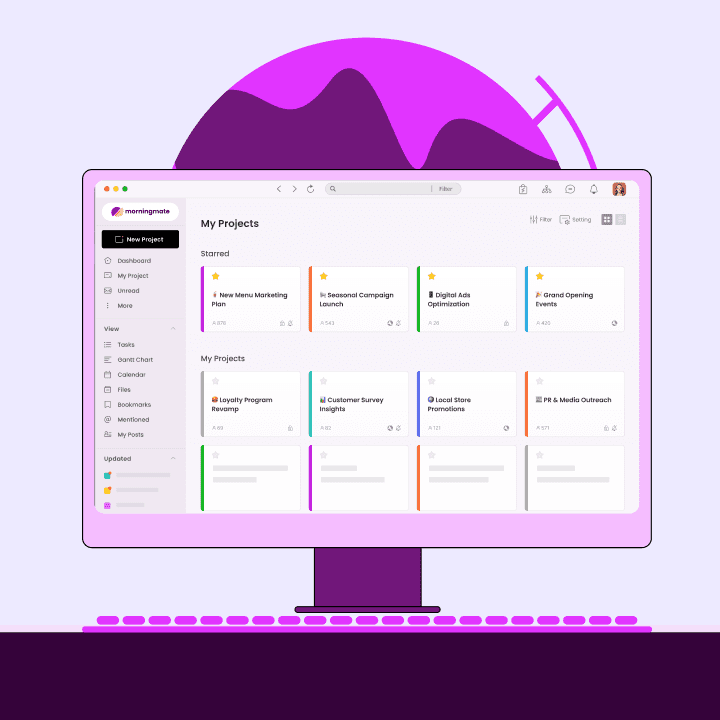
With Morningmate — a lightweight work management tool built for exactly this kind of small, fast-moving team — the entire campaign lives in one workspace. Tasks are created with named owners and deadlines. The brief, creative files, and feedback threads are all attached directly to the relevant task, so context never scatters. The founder gets a clean approval request as a task with a due date, not a buried email — and can respond in seconds from mobile.
Morningmate's built-in chat works like WhatsApp in terms of familiarity, but conversations are tied to specific projects rather than floating in a general group. When the founder approves copy in the chat thread, that conversation stays attached to the task — not lost in a personal messaging app three weeks later when someone needs to check what was decided.
The Feed view — which looks like a social media timeline — means the whole team can see project updates without needing to dig into nested folders or ping anyone for a status update. Task tracking becomes something the team sees naturally, rather than something the manager has to force through weekly reminders.
The result: less "what's the status?" and more actual work getting done. That's not a productivity platitude — it's what happens when your task coordination system matches how a small team actually communicates.
Task Management Approaches: Before and After a Structured System
Task Management Area | Scattered Approach | Structured System |
|---|---|---|
Feedback collection | Email, WhatsApp, verbal — all separate | One thread per task, attached to deliverable |
Approvals | Open-ended requests with no deadline | Approval tasks with named owner and due date |
File versions | Multiple versions across Drive, email, Dropbox | Latest file pinned to task, history visible |
Status visibility | Manager has to ask for every update | Feed view shows live progress automatically |
Decision logging | Lives in someone's memory or a chat message | Written into task comments at time of decision |
On-Time Campaign Delivery Rate by Task Coordination Method (%)
34%
Chat + Email Only
57%
Spreadsheet Tracking
81%
Unified Task System
Fig 2: Estimated on-time delivery improvement by task management approach in SMB marketing teams (illustrative)
Your Task Management Checklist for This Week
Apply this to your current or next campaign. Task management only works if it's actually set up — not just intended. Run through this list before your project hits week two.
☐ Every deliverable has one named owner (not a role, a person)
☐ Every approval is a task with a deadline attached
☐ Feedback has exactly one home — and the whole team knows where it is
☐ A mid-campaign task tracking check-in is already on the calendar
☐ Decisions are written into task comments within 24 hours of being made
☐ Blockers must be flagged within 24 hours — this is a team norm, not a suggestion
☐ A weekly task coordination audit is scheduled for every Monday
☐ Freelancers and the founder are working from the same system, not separate channels
☐ File versions are pinned to tasks, not scattered across platforms
☐ Your task workflow is documented somewhere the whole team can see it
Long-running projects don't fall apart because your team stops caring. They fall apart because the task management structure that carried week one isn't built to survive week three. Build the structure first — and the campaign will take care of itself.