Project Management

Effective task management is the backbone of any complex project — and the moment you mix freelancers with full-time staff, that backbone starts to bend. Not because either group is unreliable, but because they operate from fundamentally different contexts: different tools, different schedules, different levels of institutional knowledge, and different definitions of "done." For operations managers trying to standardize workflows across a growing SMB, this sync gap isn't just an inconvenience. It's a recurring, compounding cost that quietly drains capacity every single week.
The problem rarely announces itself loudly. It shows up as a freelancer delivering work based on a brief that was updated three days ago in a Slack thread nobody forwarded them. Or a full-time employee duplicating work because they didn't know the contractor had already completed it. Or a project milestone slipping because task ownership was assumed rather than assigned. These are task management failures dressed up as communication problems.
If your team blends contract and permanent staff — and most growing SMBs do — you need a structural answer, not just a reminder to "communicate better." This article gives you exactly that: a repeatable framework for closing the sync gap before it closes your deadlines.
The Compounding Cost of Mixed-Workforce Drift
Let's put numbers to the problem. Gallup research consistently shows that unclear roles and expectations are among the top drivers of disengagement — and disengagement costs the global economy an estimated $8.9 trillion annually. For a smaller team, even a fraction of that translates to missed deadlines, rework cycles, and manager hours spent chasing status instead of driving strategy.
When freelancers and full-time employees share a project, task coordination failures multiply because each group has a different relationship to context. Full-timers carry institutional knowledge in their heads — they know why a process works a certain way, who the decision-makers are, and what "approved" actually means. Freelancers don't. Without structured task management, they fill in the gaps with assumptions. And assumptions, at scale, are expensive.
According to McKinsey's organizational health research, companies with clear, documented workflows significantly outperform peers on execution speed and quality. The difference isn't talent — it's system design. Your task workflow either absorbs the complexity of a mixed workforce, or it magnifies it.
Sync Failure Mode | How It Appears | Estimated Weekly Cost |
|---|---|---|
Unclear task ownership | Duplicated work or missed deliverables | 3–5 hours rework per project |
Outdated brief or context | Freelancer delivers based on stale info | 1–2 revision cycles per deliverable |
Status buried in chat | Manager manually chases updates | 4–6 hours manager time lost |
No shared definition of done | Approval bottlenecks, late sign-offs | 2–3 day milestone delays |
Introducing the SCOPE Framework for Mixed-Workforce Task Management
To solve mixed-workforce drift systematically, you need more than a tool — you need a model. The SCOPE Framework is a five-component structure designed specifically for operations managers standardizing task coordination across freelancers and permanent staff. Each component targets one of the core breakdown points that cause projects to lose sync the moment complexity increases.
SCOPE stands for: Structured onboarding, Centralized task tracking, Ownership clarity, Progress visibility, and Escalation paths. Together, these five components eliminate the guesswork that causes mixed teams to drift apart as soon as a project moves past its simple early stages.
Where Mixed-Workforce Projects Break Down (% of ops managers reporting as major issue)
71%
Unclear task ownership
64%
Status buried in chat
58%
Stale briefs and context
49%
No escalation path
Fig 1: Common mixed-workforce task management pain points reported by operations managers (illustrative, 2026)
S — Structured Onboarding for Every Contributor, Every Project
Full-time employees absorb context passively over time. Freelancers don't have that luxury — and you can't afford to wait for them to catch up mid-project. Structured onboarding means every contributor, permanent or contract, receives the same project-level brief before any task coordination begins.
In practice, this looks like a project kickoff document pinned to the project workspace: goals, stakeholders, approval chain, key dates, file naming conventions, and a glossary of internal terms. It takes 30 minutes to build once and saves hours of back-and-forth for every project that follows. The moment you skip it, you're betting that everyone shares your mental model of the project. They don't.
C — Centralized Task Tracking Across the Full Team
The single biggest driver of mixed-workforce drift is task tracking fragmentation. Full-timers track work in one system, freelancers work from emailed briefs or personal to-do apps, and updates live in separate chat threads that nobody cross-references. The result: no single view of who is doing what, and no way to catch blockers before they become delays.
Centralized task management means every task — regardless of who owns it — lives in one shared workspace with a visible status, a clear assignee, and a due date. This isn't about micromanagement. It's about giving every contributor, in-house or freelance, the same operating picture. When task tracking is unified, status updates happen naturally rather than through manual check-ins.
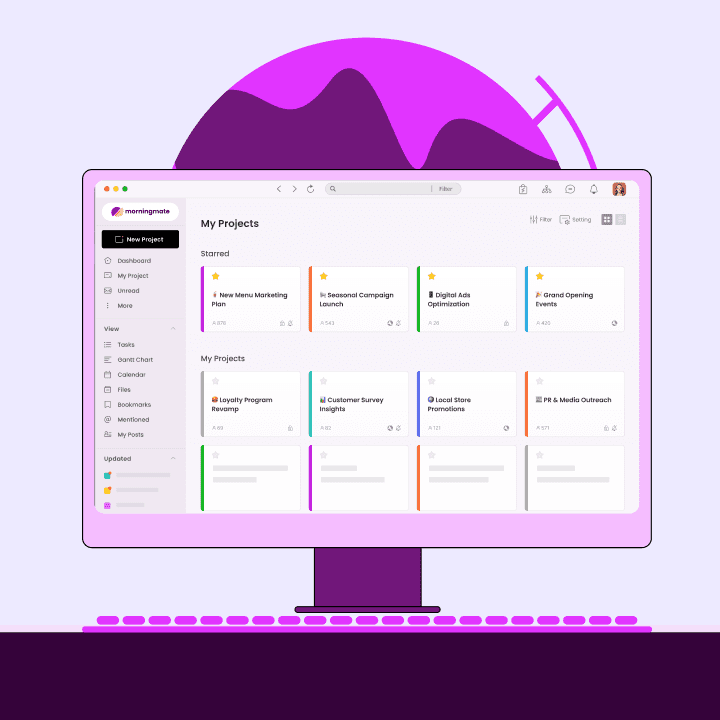
This is where a tool like Morningmate becomes operationally relevant. It gives teams a shared workspace where tasks, files, and updates sit together — not scattered across email, WhatsApp, and three different apps. Freelancers and full-timers join the same project space, see the same task board, and update statuses in the same place. The ops manager gets a single pane of glass without building a custom dashboard.
O — Ownership Clarity: One Name on Every Task
Shared responsibility is the enemy of task execution. When a deliverable is assigned to "the design team" or "marketing," everyone assumes someone else is leading it. In a mixed workforce, this ambiguity is even more dangerous because freelancers may not feel authorized to take initiative on a task that wasn't explicitly theirs.
The rule is simple: every task has exactly one owner. Not a team, not a group — one person whose name is attached to the deliverable and who is accountable for its completion. Collaborators can be listed, but ownership is singular. This applies whether the assignee is a full-time designer or a contract copywriter engaged for the quarter.
Harvard Business Review research on accountability design consistently shows that named ownership outperforms group ownership on completion rates, even when the underlying skill set is identical. Clarity is the mechanism — not motivation.
P — Progress Visibility Without Manual Task Status Chasing
If you're regularly sending messages that start with "Just checking in on…" or "Can you give me an update on…", your task management system isn't doing its job. Progress visibility means the current status of every task is accessible without asking — not because people are obligated to over-communicate, but because the system captures updates as a byproduct of normal work.
This requires two things: a defined set of status labels (e.g., Not Started, In Progress, In Review, Done) and a norm that task assignees update status when they move work forward. Neither is complex. Both are non-negotiable if you want to stop chasing updates and start leading by exception.
Morningmate's Feed view, which surfaces project activity in a familiar social-media-style stream, makes this natural for non-technical team members. Freelancers who might resist a heavy project management tool can log updates without learning a complex new interface. Task coordination stays visible without requiring a daily standup to surface it.
E — Escalation Paths: Task Management for When Things Go Sideways
Every complex project hits blockers. A freelancer can't proceed because an internal stakeholder hasn't signed off on a direction. A full-time employee is waiting on a contractor deliverable that's running late. Without a defined escalation path, these blockers sit in silence until they become deadline crises.
An escalation path answers three questions in advance: Who do you notify when a task is at risk? By when do you escalate? What's the fallback if the blocker isn't resolved within 24 hours? Document these at the project level during kickoff — not after the first crisis hits. Freelancers especially need this spelled out because they often hesitate to flag issues to people they don't have an established relationship with.
SCOPE in Practice: A Standardized Task Management Flow with Morningmate
Here's what SCOPE looks like applied to a real scenario: a content marketing project involving two in-house team members and two freelance writers delivering a six-article series over eight weeks.
Week 0 — Structured Onboarding: The ops manager creates a project space in Morningmate, pins the project brief (topic list, tone guide, word counts, approval workflow, and file naming convention), and invites all four contributors. Every participant — staff and freelance — receives the same context before a single task is assigned.
Week 1 — Centralized Task Tracking: Six article tasks are created in the shared workspace. Each task includes a brief summary, linked reference files, a due date, and a status label. Nothing lives in email or WhatsApp. All updates flow through the same task board.
Ongoing — Ownership Clarity: Each article is assigned to one writer by name. The in-house editor is listed as the reviewer. The ops manager is the final approver. No ambiguity about who is accountable at each stage.
Ongoing — Progress Visibility: Writers update task status when they move from drafting to review. The editor updates when revisions are submitted. The ops manager can check the project board at any moment and know exactly where all six articles stand — without sending a single chase message.
Built-in escalation: The kickoff brief documents that any task at risk of missing its deadline should be flagged in the task comment thread 48 hours in advance, tagging the ops manager. Morningmate's built-in chat means that flag reaches the right person immediately, not buried in a general Slack channel.
SCOPE Component | Without Standardization | With SCOPE + Centralized Task Tracking |
|---|---|---|
Onboarding | Freelancers start from scattered email threads | Single pinned brief; everyone starts with same context |
Task Tracking | Multiple systems, no single source of truth | All tasks in one shared workspace, visible to all |
Ownership | Assigned to teams or left ambiguous | One named owner per task, no exceptions |
Progress Visibility | Manager manually chases status via chat | Live task statuses; no chase messages needed |
Escalation | Blockers flagged late or not at all | Pre-defined path; 48-hour flag norm enforced |
On-Time Task Completion Rate: Before vs. After SCOPE Implementation
41%
No framework, ad-hoc tools
59%
Basic task tracking only
83%
SCOPE + centralized task management
Fig 2: Estimated on-time completion improvement by task management maturity level (illustrative, 2026)
Your Task Management Implementation Checklist
You don't need to overhaul everything at once. Start with your next mixed-workforce project and apply SCOPE one component at a time. Here's a short checklist to make it actionable from day one:
Before kickoff: Build a one-page project brief covering goals, stakeholders, approval chain, key dates, and file conventions. Pin it to your shared project workspace.
At kickoff: Invite all contributors — staff and freelance — to the same centralized task management workspace. No parallel tracks.
Task creation: Every task gets one named owner, a due date, and an initial status. No team-level assignments.
Status norms: Define your status labels upfront (e.g., Not Started / In Progress / In Review / Done) and set the expectation that assignees update status when they advance work.
Escalation protocol: Document the escalation path in the kickoff brief: who to tag, when to flag, what the fallback is.
Weekly review: Spend 15 minutes scanning the task board for anything stuck in "In Progress" for more than three days. Intervene before it becomes a deadline issue.
Post-project: Note which SCOPE components broke down and update your template. The system gets better with every project cycle.
Mixed-workforce projects don't lose sync because people are careless. They lose sync because the system assumes everyone shares the same context, the same tools, and the same definition of "on track." Task management done right removes those assumptions entirely. The SCOPE framework gives you a structured, repeatable way to standardize task coordination across every contributor — full-time or freelance — so the next complex project runs on process, not hope. Tools like Morningmate make that structure accessible without the learning curve of enterprise software, which matters when you're onboarding a new contractor who needs to be productive in 48 hours, not 48 days.