Project Management

Good task management is supposed to give you back your time — but for a lot of small business owners, it quietly does the opposite. You set up a system, assign work, and then spend the rest of the week chasing updates, correcting half-finished jobs, and wondering why nothing moves unless you push it. Sound familiar? That loop is not a people problem. It is a task management problem, and the root cause is almost always the same: your tasks are missing the information people need to work without you.
When task coordination breaks down at this level, micromanagement feels like the only fix. You step in because the alternative — letting a client deliverable miss its mark — is worse. But every time you do that, you are also confirming to your team that you will always catch things. So they stop owning outcomes the way you need them to. The irony is that bad task management creates the very dependency it was supposed to prevent.
This article is about breaking that cycle. Not with a new acronym or a complicated system, but with one honest look at where your task workflow is actually leaking — and a few practical changes that let your team move forward without needing you in the room.
The Real Cost of Thin Task Management
A task that says "update the website copy" is not a task — it is a reminder. It tells someone that a thing needs to happen, but it leaves every meaningful question unanswered: Which pages? By when? What tone? Who approves the final version? When those questions are not answered inside the task itself, the person doing the work either guesses or comes back to ask you. Either way, you are now part of the workflow whether you wanted to be or not.
Multiply this across ten to twenty open tasks on any given week and the math gets ugly fast. You are not managing a business — you are managing a queue of clarification requests dressed up as a task list. The hours you lose to that are real hours that could have gone toward winning new clients, improving your product, or simply not working on a Saturday.
There is also a slower, harder-to-see cost. When your team knows that tasks are incomplete by default, they develop a habit of waiting. They wait for context, wait for approval, wait for the next check-in. That waiting kills momentum, and momentum is one of the few genuine advantages a small team has over a bigger, slower competitor.
What a thin task looks like | What happens next | Where the owner ends up |
|---|---|---|
No due date | Team prioritises by feel, urgent beats important | Owner reminded it exists at the last minute |
No success criteria | Work is done to a personal standard, not the business standard | Owner revises or redoes the output |
No single owner | Everyone assumes someone else is handling it | Owner discovers it fell through the gap |
No context or reference files | Team stops to ask questions or improvises | Owner answers the same question repeatedly |
Why This Happens: Task Management Built for You, Not Your Team
Most founders set up their task management system from their own point of view. They know what every task means because it lives in their head. They know that "update the website copy" refers to the three product pages that need refreshing before the upcoming campaign, using the new brand guidelines that arrived last Tuesday. Their team does not know any of that — and the task does not tell them.
This is the real root cause: tasks are created as memory prompts for the owner, not as self-contained work instructions for the team. The owner can execute them because they carry the context everywhere. The team cannot execute them independently for the same reason — they do not have that context, and it is not written down anywhere accessible.
The fix is not to hire someone to manage the work for you, and it is not to spend three hours writing perfect briefs. It is to raise the minimum standard for what a task is allowed to look like before it gets assigned to anyone.
A Practical Task Management Fix: The Complete-Before-You-Assign Standard
The single most effective change a small team can make to their task management is enforcing a "complete before you assign" rule. Before any task lands in someone's queue, it must answer five questions. Not a long brief — just five fields that take two to four minutes to fill in. Once this becomes habit, the number of inbound questions drops sharply and work actually moves.
Step 1: Name the outcome, not the activity
Replace vague verbs with a definition of done. "Update website copy" becomes "Three product pages revised to match the new brand voice guide — ready for final review." Anyone reading that knows what finished looks like. That clarity alone cuts a significant chunk of back-and-forth.
Step 2: Set a hard deadline with a buffer day
If the work is needed by Friday, the task due date is Thursday. That one-day buffer is not laziness — it is your safety net for the inevitable last-minute question or revision. Teams that deadline to the wire always miss. Teams that build in a buffer usually land on time.
Step 3: Name one person, not a group
Shared task ownership is invisible task ownership. Even if multiple people contribute, one name goes on the task as the person responsible for delivery. Everyone else is a collaborator. This sounds obvious, but it is the single most common gap in small team task management — and the one that causes the most dropped balls.
Step 4: Attach the reference material inside the task
The brief, the brand guide, the client email, the previous version — all of it goes into the task itself, not in a separate folder or a side conversation. If the person doing the work has to go hunting for context, they will either delay or make assumptions. Both outcomes cost you time.
Step 5: State how and when you want an update
Do not leave update cadence to chance. A single line at the bottom of every task — "Post a status update in the task comments by Wednesday noon if anything is blocked" — eliminates a category of check-in meetings entirely. Your team knows when to surface problems. You are not left wondering whether to chase or wait.
How Task Management Lives (or Dies) in Your Tooling
The complete-before-you-assign standard only works if your tools make it easy to build tasks that way — and easy for your team to find everything they need without switching apps. This is where a lot of small businesses quietly undermine themselves. They use one place for tasks, another for files, and a third for conversation. By the time context is scattered across three platforms, the "complete" task is actually just a pointer to information that lives somewhere else.
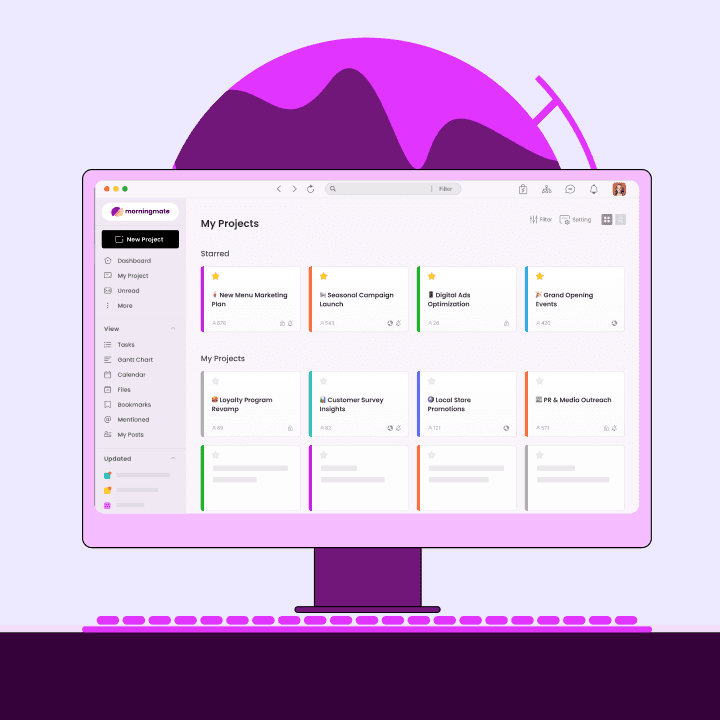
This is exactly the problem that Morningmate is built to solve. It is a lightweight work management tool — used by more than 550,000 teams worldwide — that keeps tasks, files, and team communication in one shared workspace. When you create a task in Morningmate, you can attach files directly, set a deadline, assign a single owner, and leave a brief inside the task itself. Your team does not need to go anywhere else to understand what is expected or find the materials they need.
The tool is also genuinely simple to use. The feed view works like a social media timeline, so even team members who are not naturally tech-comfortable can navigate it without training. That matters on a lean team where you cannot afford a week of onboarding every time you add a new piece of software.
One feature worth highlighting for this specific problem: Morningmate's task-creation agent (part of their Repattern AI suite) can turn a message or a conversation into a tracked task automatically. If you are discussing a piece of work in the built-in chat and you want it captured, the agent converts it into a real task rather than letting it get buried. That means fewer things fall through the cracks — and fewer moments where you find yourself asking "wait, did we ever actually assign that?"
Task management element | Scattered tools | One shared workspace (Morningmate) |
|---|---|---|
Task context and files | Split across email, cloud storage, and chat apps | Attached directly inside the task |
Status visibility | Owner must chase for updates verbally or by message | Task status visible to everyone in real time |
Converting conversation to task | Manual, often forgotten | AI task-creation agent captures it automatically |
Onboarding new team members | Must be walked through multiple platforms | Familiar interface, one workspace to learn |
The Micromanagement Test: Are Your Tasks Complete Enough?
Here is a quick way to diagnose whether your task management is creating dependency or preventing it. Look at the last five tasks you assigned. For each one, ask: could a capable person complete this without asking me a single question? If the honest answer is no for more than two of them, your task workflow is the problem — not your team's initiative.
You can run this check in about ten minutes. It is more useful than any retrospective meeting because it shows you the exact gap, not a general sense that "things feel slow." Fix the tasks and the slow feeling tends to fix itself.
Also worth checking: are completed tasks actually being marked complete? A task management system where people do the work but do not close the task gives you a permanently cluttered board and no clean sense of what is still open. Closing tasks properly sounds trivial, but it is what turns your task list into a reliable picture of where the business actually stands — rather than a graveyard of finished work that looks unfinished.
Your Next Step: Start With This Week's Open Tasks
Fixing your task management does not require a new process rollout or a team meeting. It requires one decision: from today, no task gets assigned until it passes the five-question check. That is it. You do not need to retroactively fix everything — just stop creating incomplete tasks going forward.
Spend thirty minutes this week reviewing whatever is already open and patch the gaps — add a due date where there is none, name a single owner where it is vague, attach the brief that exists but lives in someone's inbox. That one session will surface the tasks most likely to stall and let you get ahead of the problems before they hit you on Friday afternoon.
If your task tracking is currently spread across email, spreadsheets, and a messenger app, this is also a good moment to consolidate. Tools like Morningmate are built specifically for teams that want real task management without the complexity and cost of enterprise software. One workspace, one source of truth, and a task structure that is complete enough for your team to work independently — that is the practical definition of good task management for a small business. And it is what makes micromanagement unnecessary, rather than inevitable.