Project Management

Good task management is the difference between a campaign that lands on time and one that quietly falls apart three days before launch. If you run marketing at a small business, you already know the feeling: your team is small, everyone wears multiple hats, and the work actually gets done — until suddenly it doesn't. A freelancer missed the brief. The founder's approval is buried in a WhatsApp thread. The social graphics went out without the final copy. And somehow, nobody saw it coming.
Informal teams move fast. That's a genuine advantage. But speed without structure means task coordination breaks down the moment more than two people are involved in a deliverable. And in a small marketing team — where you're juggling campaigns, content calendars, freelancers, and a founder who reviews everything — that's basically always.
This article is about how to add just enough structure to your task workflow so deadlines stop slipping, without turning your lean team into a bureaucracy. No 47-step PM process. No enterprise software that nobody will actually use. Just a repeatable system that works at small-team speed.
Where Task Management Breaks Down for Small Marketing Teams
Here's a scenario that's painfully common. It's campaign launch day. The email goes out at 10am. By 10:15, you realise the landing page still has placeholder copy, the paid ad creative hasn't been approved, and the social post your freelancer was supposed to schedule is sitting in a Google Doc with a comment that says "waiting on logo — final version?" Nobody dropped the ball intentionally. The task tracking just never existed in a form everyone could see and act on.
The Real Problem: Invisible Handoffs
In informal teams, work gets assigned through chat messages, verbal mentions in calls, or emails that get buried. The person who assigned the task thinks it's in progress. The person who received it thought it was optional, or didn't realise there was a hard deadline attached. Asana's Anatomy of Work report found that workers switch between apps an average of 10 times per hour when trying to track work — and that context-switching eats directly into execution time. For a two-person marketing team running five deliverables at once, that's not a productivity stat. That's a missed deadline waiting to happen.
The Approval Black Hole
Approvals are where informal task workflows die. You send a Canva link in Slack. The founder opens it on mobile, intends to comment later, and forgets. You follow up two days later in a different thread. They reply, but their feedback contradicts what they said in a call last week. Now you're rebuilding creative the night before launch. This isn't a people problem — it's a task coordination problem. There's no single place where the approval request, the asset, the feedback, and the sign-off all live together.
According to Harvard Business Review, poor coordination costs organisations significantly in rework and delay — and small teams feel that disproportionately because there's no buffer. When one handoff fails, everything behind it stacks up.
Breakdown Type | What it looks like | Impact on deadlines |
|---|---|---|
Invisible handoffs | Tasks assigned via chat, no record of who owns what | Work falls through the cracks; nobody follows up |
Approval black holes | Review requests buried in multiple threads | Launch delays; last-minute rework |
Scattered feedback | Comments across email, chat, Docs, and calls | Conflicting versions; rework loop |
No shared task tracking | Everyone has their own to-do list; no team view | Status unknown until something is already late |
How Often Informal Teams Miss Deadlines (And Why)
The data on this is uncomfortable. Gallup research consistently shows that unclear roles and expectations are among the top drivers of disengagement and missed deliverables — and informal teams, almost by definition, have fewer written expectations than structured ones. That gap shows up directly in deadline performance.
% of Campaign Deadlines Missed Per Quarter — By Task Coordination Method
61%
Chat & Email Only
44%
Spreadsheet Tracking
19%
Structured Task Workflow
Fig 1: Estimated deadline miss rate by coordination method — illustrative based on industry trends
The pattern is consistent: the more informal the task tracking, the higher the miss rate. And for marketing teams specifically — where campaign timing is everything — even one missed deadline can mean wasted ad spend, misaligned social posts, or a product launch that whimpers instead of lands.
A Repeatable Task Management Play for Small Marketing Teams
You don't need a complex system. You need a consistent one. Here's a five-step task workflow that works for teams of two to ten, including freelancers and a founder who reviews but doesn't live in your tools.
Step 1: Create One Campaign Board, Not Fifty Threads
Every campaign gets a single workspace — not a Slack channel, not a shared Google Doc, not a folder. One place where every task, asset, deadline, and piece of feedback lives. When someone needs to know what's happening with the April email campaign, they open one board and see it all. Task tracking only works when everyone is looking at the same surface.
Step 2: Assign Every Task with an Owner and a Due Date
No task is "ours." Every task has one person responsible for it. When you create a task — "write subject line variations," "design hero banner," "QA landing page" — it gets an owner and a deadline before it leaves your hands. This single habit eliminates the majority of missed-handoff situations. If it doesn't have a name and a date, it doesn't exist as a task.
Step 3: Attach Approvals to Tasks, Not to Messages
When something needs founder sign-off, the approval request lives on the task itself — not in a separate Slack message, not in an email. The asset, the context, and the approval status are all in one place. The founder gets a notification, reviews it, and marks it approved or leaves feedback directly on the task. No more chasing. No more "did you see my message?"
Step 4: Use a Daily Stand-Up Format for Task Status
This doesn't have to be a meeting. A quick async post — "Here's what I'm moving today, here's what's blocked" — gives your whole team task-level visibility in two minutes. It also surfaces blockers before they become emergencies. If your freelancer is waiting on a brief and you don't know until Friday, you've already lost two days.
Step 5: Do a Campaign Retro on Task Coordination, Not Just Results
After each campaign, spend ten minutes reviewing: which tasks slipped and why, where approvals stalled, and which handoffs broke down. Most post-mortems focus on performance metrics. The more useful question for task management is: where did the workflow fail, and how do we prevent it next time?
Common Task Management Failure Points (and How to Avoid Them)
Even with a system in place, a few patterns kill task workflows in small teams. Here's what to watch for:
Failure Point 1: The Founder Approval Bottleneck
When the founder is the only approver and they're unavailable, everything stacks up. Fix this by pre-defining what actually needs founder approval versus what you can approve yourself. Create a simple rule: creative concepts need sign-off; individual social posts don't. Then make sure the items that do need approval are surfaced clearly in your task tracking system, not buried in a feed of messages.
Failure Point 2: Freelancers Working Outside Your System
Freelancers default to email and their own task tools. If your task coordination system doesn't include them, you lose visibility on 30–50% of your deliverables. Give every freelancer access to the specific project board they're working on. Keep it simple enough that they'll actually use it — one board, their tasks only, clear due dates.
Failure Point 3: Task Status That Only Lives in Someone's Head
If the only way to know a task is done is to ask the person who did it, your task workflow isn't working. Every task should have a visible status — in progress, needs review, blocked, done — that anyone on the team can see without sending a message. This is the difference between proactive task management and reactive firefighting.
How Morningmate Brings Task Management, Approvals, and Chat Together
This is where tool choice actually matters. Most small marketing teams end up using a mix of WhatsApp for quick questions, email for briefs, Google Sheets for campaign tracking, and something like Notion for content calendars. The result is that task coordination is fractured across four surfaces and nobody has full visibility.
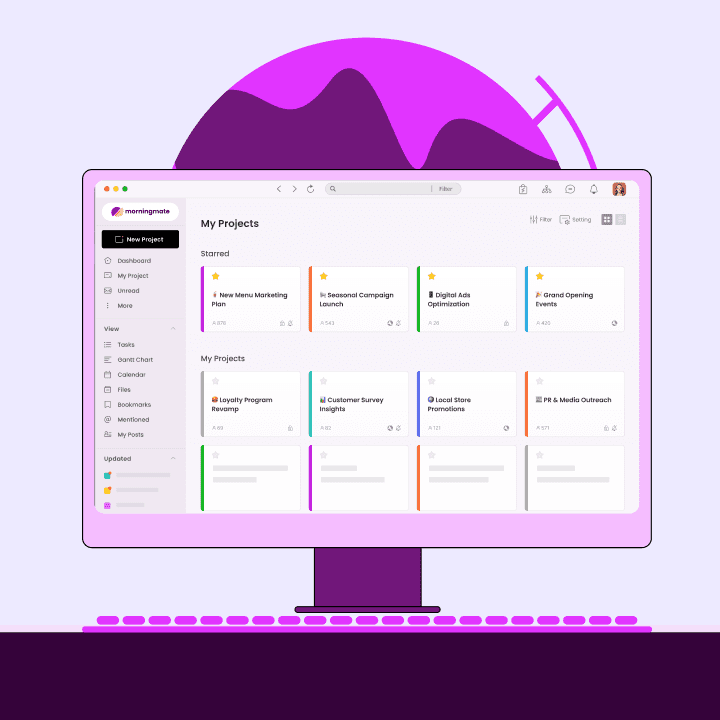
Morningmate is a lightweight work management tool that puts task tracking, built-in chat, and file sharing in one place — without the complexity of tools like Asana or Jira that require an onboarding process just to get started. The interface feels familiar straight away: the Feed view works like a social media timeline, and the chat functions like WhatsApp, so your team and freelancers actually adopt it instead of ignoring it.
A Worked Example: The April Email Campaign
Here's how the campaign-day disaster from the intro looks different with structured task management in Morningmate. One week before launch, you create a campaign board called "April Email Launch." Every deliverable becomes a task: copywriting, design, landing page QA, email build, social posts. Each task has an owner, a due date, and a status. Your freelance designer is added to the board — they only see their tasks, and they can update status directly without logging into anything new.
When the hero banner is ready for approval, your designer attaches it directly to the task and tags the founder. The founder gets a notification, opens the task on mobile, sees the asset and the brief in the same view, and leaves their feedback as a comment. No separate email. No lost WhatsApp thread. The feedback is right there, attached to the task, visible to everyone who needs it. The designer makes the revision, marks the task as "ready for final approval," and the founder signs off in one tap.
On launch day, you open the campaign board and see every task in real time. Three are marked done. One is in review. Nothing is a surprise. That's what consistent task management actually looks like in practice.
Campaign Workflow Step | Without structured task management | With Morningmate task tracking |
|---|---|---|
Task assignment | Verbal or chat message, easily forgotten | Assigned with owner + due date, visible to all |
Founder approval | Request sent in email or WhatsApp, gets buried | Tagged on task, approved with one comment |
Freelancer handoff | Brief sent over email, status unknown | Freelancer accesses board, updates task status live |
Launch-day check | Manually chasing each person for updates | One board view shows all statuses in real time |
What Changes When Task Management Is Consistent
The shift from informal to structured task coordination doesn't slow teams down — it actually speeds them up because people spend less time chasing and more time executing. Teams that implement even a basic task workflow see measurable improvements in on-time delivery within the first month. The compound effect over a full quarter is significant.
On-Time Campaign Delivery Rate — Before vs. After Structured Task Workflow
41%
Informal Only (Before)
67%
Basic Task Tracking
88%
Structured Workflow + Integrated Tool
Fig 2: On-time delivery improvement by task management maturity — illustrative based on industry benchmarks
The teams that hit 80%+ on-time delivery aren't the ones with the biggest headcount. They're the ones with the clearest task coordination — where every deliverable has an owner, every approval has a home, and every person on the team (including freelancers) can see what's happening without sending a message to find out.
Your Task Management Checklist for This Week
Apply these this week — not next quarter, not at the next planning meeting. Your next campaign will benefit from every one of these actions, and none of them require a major tool overhaul to start.
Pick one tool as your single task tracking surface — campaigns, tasks, and approvals all live there, not in chat or email
Audit your current campaign: list every open deliverable and confirm it has an owner and a due date
Create a simple approval rule with your founder — what needs their sign-off, what doesn't, and how approvals get flagged
Onboard your active freelancers to your task board — give them access only to their tasks so it stays simple
Set up daily async task status updates — a quick post, not a meeting, so blockers surface before they cause delays
Schedule a 10-minute task retro after your next campaign launch to capture what broke down in the workflow
Define "done" for every task type — copywriting is done when it's approved, not when it's drafted; design is done when the final file is shared
Good task management isn't about adding overhead to a small team — it's about removing the invisible friction that makes deadlines slip and campaigns land sideways. The structure you put in place this week is what lets your team move fast and reliably. That combination — speed plus consistency in your task workflow — is what separates marketing teams that grow from ones that just stay busy. Start with one board, one campaign, and one clear owner per task. Build from there.