Project Management

Good task management is the difference between a launch that lands and one that quietly implodes — and most small marketing teams don't realize they need a real system until they're already on fire. Picture this: it's 8 a.m. on campaign launch day. Your email sequence is scheduled, the social posts are queued, the paid ads are ready to flip on. Then your founder pings you on WhatsApp: "Wait — did we ever get legal sign-off on that headline?" You freeze. You scroll back through three different threads. You find a version of the copy in Google Drive, another in an email chain, and a comment in the doc that says "check with founder" — but no actual answer. Launch gets delayed by four hours. The moment is gone.
This isn't a people problem. It's a systems problem. And it only shows up when your team crosses a specific threshold — not a headcount number, but a complexity number. The moment you're running more than two campaigns simultaneously, juggling a freelancer or two, and looping in a founder who reviews things sporadically, your informal "everyone just knows what's happening" approach stops working.
The good news: you don't need enterprise software to fix this. You need a lightweight, repeatable workflow built around proper task coordination — one that keeps approvals visible, deadlines clear, and context attached to the work itself. Here's how to build it.
Where Small Team Task Management Actually Breaks Down
It rarely breaks at execution. Your team is capable. It breaks at the handoff points — the moments between "someone is working on this" and "someone else needs to approve, review, or act on this." Those gaps are where campaigns slip.
The Three Handoff Gaps That Kill Campaigns
According to Asana's Anatomy of Work report, employees spend 60% of their time on work about work — status updates, chasing approvals, searching for files — rather than skilled work itself. For a lean marketing team, that ratio is brutal.
Approval gaps: The founder or stakeholder doesn't know a review is waiting because the request got buried in a chat thread.
Context gaps: A freelancer gets a task but the brief, the brand guidelines, and the previous version are all in different places.
Status gaps: Nobody actually knows if the task is done, in review, or stuck — so everyone assumes someone else is handling it.
These aren't random failures. They're predictable consequences of doing task tracking informally when the workload has already outgrown informal methods.
The Tipping Point: When Informal Stops Working
Most small marketing teams hit their task management tipping point between three and five active projects running at once. That's not many. One product launch, one content calendar, one paid campaign, and one collaboration with a freelancer — and suddenly the "just message me" system collapses. Research published in Harvard Business Review found that coordination costs grow disproportionately as team complexity increases, even when headcount stays flat.
Situation | Informal task tracking | Structured task management |
|---|---|---|
Approval needed from founder | Message in WhatsApp, easy to miss | Task assigned with due date + notification |
Freelancer needs brief | Emailed separately, version unclear | Attached directly to task card |
Campaign status check | Group chat or manual update call | Visible status on shared task board |
Post-launch debrief context | Scattered across email + docs + chat | All comments + files in one task thread |
A Repeatable Task Management Play for Small Marketing Teams
You don't need a certification in project leadership to run a tight campaign. You need five consistent habits applied to every piece of work that crosses two or more people's desks. Here's the exact workflow to implement this week.
Create one task per deliverable, not per project. "Q3 campaign" is not a task. "Write email subject line variations — due Friday" is a task. Break every campaign into specific, ownable deliverables with a single named owner.
Attach context at the point of creation. Every task gets a brief, a link, or a reference file attached when it's created — not when someone asks for it three days later. This removes the freelancer "where's the brief?" message entirely.
Use three status labels only: In Progress, Needs Review, Done. Anything more complex and your team stops updating statuses. Keep it stupid simple so task tracking actually happens.
Tag the approver as a named step, not an afterthought. If the founder needs to review something, that review is a separate task assigned to them with a deadline. Not a WhatsApp message. A task with a due date.
Do a 10-minute Monday task audit, not a status meeting. Every Monday, the team spends ten minutes looking at the shared task board and flagging anything blocked. This replaces the "what's everyone working on?" meeting that eats 45 minutes.
This isn't heavy process. It's the minimum viable structure that lets a four-person team — two internal, one founder, one freelancer — actually coordinate without constant check-ins.
Where Small Team Marketing Hours Actually Go Each Week
41%
Actual creative work
27%
Chasing approvals
19%
Searching for files
13%
Status check-ins
Fig 1: Illustrative breakdown of a small marketing team's weekly hours (Asana Anatomy of Work, adapted)
Common Task Management Failure Points (and How to Dodge Them)
Even teams with the right intentions make the same task workflow mistakes. Here are the ones that consistently derail small marketing operations — and the specific fix for each.
Failure 1: The "Just Send Me a Message" Approval Loop
When your founder or a senior stakeholder prefers chat for everything, approvals become invisible to everyone else on the team. A message gets sent, it gets seen three days later, no one knows if it was approved. Fix this by making the rule explicit: chat is for quick questions, tasks are for anything that needs a decision or a deliverable. Even if the conversation happens in chat, the outcome gets logged as a task status update.
Failure 2: Tasks Without Deadlines
A task with no due date is a wish. When you're coordinating with freelancers across time zones, "whenever you can" means never on time. Every task in your task tracking system needs a specific date — and for approval tasks, build in a buffer of at least 48 hours before the actual campaign deadline.
Failure 3: The Context Lives in Someone's Head
If only you know why a decision was made, the team is one sick day away from a crisis. Comments, rationale, and feedback all belong inside the task itself — not in a Slack DM or a WhatsApp voice note that disappears into the scroll. McKinsey research has found that employees spend nearly two hours daily searching for information — a cost that compounds fast on small teams where everyone is already stretched.
Failure 4: One Tool for Everything Except the Work
Many small teams end up with chat in WhatsApp, files in Drive, tasks in a spreadsheet, and approvals in email. Each tool is fine in isolation. Together, they create a coordination nightmare. The fix isn't adding another app — it's consolidating so that task coordination, file sharing, and team discussion live in the same place.
How Morningmate Brings Task Management, Approvals, and Chat Together
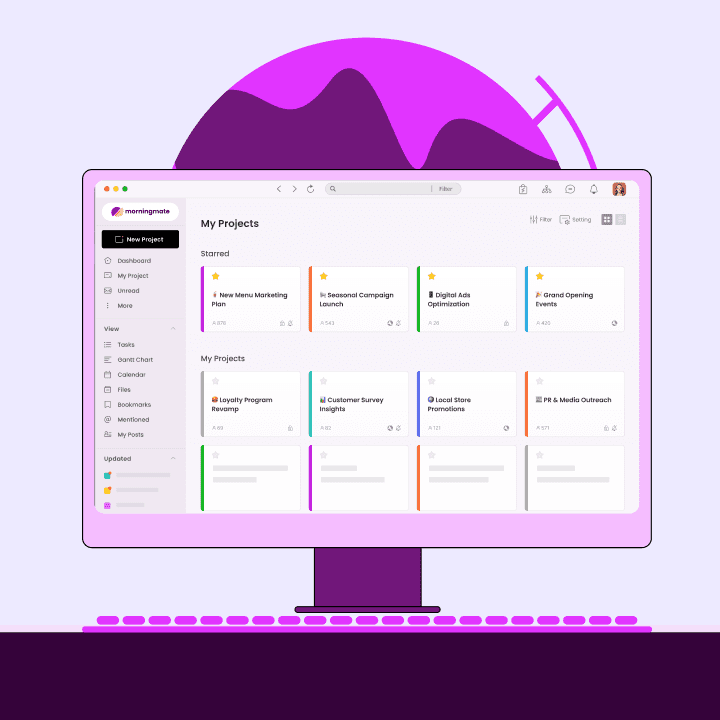
This is exactly the problem morningmate was built to solve — not with the complexity of Jira or the overhead of Asana, but with a lightweight workspace that feels familiar from the first login. Morningmate combines task management, built-in chat, and file sharing in a single interface that even non-technical teams pick up immediately. It's used by over 550,000 teams worldwide, most of them running lean.
Here's what the campaign launch scenario from the top of this article looks like when it runs through Morningmate instead of scattered tools:
Worked Example: The Campaign Launch That Didn't Break
It's Tuesday. Your team is launching a summer email campaign on Friday. Here's how task tracking plays out in Morningmate's feed-style workspace — which looks and feels like a social feed, so onboarding takes minutes, not days.
Monday: You create a task card for "Legal review — email headline copy." You attach the copy doc directly to the card, set the due date as Wednesday noon, and assign it to your founder. Morningmate sends them a notification automatically.
Tuesday: Your freelance designer needs the brand kit. Instead of emailing it separately, you drop it into the task card for "Design — email header banner." The designer opens the task, sees the brief and the file in one place, and gets to work.
Wednesday: The founder leaves a comment on the legal review task: "Approved — change 'free' to 'complimentary' in line 3." That comment is timestamped, attached to the task, and visible to the whole team. No more "did we get approval?" questions.
Friday morning: You check the task board. Every deliverable shows "Done" or "In Progress." Nothing is ambiguous. Launch goes out on time.
The built-in chat in Morningmate — which uses a familiar WhatsApp-style interface — means your team still communicates quickly. But the actual work decisions live in tasks, not in messages that vanish into scroll history. That's the structural shift that stops campaigns from breaking at the handoff.
Campaign phase | Scattered tools approach | Morningmate task workflow |
|---|---|---|
Brief distribution | Email to freelancer, version confusion | File attached to task card, always current |
Founder approval | WhatsApp ping, easy to miss or forget | Task assigned with due date + auto-notification |
Feedback tracking | Google doc comments + separate emails | All comments timestamped inside task |
Launch-day status check | Call the team, dig through threads | One-glance task board, all statuses visible |
Post-launch debrief | Reconstruct from memory + scattered notes | Full task history with decisions attached |
Reduction in Approval Delays After Structured Task Management Adoption
12%
No system (chat only)
34%
Spreadsheet tracking
67%
Integrated task tool
Fig 2: Illustrative improvement in on-time approvals by task management method (illustrative, based on workflow research)
Your Task Management Checklist to Apply This Week
Task management doesn't need a three-month rollout. It needs one consistent week of building the right habits. Run through this checklist before your next campaign kicks off, and your team will feel the difference immediately.
☐ Break your next campaign into individual task cards — one deliverable, one owner, one due date per card
☐ Attach the brief, reference files, or relevant links directly to each task at creation time
☐ Set up three status labels: In Progress, Needs Review, Done — nothing more complex
☐ Create a separate approval task for every founder or stakeholder review, with a deadline 48 hours before you actually need it
☐ Move all work decisions out of chat and into task comments — make this a team agreement, not just a personal habit
☐ Block 10 minutes every Monday to review the task board as a team instead of running a status meeting
☐ If you're still tracking tasks in a spreadsheet or chat, pick one tool — like morningmate — where task coordination and team conversation can happen in the same workspace
The moment your team stops feeling small isn't when you hire your fifth person or hit your revenue milestone. It's when a single missing approval can derail a campaign you've spent three weeks building. That's the moment task management stops being optional. Build the system now — before the next launch day surprise — and every campaign after this one gets a little smoother, a little faster, and a lot less dependent on everyone remembering everything at once. You can explore how lightweight task workflows help small teams stay on track without adding overhead to your already-full plate.