Project Management

Task management should be straightforward: assign work, track progress, get results. But for most small business owners, the reality looks nothing like that. Instead, task management is happening inside a tangle of group chats — WhatsApp threads, Telegram groups, or Messenger channels — where real work gets buried under GIFs, one-liners, and off-topic replies. If your team is tracking tasks this way, you are already paying a price. You just might not see it on your P&L yet.
Here is a scenario that plays out in thousands of small businesses every week. You ask your team in a group chat to handle a client deliverable. Someone replies "on it." Three days later, the client follows up. You scroll back through 200 messages looking for who said what. Turns out the task was acknowledged but never actually assigned, and the file someone uploaded got buried 40 messages deep. The client is annoyed. You are frustrated. And your team is confused about who dropped the ball.
That is not a communication problem. That is a task tracking failure — and it is costing you more than you think.
The Real Cost of Running Task Management Through Group Chats
Group chats were built for quick conversation, not task coordination. When you use them as a substitute for proper task management, the hidden costs stack up fast. According to research compiled by Atlassian, employees lose an average of 31 hours per month to unproductive meetings and chasing down information — and chat-based task tracking is one of the biggest contributors.
For a 10-person team, that is hundreds of hours a month spent on friction instead of output. At an average fully-loaded cost of $30 per hour per employee, that is over $9,000 in lost productivity every month — from a problem that most owners do not even recognize as a problem.
Three Specific Ways It Bleeds Money
Tasks fall through the cracks. A message is not a task. It has no owner, no deadline, and no status. When a task lives only in a chat message, it dies when that message scrolls out of view.
You become the bottleneck. Without a clear task tracking system, your team defaults to pinging you for clarification, priority, and approval — constantly. Instead of running the business, you are running messages.
Accountability disappears. When something is not done, nobody can point to who owned it. You cannot fix what you cannot trace. Post-mortem conversations happen in the same chat that caused the problem, making pattern recognition almost impossible.
The table below shows the concrete difference between group chat task tracking and structured task management for a typical small team.
Task Management Aspect | Group Chat (WhatsApp/Telegram) | Structured Task Tracking |
|---|---|---|
Task ownership | Unclear — implied by who replied | Explicit — assigned to one person |
Deadline visibility | Buried in message history | Visible to entire team at a glance |
Progress tracking | Requires chasing updates manually | Status updated in real time |
File retrieval | Scroll and search — average 12 min | Attached to the task — found instantly |
Accountability | Disputed — "I thought you had it" | Clear audit trail, no ambiguity |
Why This Happens: The Root Cause Every Owner Recognises
The reason teams run task management through group chats is not laziness. It is familiarity and speed. Everyone already has WhatsApp on their phone. Onboarding a new tool feels like a project in itself. And when you are running a 10- to 30-person business, the last thing you want is to spend a week setting up software that nobody uses.
So the path of least resistance wins: "Just message me when it is done." That works when you have three people. It breaks when you have eight. And it collapses entirely when you hit fifteen.
The real root cause is that most small teams never established a deliberate task workflow. Chat filled the vacuum. And by the time the pain is obvious — missed deadlines, repeated mistakes, frustrated clients — the habit is already baked in. According to a Harvard Business Review analysis, workers check messaging platforms an average of 36 times per hour, and each interruption costs 23 minutes of recovered focus. For a small team juggling real work, that math is brutal.
Time Lost Per Week to Ineffective Task Tracking Methods
3 hrs
Email Threads
6 hrs
Group Chats
1 hr
Structured Task Tool
Fig 1: Estimated weekly hours lost per employee chasing task updates by method (illustrative, based on industry benchmarks)
A Practical Fix: Moving Task Management Out of the Chat
The good news is you do not need to overhaul everything overnight. You do not need a complex project management tool with 47 features nobody will use. You need a simple, sequential shift in how your team assigns, tracks, and closes work. Here is a four-step approach that works for lean teams.
Step 1: Name the Task Clearly Before Assigning It
Every task needs three things before it leaves your mouth or your keyboard: a clear action verb ("Write," "Send," "Fix," "Review"), one owner, and a due date. If a task cannot be described in one sentence with those three elements, it is not ready to be assigned. Stop letting vague requests live in chat as implied tasks. Write them out properly.
Step 2: Put the Task Where It Can Be Tracked — Not Where It Can Be Chatted
Your task coordination system and your chat system should not be the same place. Chat is for quick conversation. Tasks need a home where they can have statuses (not started, in progress, done), deadlines, file attachments, and comments tied to the specific work — not buried in a general group thread.
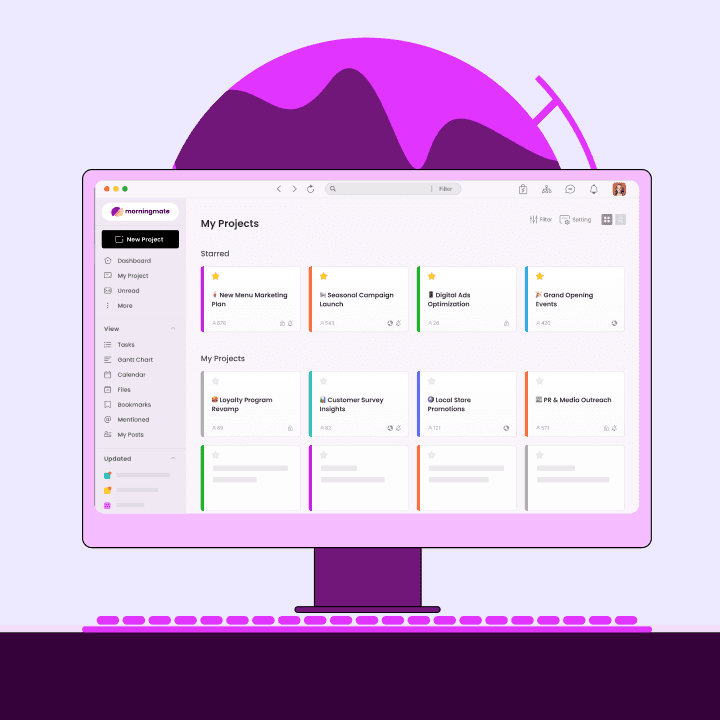
This is exactly where a tool like Morningmate earns its place on a small team. It gives you a dedicated task management workspace that is as easy to use as a social media feed — your team sees tasks, updates, and files in a familiar scrollable view, without having to learn a complicated new interface. Tasks are real objects with owners and deadlines, not messages that scroll away.
Step 3: Do a Daily Two-Minute Task Review
Each morning, anyone with open tasks looks at their task list — not the group chat — and updates statuses. This takes two minutes per person and replaces the need for a 30-minute update meeting or ten "any update on this?" messages throughout the day. The task workflow becomes the single source of truth.
Step 4: Use Chat for Questions, Not Task Management
Chat stays for what it is good at: quick questions, social interaction, decisions that need fast back-and-forth. Any outcome from a chat conversation that requires action gets converted into a task immediately. The rule is simple: if it needs to be done, it gets logged as a task. If it is just conversation, it stays in chat. Never let the two mix.
Morningmate is built around exactly this separation. It has a built-in chat that looks and feels like the messaging apps your team already uses, sitting right alongside the task management workspace. There is no need to switch between four different tools. Everything lives in one place, and chat does not contaminate your task workflow.
Why Most "Fixes" Fail — and What Makes Task Management Actually Stick
A lot of small business owners have tried to fix this before. They set up a Trello board that nobody updated after week two. They bought a Asana license that felt like overkill for a 12-person team. The tools got abandoned because they added complexity without removing friction.
According to McKinsey's research on workplace productivity, employees spend nearly 20% of their workweek searching for internal information or tracking down colleagues for updates. The tools that actually fix this are not the most powerful ones — they are the ones people actually use consistently.
Task management sticks when three conditions are met: the tool is simpler than the problem it replaces, the team sees an immediate personal benefit (less chasing, fewer re-dos), and the owner models the behavior. If you are still assigning tasks in the group chat, your team will too.
What to Look for in a Task Tracking Tool for a Small Team
Setup time under one hour — no IT support needed
Mobile-first so field or part-time staff can use it without a laptop
Task assignment with clear ownership, due dates, and file attachments
Built-in communication so you are not jumping between apps
Flat, affordable pricing that does not punish you for adding team members
Morningmate checks every one of these boxes. It is used by over 550,000 teams globally and was deliberately designed for non-technical teams — the kind of teams where half the staff would reject anything that looks like enterprise software. The Feed view feels like scrolling a social timeline, making adoption genuinely fast. You can read more about what to look for when picking your first work management tool if you are still in evaluation mode.
Criteria | Group Chat Task Tracking | Morningmate Task Management |
|---|---|---|
Setup time | Instant (already using it) | Under 30 minutes |
Task ownership clarity | None | Explicit, with notifications |
Deadline tracking | Buried in conversation | Built into every task |
Files attached to work | Scattered across threads | Attached directly to the task |
Cost (small team) | Free — but costs hours in lost productivity | Affordable flat pricing |
The ROI of Getting Task Management Right
Let's make this concrete. If your team of 10 saves just 45 minutes per person per day by moving task tracking out of group chat and into a proper task workflow — that is 7.5 hours of recovered productive time daily. At $30 per hour fully loaded, that is $225 per day, $1,125 per week, and over $58,000 per year. Morningmate costs a fraction of that. The ROI is not theoretical; it is recoverable time that your team is currently burning.
Beyond the numbers, proper task management changes the texture of how your business runs. You stop being the person everyone comes to for updates. Your team starts operating with more ownership. Clients get deliverables on time. And you get to spend your hours on the work that actually grows the business — not chasing down who said they would handle the invoice.
Team-Reported Improvement After Adopting Structured Task Management
71%
Fewer Missed Deadlines
65%
Less Time Chasing Updates
82%
Clearer Accountability
Fig 2: Small team self-reported improvements after switching from chat-based task tracking to a dedicated task management tool (illustrative, based on aggregated SMB surveys)
Your Next Step: One Task Management Change This Week
Task management does not have to be a big project. Start with one rule this week: any work that needs to be done by a specific person by a specific date gets logged as a task — not sent as a message. Pick the simplest tool that lets your team do that without friction, and commit to it for 30 days.
If your team is still running task tracking through group chats, the clock is already running on what that costs you. The fix is not expensive or complicated. It is a deliberate decision to stop letting conversations pretend to be task management.
You can start a free workspace on Morningmate today and have your team's first real task workflow running before end of day. No lengthy onboarding. No IT ticket. Just task management that actually works — so you can get back to running your business instead of running your inbox.