Project Management

Task management without a dedicated project manager is not a gap you can afford to ignore — it is a compounding liability. Every week your team juggles multiple ongoing projects without a standardized task management system, the hidden costs multiply: duplicated work, missed handoffs, status meetings that produce no decisions, and an ops manager spending hours manually chasing updates instead of improving the systems that actually drive growth. Research from the Project Management Institute estimates that organizations waste an average of 11.4% of investment due to poor project performance — and that figure rises sharply when no dedicated PM role exists.
For operations managers at growing SMBs, this is not an abstract statistic. It shows up on Monday morning when three teams are waiting on the same approval nobody owns. It shows up mid-sprint when two people have been working on the same deliverable in parallel. And it shows up at the end of the quarter when leadership asks for a project status report and the honest answer is: "I have to go find that."
The good news is that you do not need a full-time project manager to bring order to multiple concurrent projects. What you need is a repeatable task management framework that any team member can follow — and the right tool to hold it together. This article gives you both.
The Compounding Cost of No Standard Task Management Process
Before building a solution, it pays to understand exactly what inconsistent task management costs at the operational level. Gallup's State of the Global Workplace report consistently finds that unclear roles and responsibilities are among the top drivers of disengagement — and disengaged employees cost businesses roughly 34% of their annual salary in lost productivity.
When task coordination relies on memory, email threads, and chat messages, three failure modes recur at every scale:
Ownership voids: Tasks that were "mentioned" in a meeting but never formally assigned drift until someone notices the deadline has passed.
Knowledge silos: Project context lives in one person's inbox or head, creating single points of failure every time that person is on leave or exits the company.
Status overhead: Managers compensate for missing visibility by scheduling extra check-in meetings — which Harvard Business Review found consume up to 23 hours of an executive's week while generating minimal actionable output.
The table below maps the operational symptoms against their root causes, so you can identify which failure mode is costing you the most right now.
Operational Symptom | Root Cause | Compounding Effect After 30 Days |
|---|---|---|
Repeated status update requests | No centralized task tracking | 2–4 hrs/week per manager lost to chasing |
Duplicated deliverables | No single task ownership record | Rework consuming 10–15% of sprint capacity |
Missed cross-team handoffs | Handoff lives in chat, not in a task | Cascading deadline slippage across projects |
Onboarding lag for new hires | Process knowledge siloed in individuals | 3–6 weeks to full productivity instead of 1–2 |
Introducing the SCOPE Framework for PM-Free Task Management
The framework presented here is called SCOPE — five operational levers that together give any ops manager systematic control over multiple ongoing projects, without needing a dedicated project manager in every team. SCOPE stands for: Structure, Clarity, Ownership, Progress visibility, and Escalation paths. Each component addresses one of the recurring failure modes described above, and each can be implemented incrementally.
Think of SCOPE not as a methodology to learn, but as a set of operational decisions to make once and embed into your team's daily task workflow. The goal is to remove the ops manager as the default information hub, and replace that role with a system.
S — Structure: Standardize How Task Management Is Set Up Across Projects
The first and most impactful lever is structural consistency. When every project uses a different folder system, naming convention, or task breakdown approach, switching between projects creates cognitive overhead that slows everyone down — not just the manager.
A practical standard to adopt: every project gets a dedicated workspace with the same three layers — a project brief (context), a task board (active work), and a file repository (supporting documents). Whether you are managing a product launch, an office relocation, or an onboarding rollout, the structure is identical. Team members always know where to look.
In operational terms, this means resisting the temptation to create ad-hoc channels or email threads for new projects. Each project is a workspace, not a conversation. Task management happens inside that workspace, not around it.
C — Clarity: Every Task Needs an Owner, a Deadline, and a Definition of Done
Ambiguity is the single most common reason tasks fall through the cracks in PM-free environments. "Someone will handle the vendor follow-up" is not a task — it is a wish. Effective task management requires that every item in the system answers three questions before it is created: Who owns it? When is it due? What does completed look like?
Operationalizing this is straightforward. Introduce a task creation standard: no task may be added to the board without an assignee, a due date, and a one-sentence acceptance criterion. It takes thirty seconds longer to create a task this way. It saves thirty minutes of clarification later.
For cross-team task coordination — where a marketing deliverable depends on a design output, which depends on a legal review — clarity also means documenting the dependency chain inside the task itself, not in a separate email thread that will be buried within 48 hours.
O — Ownership: Assign a Task Coordinator Per Project, Not a Project Manager
You do not need a full PM. You need one person per project who owns the task board — not all the work, just the coordination. This is the task coordinator role. Their job is narrow: keep the board current, flag blockers, and escalate when a task is overdue. They are not accountable for outcomes; they are accountable for visibility.
Rotating this role across team members has an additional benefit: it distributes process knowledge and eliminates the knowledge silos that make onboarding and cross-team work so painful. When three people on a five-person team have held the task coordinator role at least once, the workflow becomes self-sustaining.
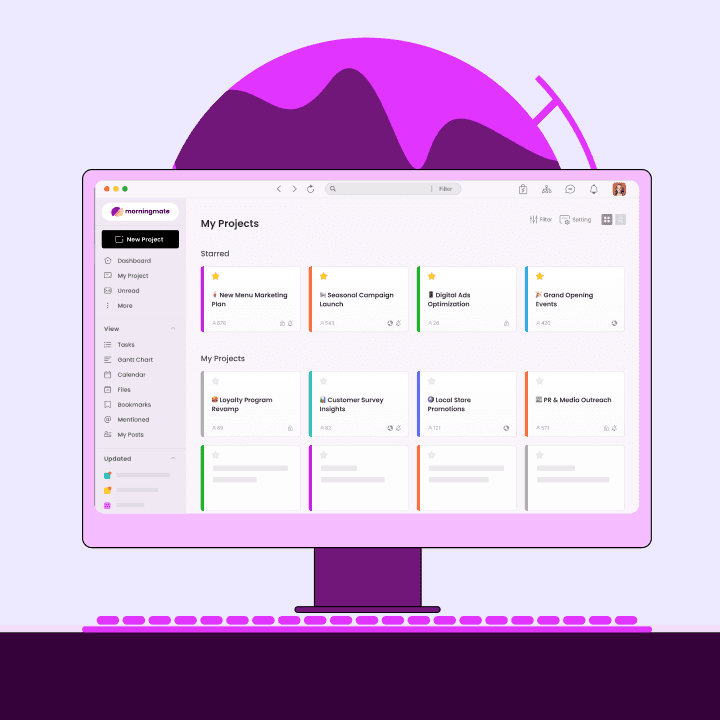
This is also where a tool like Morningmate becomes operationally useful. Its task management system lets you assign tasks with clear ownership and deadlines, while the Feed view gives the task coordinator a real-time snapshot of everything in motion across the project — without needing to build a status report manually.
Weekly Hours Spent on Manual Status Updates by Team Size (SMBs, 2026)
4 hrs
10–25 people
9 hrs
26–50 people
15 hrs
51–100 people
Fig 1: Estimated weekly hours lost to manual status chasing in PM-free SMB environments (illustrative, based on PMI research trends)
P — Progress Visibility: Task Management Must Be Readable at a Glance
Visibility is not the same as reporting. Reporting is something you produce after the fact. Visibility is something the system gives you in real time — and it only works if the task tracking layer is kept current by the people doing the work, not assembled by a manager compiling updates from five sources.
The operational standard here is simple: task status must be updated by the assignee as work progresses — Not Done, In Progress, Blocked, Done. Nothing more complex than that. When every task in the board reflects its true current state, the ops manager can review the full project portfolio in under ten minutes instead of holding a thirty-minute standup to extract the same information verbally.
Morningmate's task workflow supports exactly this model. Tasks are visible across the workspace Feed, assignees update their own items, and the ops manager or task coordinator sees blockers surface automatically — no chasing required. For teams that previously managed task coordination through WhatsApp threads or email chains, the shift to structured task tracking typically cuts status overhead by more than half in the first month.
E — Escalation Paths: Define What Blocked Means and What Happens Next
The most overlooked element in PM-free task management is a defined escalation path. Teams often know how to flag that something is blocked. They rarely know who is authorized to unblock it, how quickly, and through what channel. This gap turns single-day delays into week-long standstills.
A workable escalation standard looks like this: any task marked Blocked for more than 24 hours triggers a direct notification to the task coordinator. If the coordinator cannot resolve it within four business hours, it escalates to the ops manager. The entire path is documented in the project workspace — not in someone's memory or a one-off Slack message.
This is what separates a mature task management system from a task list with status labels. The system knows what to do when things go wrong, without requiring the manager to be the first to notice.
Manual vs. Standardized Task Management: A Side-by-Side Comparison
The operational difference between ad-hoc task coordination and a standardized task management system is not subtle. Here is how the same set of scenarios plays out under each approach.
Scenario | Manual / Ad-Hoc | SCOPE Framework + Standardized Task Tracking |
|---|---|---|
New project kickoff | Kickoff meeting → tasks distributed by email → no single record | Workspace created → tasks assigned with owners + due dates → live from day one |
Onboarding a new hire to an active project | Senior team member spends 3–5 hrs briefing verbally | New hire reads project brief + task board → up to speed in under 1 hr |
Weekly project status | 30-min meeting to verbally collect updates | Manager reviews task board in 8 minutes; meeting becomes decision-only |
Cross-team handoff | Communicated via chat; often missed or forgotten | Handoff task created, assigned, with dependency noted — tracked to completion |
Blocked task | Sits unresolved until noticed in next check-in | Escalation path triggers within 24 hrs; resolved before cascading |
Applying SCOPE with Morningmate: A Worked Example
Here is how a 35-person operations team used the SCOPE framework inside Morningmate to manage a vendor onboarding rollout across three departments simultaneously — with no dedicated project manager.
Structure: The ops manager created one Morningmate workspace per vendor, each with the same layout: a project brief post pinned to the top of the Feed, a task board with standardized columns (Not Started, In Progress, Blocked, Done), and a shared file folder for contracts and SOPs.
Clarity: A task creation rule was enforced: every task required an assignee, a due date, and a one-sentence definition of done. The ops manager spent one hour setting this up in a template at the start of the project — saving an estimated six hours of clarification conversations over the following three weeks.
Ownership: One team lead from each department was designated as task coordinator for their vendor workspace. They were not doing extra work — they were responsible for keeping the task board accurate and flagging blockers. Morningmate's built-in chat let them communicate about blockers without leaving the workspace, keeping context in one place rather than scattered across three messaging apps.
Progress visibility: The ops manager checked the three workspace feeds each morning — a ten-minute review that replaced the daily check-in call. Status was visible by task status labels, not by verbal report.
Escalation: Any task Blocked for more than one business day was flagged in the workspace chat, tagged to the ops manager. Two escalations arose during the four-week rollout. Both were resolved within the same day. Neither required an unplanned meeting.
The result: three concurrent vendor onboardings completed on schedule, with a new hire joining mid-project and reaching full contribution in under two days by reading the workspace history — not by shadowing a colleague for a week.
On-Time Project Completion Rate: Before vs. After SCOPE Framework Adoption
41%
Before (Ad-Hoc)
63%
Partial Structure
87%
Full SCOPE + Tool
Fig 2: Estimated on-time delivery improvement by task management maturity level (illustrative, based on PMI benchmarks)
Implementation Checklist: Deploy SCOPE in Your Team This Week
Effective task management does not require a six-month rollout. The five actions below can be implemented in a single planning session and begin generating visibility within days. Use this checklist to put SCOPE into operation immediately.
✅ Structure: Create a standardized workspace template for all active and future projects — same layout, same columns, same file structure every time.
✅ Clarity: Introduce and enforce the three-field task creation rule: assignee, due date, definition of done. No exceptions.
✅ Ownership: Name one task coordinator per active project. Document their role in the workspace brief so everyone knows who owns the board.
✅ Progress visibility: Set a team norm: task status must be updated by the assignee whenever work state changes. Replace the daily standup with a board review.
✅ Escalation path: Write and pin the escalation rule in every workspace: Blocked for 24 hrs → notify coordinator; unresolved after 4 hrs → escalate to ops manager.
✅ Tool alignment: Consolidate task management into one platform. If your team currently tracks work across email, chat apps, and spreadsheets, migrating to a single system — such as Morningmate, which combines task tracking, file management, and built-in chat in one lightweight workspace — removes the coordination overhead that no framework can fix on its own.
Standardized task management is not about adding bureaucracy. It is about removing the invisible tax your team pays every day for operating without a system. The SCOPE framework gives you a named, memorable structure to implement once and scale as your team grows — no project manager required, and no guesswork about where things stand.