Project Management

Good task management inside a single department is hard enough. But when work crosses a boundary — from sales to operations, from marketing to finance, from customer success to the product team — something almost always breaks. A file goes missing. A deadline gets assumed rather than confirmed. Someone starts a task based on outdated information. And you, the owner, only find out when a client calls to ask what happened.
Cross-department handoffs are one of the most underestimated drains on small business productivity. Unlike a missed deadline inside one team (which is visible), handoff failures are invisible until they become expensive. The work looks like it's moving. People are busy. Messages are being sent. But progress has quietly stalled at the seam between teams — and no one is flagging it because no one owns it.
If your business has more than one department and fewer than fifty people, this is almost certainly happening right now. The good news: it's fixable, and you don't need a complex system or a dedicated project coordinator to fix it.
The Real Cost of a Broken Handoff
Let's put a number on it. Research from the Project Management Institute consistently shows that poor project coordination — including handoff gaps — is one of the leading causes of failed or delayed projects in small and mid-size companies. Time lost to "where are we on this?" conversations adds up fast: for a ten-person team, even thirty minutes of rework or re-clarification per person per week equals over 250 hours of lost output a year.
That's not a communication problem. That's a task coordination problem — one that compounds every time a handoff happens without a shared, structured record of what was agreed, what's needed, and who's responsible next.
Here's what a broken handoff actually costs in the real world:
Rework because the receiving team didn't have the right context
Delays because the handoff wasn't flagged as urgent
Duplicated effort when two people both assume the other has started
Client-facing mistakes when internal confusion becomes external
Owner time spent mediating between departments instead of growing the business
Handoff Failure Type | What It Looks Like | Hidden Cost |
|---|---|---|
No clear owner at transfer | Task sits unstarted for days | Missed deadlines, client escalations |
Context lives in email/chat | Receiver starts from scratch | 2–4 hours of rework per task |
No deadline set at handoff | Each team assumes the other is on it | Duplicated effort, owner escalation |
File version confusion | Team works from wrong draft | Full revision cycle repeated |
Why Task Management Falls Apart Between Teams
The root cause is almost never lazy employees or bad intentions. It's a structural problem: most small businesses have no shared task management layer that spans departments. Instead, each team has its own informal system — a mix of email, WhatsApp, spreadsheets, or mental notes — and when work moves between teams, it leaves the structure behind.
Think of it like handing someone a parcel with no address label. The original sender knows everything about it. But the moment it changes hands, that context disappears. The receiver has to either guess or ask — and asking takes time, causes friction, and often gets delayed.
Harvard Business Review has documented how collaboration overhead — the time spent aligning, clarifying, and re-explaining — now consumes a disproportionate share of the working day. In small businesses, where there's no operations team to manage coordination, this overhead falls on the owner or the most senior person available. That's you, being pulled into status calls that shouldn't require your involvement at all.
Where Task Coordination Time Is Lost in Cross-Department Handoffs
62%
Re-explaining context
48%
Chasing status updates
41%
Rework from missed context
29%
Waiting for file access
Fig 1: Estimated proportion of cross-department coordination time lost to common handoff friction points (illustrative)
A Practical Task Management Fix for Lean Teams
You don't need a new hire or a complex system. You need a simple, repeatable handoff protocol that your team can actually follow — one that keeps task tracking intact as work moves between departments. Here's a five-step approach built for small teams.
Step 1: Give Every Cross-Department Task a Single Written Record
Before any work crosses a team boundary, create a task record — not a message, not an email, a task. That record should include: what needs to happen, why it matters, what "done" looks like, the deadline, and who owns it on the receiving end. This is the bare minimum for responsible task management.
Step 2: Attach the Context to the Task, Not to a Person
All the files, decisions, and background information that the receiving team needs should live on the task itself — not in someone's inbox, not in a chat thread. If the person who handled it originally goes on holiday, the work should still be able to move. Context stored in chat or email is context that can disappear.
Step 3: Assign a Named Owner on the Receiving Side
The biggest single cause of handoff failure is ambiguity about who picks it up next. When a task is handed to "the ops team" or "finance," it often goes to no one. Every cross-department task needs a named individual on the receiving end — and that person should acknowledge it. No acknowledgement, no handoff.
Step 4: Set a Response SLA, Not Just a Deadline
Deadlines tell you when work must be done. Response SLAs tell you when the receiving team must acknowledge and start. For most small businesses, a simple rule works: any cross-department task must be acknowledged within 24 hours. This surfaces blockages before they become emergencies.
Step 5: Track Progress in One Shared Space, Not in Update Meetings
If the only way you know where a cross-department task stands is by scheduling a call or sending a follow-up message, your task workflow has a gap. Status should be visible to anyone involved without anyone having to ask. This is where the right tool makes a real difference — not by adding complexity, but by replacing the constant status-checking habit with passive visibility.
How Morningmate Closes the Task Management Gap Between Departments
Most small businesses end up with one tool for chat (WhatsApp or Slack), one for files (email or Google Drive), and a spreadsheet somewhere tracking tasks. None of them talk to each other, and none of them travel with the work when it crosses a department boundary. That's the tool sprawl that drains your team without anyone noticing.
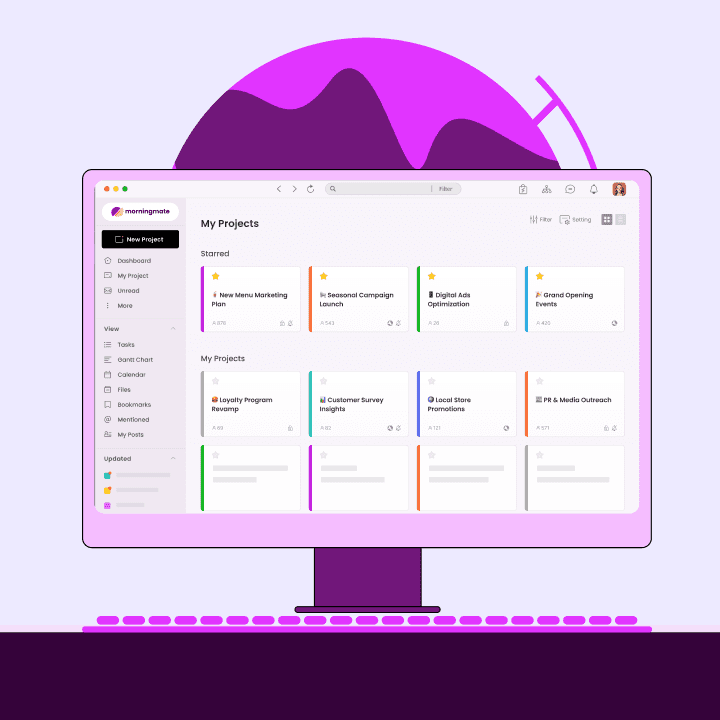
Morningmate is a lightweight work management platform used by over 550,000 teams that brings task management, file sharing, and built-in chat into one shared workspace. It's designed to be simple enough that non-technical teams adopt it without training — the interface looks and feels like tools people already use every day, so there's no learning curve blocking adoption.
For cross-department task coordination specifically, the way it works is practical: you create a task, attach the relevant files and context directly to it, assign an owner, and set a deadline. The task then lives in a shared feed that all relevant team members can see — no one needs to ask for a status update because the status is always visible. When work moves from sales to operations, or from marketing to finance, the full context travels with it.
The built-in chat feature means that task-related conversations stay linked to the task itself, not scattered across private message threads. That alone eliminates the most common cause of context loss during handoffs. And because Morningmate is a single tool rather than five, you're not adding to your team's app fatigue — you're consolidating.
If you're currently managing cross-department task workflows through email threads or messenger apps, the shift to a centralized task management workspace doesn't have to be a big project. Morningmate is built to be set up in an afternoon, not over a month-long implementation.
Handoff Stage | Without a Task System | With Morningmate's Task Tracking |
|---|---|---|
Briefing the next team | Long email or verbal catch-up | Task created with context attached |
Confirming ownership | Assumed or verbally agreed | Named assignee, notified instantly |
Checking progress | Follow-up messages and calls | Visible in shared feed at a glance |
Accessing files | Hunt through email attachments | Files attached to the task record |
Post-handoff questions | Back-and-forth in chat/email | Conversation threaded to task |
The Measurable Difference When Task Workflow Is Structured
Asana's Anatomy of Work report found that employees spend a significant portion of their week on coordination work — chasing updates, clarifying instructions, and re-doing work done incorrectly the first time. Structured task management that spans departments directly reduces all three of those drains. Teams that implement a shared task workflow see faster turnaround on cross-functional projects, fewer escalations, and less owner involvement in day-to-day coordination.
Reduction in Cross-Department Coordination Overhead After Structured Task Management
15%
Email-only teams
34%
Chat tools + spreadsheet
71%
Unified task platform
Fig 2: Estimated reduction in cross-department coordination overhead by tool setup (illustrative)
Your Next Step: One Handoff, Fixed This Week
You don't need to overhaul everything at once. Pick the one cross-department handoff that causes the most friction in your business right now — the one that most often requires your personal intervention, generates the most follow-up messages, or has caused a client issue in the last quarter. That's your starting point for better task management.
Map out what information the receiving team actually needs to start without asking questions. Write it down as a task template. Assign a named owner. Attach the files. Set a deadline and a 24-hour acknowledgement expectation. Run that process for two weeks and measure how many follow-up messages you send compared to before.
If you want the task tracking to stick across your whole team without adding another tool to the pile, Morningmate gives you a single workspace where tasks, files, and conversations live together — and where cross-department work stays visible from start to finish. It's the kind of lightweight system that a lean team can actually maintain without a dedicated project coordinator or a complex setup.
The friction in your cross-department handoffs isn't a people problem. It's a task management structure problem. Fix the structure, and the people — and the work — will flow.