Project Management

Good task management is supposed to keep your campaigns moving — but if you're a marketing manager at a small business, chances are your real task management system is a patchwork of email threads, Slack DMs, a shared Google Sheet nobody updates, and a founder who drops feedback via voice note at 11pm. That's not a workflow. That's a liability.
Here's the thing: when a campaign goes sideways — and it will — your team needs a paper trail to understand what happened, who approved what, and where things broke down. Email is the default paper trail for most small marketing teams, but it's one of the worst tools for the job. Decisions get buried in reply-all chains, approvals disappear into spam folders, and your freelance designer never got the brief revision because it was in a thread they were cc'd on three weeks ago.
This article is about building a task management system that actually creates a usable record of your marketing work — not a digital paper pile, but a living, searchable trail of decisions, approvals, and deliverables that your whole team can actually find when it matters.
When Campaign Day Becomes a Fire Drill
Picture this: it's 8am on launch day. Your paid social campaign is supposed to go live at 9. You open your inbox and find a message from your freelance copywriter asking which version of the headline was approved. You search your email, find three different versions in two different threads. You ping the founder on WhatsApp. No reply yet. You check the Google Sheet — it hasn't been touched in five days. Your designer is asking whether to use the old logo or the updated one. The social scheduler is loaded with the wrong UTM links.
By 9:30am, the campaign is live — 30 minutes late, with the second-best headline, and a tracking link you're not fully confident in. This isn't a one-off disaster. According to Asana's Anatomy of Work report, knowledge workers spend 58% of their time on work about work — status updates, chasing approvals, searching for information — rather than doing the actual work. For a two-person marketing team running multiple campaigns, that's a devastating ratio.
The root cause isn't effort. Everyone on your team is working hard. The root cause is that your task coordination lives in a dozen different places and none of them talk to each other.
Where Task Management Actually Breaks Down
The Approval Black Hole
Marketing work is approval-heavy by nature. Copy needs sign-off. Design needs review. Campaign budgets need the founder's thumbs-up. But when your approval process lives in email, approvals become the single biggest bottleneck in your task workflow. Messages get missed, "approved" replies get lost, and your team proceeds on assumptions rather than confirmed sign-offs.
Context Lives in Chat, Not in Tasks
Your team has the important conversations — about direction changes, budget shifts, messaging pivots — in WhatsApp or Slack. But those conversations are invisible to the task. Three weeks later, when a freelancer picks up a task, they have zero context about why the brief changed. They do the work based on outdated information. You get a deliverable you can't use. That's a task tracking failure, even if the task itself was "completed."
The Version Control Swamp
Email attachments multiply. "Final_v3_REALLYFINAL.pdf" is a universal joke with a real cost. Without a clear task management record showing which file was approved and when, your team defaults to the most recent file in their Downloads folder — which may or may not be the right one.
Problem Area | Email-Based Workflow | Structured Task Management |
|---|---|---|
Approval tracking | Buried in reply chains, easy to miss | Logged on the task, visible to all |
Brief revisions | Sent separately, freelancers miss them | Attached to the task, always current |
Decision context | Lives in chat, disconnected from work | Threaded in task comments |
File versions | Multiple attachments, unclear which is final | Single source, version-stamped |
Freelancer onboarding | Requires lengthy email catch-up | Task history tells the full story |
The Campaign Task Management Playbook: A Repeatable Workflow
You don't need a 40-step process. You need a lightweight task management rhythm that creates a paper trail automatically — without adding admin work to an already-stretched team. Here's a campaign workflow that works for small marketing teams.
Step 1 — Create one task per deliverable, not per campaign. Don't create a single "Q3 Email Campaign" task. Create individual tasks for copywriting, design, scheduling, and QA. Each task becomes its own paper trail.
Step 2 — Write the brief inside the task description, not in a separate doc. Everything your freelancer or teammate needs to execute should live inside the task itself. Link to reference files, include the target audience, the CTA, the deadline, and the approval owner.
Step 3 — Tag an approval owner on every task. Every task that needs sign-off gets a named approver. Not "the founder" — a specific person, with a deadline for their review. If approval is overdue, the task status makes it visible.
Step 4 — Log all feedback as task comments, not as separate messages. When the founder sends a voice note with feedback, that feedback gets summarized and added as a comment on the relevant task. The task becomes the record. Chat is for speed; the task is for memory.
Step 5 — Update the task status at every transition. Draft → In Review → Approved → Scheduled. Four status changes. Each one is a timestamp in your paper trail. If something breaks on launch day, you can trace exactly where the handoff failed.
Step 6 — Attach the final approved file to the task. Not to the email thread. Not to a shared drive folder nobody organizes. To the task itself, clearly labeled as the approved version. This is your version control, and it costs zero extra effort.
Where Marketing Teams Lose Time in Their Task Workflow
61%
Chasing approvals
54%
Searching for files
47%
Re-explaining context
39%
Version confusion
Fig 1: Common time sinks in small team marketing workflows (illustrative, based on industry patterns)
Common Task Management Failure Points (and How to Dodge Them)
Failure Point 1: The "I'll update the task later" habit
Your team does the work, then forgets to log it. The task stays stuck in "In Progress" for two weeks after it's done. The fix is simple: make task status updates the last step of every piece of work, not an optional admin task. If the task isn't updated, the work didn't happen — at least not in any way the rest of the team can see.
Failure Point 2: Founder feedback that never makes it into the task
The founder reviews the landing page and fires off four thoughts in a WhatsApp message. Your task management system sees none of this. You act on the feedback, but the task history shows no record of why the copy changed. Two months later, when you're reviewing what worked, you have no idea. Assign someone — even yourself — to translate founder feedback into task comments within 24 hours.
Failure Point 3: Freelancers operating on stale information
According to McKinsey's research on collaborative work, employees spend nearly 20% of their workweek searching for internal information. For freelancers working part-time on your projects, that number spikes even higher. If your brief lives in the task and gets updated in real time, your freelancer always has the right information — no email archaeology required.
Failure Point 4: Using task tracking for communication instead of decisions
Task comments aren't a chat channel. Keep task comments focused on decisions, approvals, file attachments, and status changes. Use chat for quick back-and-forth. The moment your task comments become a running conversation, the actual decisions get buried.
How Morningmate Makes This Task Management System Work in Practice
The workflow above only works if your task management tool, your approvals, and your team communication actually live in the same place. That's exactly the gap morningmate is built to close. It's a lightweight work management tool that combines task tracking, built-in chat, and file management in a single workspace — without the overwhelming complexity of tools like Jira or Asana that require a dedicated admin to maintain.
Here's a worked example. Imagine you're running a product launch campaign with a two-person internal team plus a freelance copywriter and a part-time designer.
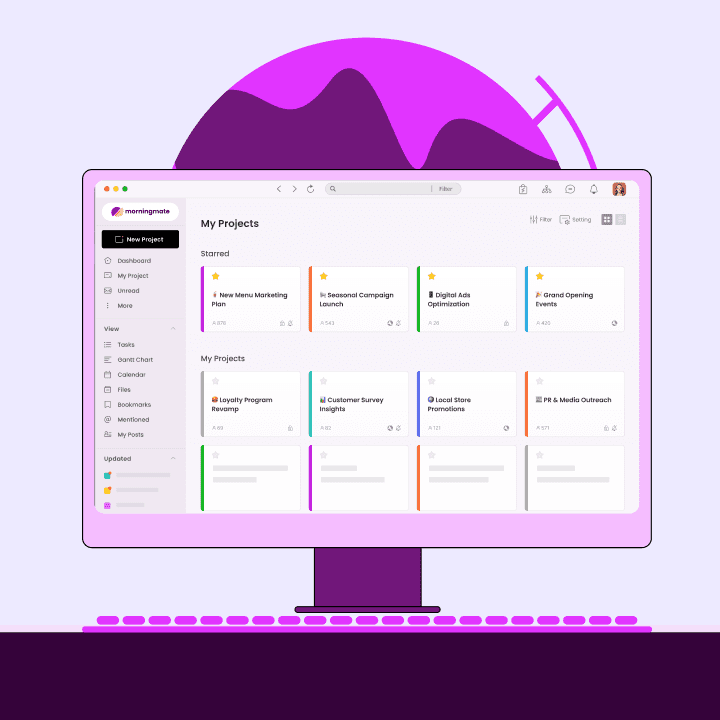
In Morningmate, you create a project for the launch. Inside it, you build individual tasks: "Landing Page Copy," "Hero Image Design," "Email Sequence — 3 Emails," "Paid Social Creative." Each task has a description with the brief, an assigned owner, a due date, and a named approval owner. Your freelance copywriter is added directly to their tasks — they see exactly what they need, and nothing else.
The founder reviews the landing page copy and leaves feedback as a comment directly on the "Landing Page Copy" task — not in a separate WhatsApp thread. The copywriter gets notified, revises the draft, uploads the new version to the task, and tags the founder for final approval. The founder approves. The task status moves to "Approved." The designer picks up the file. No emails. No lost threads. The entire decision history is right there on the task.
Morningmate's feed view — which looks and feels like a social media timeline — means your team actually checks in regularly rather than treating it like another tool to log into reluctantly. The built-in chat means quick conversations happen next to the work, not in a separate app. And when your next freelancer joins the team, they have instant access to the full task history without anyone needing to write a catch-up email.
The result is a genuine paper trail: every approval, every revision, every file, every decision — all attached to the task that generated it. This is what Harvard Business Review highlights when it describes high-performing teams: they don't just complete tasks, they build shared records of why and how decisions were made.
Task Management Need | Email + Chat Patchwork | Morningmate Workflow |
|---|---|---|
Approval paper trail | Scattered across inbox folders | Timestamped on each task |
Freelancer briefing | New email every engagement | Brief lives inside the task |
Founder feedback loop | WhatsApp voice notes, lost context | Comment on task, instant notification |
Campaign post-mortem | Reconstruct from memory and emails | Full task history, searchable |
Tool adoption barrier | N/A — already too familiar | Social-style feed, WhatsApp-style chat |
Team Efficiency Gains After Centralizing Task Management
22%
Email-only teams
41%
Chat + PM tools
78%
Unified task platform
Fig 2: Estimated efficiency gains from centralizing task tracking, approvals and communication (illustrative)
Your Task Management Checklist to Apply This Week
You don't need to overhaul everything at once. Start with your next campaign and apply this task management checklist from day one. The paper trail builds itself if you set the right habits up front.
Create one task per deliverable — not one task per campaign
Write the full brief inside the task description, including audience, CTA, deadline and tone
Assign a named approval owner (a specific person, not just "the team") to every task that needs sign-off
Set a review deadline on every approval task — no open-ended "whenever you get a chance" reviews
Route all founder or stakeholder feedback into task comments within 24 hours of receiving it
Attach the final approved file directly to the task, labeled clearly as the approved version
Update task status at every transition: Draft → In Review → Approved → Live
After each campaign, run a five-minute task audit: were all statuses updated? Were approvals logged? Was every revision noted?
Good task management isn't about creating more admin — it's about making the work you're already doing visible, searchable, and retrievable. When your next campaign launch hits a snag, you want to spend 30 seconds finding the approved brief, not 30 minutes reconstructing it from a chain of emails nobody can find. Build the trail now. You'll thank yourself when it counts.