Project Management

Effective task management starts long before anyone opens a calendar invite. Yet in growing SMBs, the shared calendar has quietly become a substitute for actual operational planning — and the cost of that confusion compounds faster than most ops managers realize. When your team treats a blocked time slot as a plan, you end up with meetings that happen on schedule but work that falls apart between them. Deadlines are visible; ownership, dependencies, and acceptance criteria are not.
This is a coordination architecture problem, not a scheduling problem. A calendar tells people when something is happening. It says nothing about who is responsible for each step, what "done" looks like, or what needs to be true before the next handoff can start. Task management fills that gap — but only when it is treated as a structured system, not an afterthought bolted onto a weekly stand-up.
If you are standardizing processes across a growing team, this distinction is foundational. The sections below lay out a practical model for separating scheduling logic from execution logic, and show you how to build the connective tissue that holds both together.
The Compounding Cost of Confusing a Schedule With a Plan
Picture a mid-sized logistics company, roughly 60 people, running onboarding cycles for new warehouse partners every quarter. Leadership blocks the same three weeks on the shared calendar each cycle. The dates are consistent. The outcomes are not. Every cycle, a slightly different set of steps gets done in a slightly different order by slightly different people, because the calendar shows the event but not the process behind it.
The hidden cost is not the occasional missed step. It is the time spent reconstructing what happened last cycle, re-explaining expectations to new team members, and manually chasing status from people who assumed someone else had it covered. Each inconsistency creates a small tax on everyone's time. Across a quarter, that tax becomes a significant operational drag — and it grows as the team grows.
The table below maps the specific gaps that open up when a calendar event is used as a proxy for a task management system.
Operational Need | Shared Calendar | Structured Task Management |
|---|---|---|
Ownership | Event organizer only; tasks unassigned | Named assignee per task, visible to all |
Dependencies | Not visible; assumed verbally | Linked tasks show blocking relationships |
Acceptance criteria | Absent; "done" is subjective | Defined in task description; reviewable |
Progress visibility | Requires manual check-in or meeting | Status visible in real time without asking |
Repeatability | Rebuilt from memory each cycle | Template reused; process is the asset |
Onboarding new staff | Relies on tribal knowledge transfer | Process is documented inside the workflow |
A Practical Model: The Three-Layer Execution Plan
Rather than retrofitting your calendar or layering task management on top of it as an afterthought, it helps to think of operational planning in three distinct layers. Each layer answers a different question, and none of them can substitute for another.
The three layers are: the timeline layer, the ownership layer, and the context layer. A shared calendar only handles the first. Mature task management addresses all three, simultaneously, in one place.
Layer One: The Timeline Layer — Task Management Needs Dates, Not Just Events
Dates matter. But a date on a calendar block is only useful if it is attached to a specific deliverable with a named owner. In most calendars, the date belongs to the meeting, not to the work. This means the work has no deadline of its own — it simply inherits the urgency of the meeting it feeds into.
In practice, task management should set due dates at the task level, not the event level. If your quarterly partner review requires a completed data pull, a drafted summary, and a signed-off agenda — each of those is a separate task with its own due date, its own assignee, and its own status. The calendar event is downstream of all of them. When those tasks are tracked properly, the meeting itself becomes a formality rather than a fire drill.
Layer Two: The Ownership Layer — Task Coordination Requires Named Accountability
The most common failure mode in cross-team coordination is not a missed deadline — it is ambiguous ownership. When a calendar invite goes to six people, all six people assume at least one of the others is handling the prep work. This is not a character flaw. It is a predictable result of a system that does not assign tasks to individuals.
Structured task management makes ownership explicit and public. Every task has exactly one accountable person. Collaborators can be added, but the assignee is singular and visible to the whole team. This one change — moving from group ownership to named ownership — eliminates most of the "I thought you had it" conversations that slow down growing teams.
It also makes onboarding dramatically faster. When a new operations coordinator joins, they do not need to shadow a senior colleague for a week to understand who does what. The task management system shows them the current state of every active workflow, who owns each step, and what the expected output is. Process knowledge stops living in people's heads and starts living in the system.
Layer Three: The Context Layer — Task Tracking Without Documentation Is Incomplete
Even when tasks are dated and owned, they fail without context. A task that says "prepare vendor report" tells an assignee almost nothing about format, data sources, review process, or what "complete" actually means. Without that context, the assignee either interrupts the task creator for clarification — breaking both people's focus — or makes assumptions that produce rework.
The context layer is where task management earns its value as a knowledge management system, not just a to-do list. Each task should carry enough documentation that an assignee can start and finish it independently. That means acceptance criteria, relevant links or files, any decisions already made, and the name of the reviewer.
For teams using async task handoffs across departments or time zones, this layer is non-negotiable. The context attached to a task is the briefing that replaces the synchronous conversation. Get it right and handoffs become seamless. Leave it out and every task eventually generates a thread of clarifying questions that could have been avoided.
Applying It With Morningmate: A Standardized Onboarding Flow
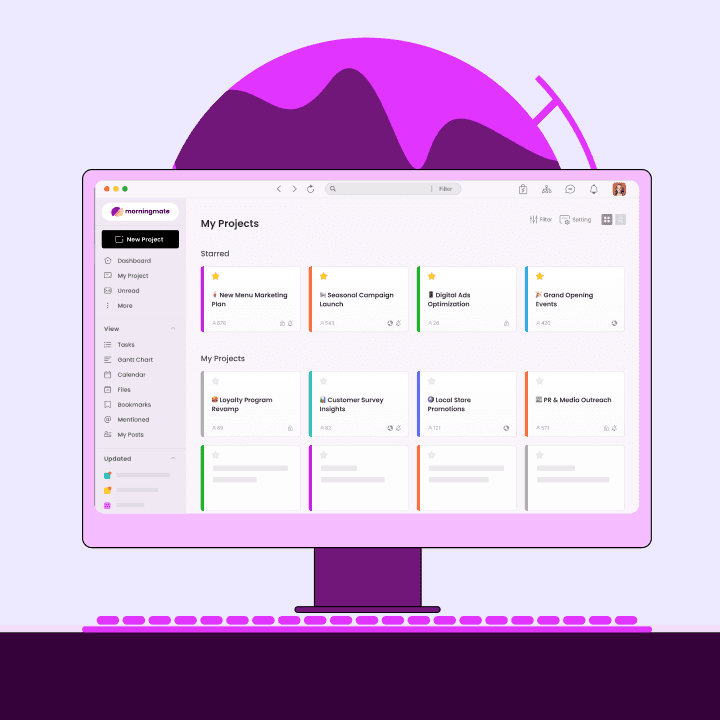
Here is how the three-layer model translates into a real operational workflow using Morningmate, a lightweight work management platform used by over 550,000 teams that brings task management, built-in chat, and file management into a single organized workspace.
Scenario: a 45-person professional services firm runs client onboarding every time a new account signs. Previously, the process lived in a shared calendar and a long email thread. Deliverables were inconsistent. New account managers were confused about their responsibilities. Senior staff spent time re-explaining steps they had explained the cycle before.
The standardized flow in Morningmate works as follows:
A project template is created once in Morningmate, covering every onboarding step — welcome pack preparation, system access provisioning, kick-off scheduling, first-week check-in, and 30-day review. Each step is a task with a named role assignee, a relative due date, and a description that serves as the standard operating procedure for that step.
When a new client signs, the ops manager duplicates the template and assigns actual names to each role. The timeline layer is set. The ownership layer is populated. The context layer already exists in the template.
Status updates happen inside the tasks, not in a separate thread. The ops manager gets real-time visibility across all active onboarding projects without sending a single "where are we on this?" message.
When a task involves a complex output — say, drafting the client's custom onboarding plan — the team can use Morningmate's Repattern assignee agent, which accepts the task, researches relevant context from within the workspace, and posts a draft in the task comments for human review. The status moves to Review automatically, and the account manager approves or refines from there. The agent handles the first pass; the person owns the final call.
The result is that every onboarding cycle runs from the same documented process, regardless of which team member is involved. New hires can take on onboarding tasks in their first week because the context layer tells them exactly what to do. The calendar still exists — but it reflects the plan rather than replacing it.
Before and After: Manual Coordination vs. Structured Task Management
The table below shows how the same operational scenario plays out under each approach. The differences are not cosmetic — they determine whether your process scales or degrades as your team grows.
Situation | Calendar-and-email approach | Three-layer task management |
|---|---|---|
New cycle begins | Ops manager emails the team; steps re-explained verbally | Template duplicated; tasks auto-assigned by role |
Status check | Manual chase via email or message | Dashboard view shows status without asking |
New team member joins | Shadowing or re-training required | Reads task descriptions; starts contributing from day one |
Process improvement | Based on anecdote; no audit trail | Task history shows where delays consistently occur |
Cross-team handoff | Relies on the right person remembering to notify | Task status change triggers next assignee automatically |
Implementation Checklist: Task Management That Replaces Calendar Dependency
Use this checklist to audit your current coordination system and identify where calendar events are substituting for proper task management. Work through it once per recurring process — onboarding, reporting cycles, campaign launches, vendor reviews.
Identify every recurring event on your shared calendar that produces work. If a meeting generates action items, those items need to exist as tasks — not in meeting notes that nobody reads.
Assign a single owner to every task. Group ownership is not ownership. If more than one person is responsible, clarify who is accountable and who is consulted.
Write task descriptions that enable independent completion. Include what done looks like, which inputs are needed, and who reviews the output. If you cannot describe done, the task is not ready to assign.
Set task-level due dates, not just event-level dates. The meeting is the deadline for everything feeding into it. Work backwards and date each task individually.
Build a template for every process that runs more than once. A template is the documented standard. It is also how you onboard new team members without a knowledge transfer meeting.
Choose a single platform for task tracking and stick to it. Morningmate's Feed-based workspace keeps tasks, files, and team communication in one place — without the complexity of enterprise project management tools that non-technical teams avoid using.
Review your process after each cycle using task history, not memory. Where did tasks stall? Which steps consistently ran late? The pattern in your task data is your process improvement roadmap.
Keep the calendar for scheduling; use task management for execution. These two tools have different jobs. Let each do its job.
A shared calendar is a useful coordination signal. It tells your team when to show up. But it cannot tell them what to do, who is responsible, or whether the work is on track. That is what task management is for — and when you treat it as a system rather than a list, it becomes the operational backbone that lets your team scale without losing consistency. The calendar shows the plan on paper. Task management is how the plan actually happens.