Project Management

Effective task management is the difference between a team that looks busy and one that's actually moving the needle. If you've ever sat in a status meeting wondering why everything feels in motion but nothing seems to get done, you're not alone. The gap between activity and progress is one of the most common — and most costly — problems facing managers today.
Busyness is easy to fake, even unintentionally. People respond to messages, join calls, update spreadsheets, and reorganize folders — all while the actual work stalls. Without a clear task management system in place, it becomes nearly impossible to tell who's making real progress and who's just spinning their wheels.
This guide will help you build the visibility you need — not to micromanage your team, but to lead them with confidence. You'll learn how to spot the warning signs of performative busyness, build a task tracking structure that reveals real output, and create a culture where progress speaks louder than activity.
Why Busy Doesn't Always Mean Productive
There's a fundamental flaw in how most teams measure work: they measure effort, not outcomes. Hours logged, messages sent, and meetings attended all feel like progress — but none of them tell you whether the project is moving forward. This is where task coordination breaks down.
Research published by Harvard Business Review has consistently shown that knowledge workers spend a significant portion of their week on low-value activities — coordination overhead, redundant communication, and status updates — rather than the deep work that actually drives results. The busier a team appears, the more likely they've fallen into this trap.
The root cause is usually a lack of structured task workflow. When tasks live in email chains, WhatsApp groups, or someone's personal to-do list, there's no shared view of what's been started, what's blocked, and what's actually done. Everyone's busy doing something — but whether that something matters is anyone's guess.
The Warning Signs: Task Management Red Flags to Watch For
Before you can fix the problem, you need to recognize it. Here are the most common signs that your team's task coordination has broken down:
Status updates require a meeting: If you can't check progress without asking someone directly, your task tracking system isn't working.
Deadlines keep slipping with no warning: Blockers are surfacing too late because there's no shared visibility into what's stuck.
Work gets duplicated: Two people doing the same thing because nobody knows what's already been assigned.
Priorities feel different to different people: Without a central task management view, each person operates on their own interpretation of what matters most.
The loudest person gets the most done: Work advances based on who follows up the most, not what's actually most important.
If three or more of these sound familiar, your team likely has a task workflow problem — not a people problem.
Warning Sign | What It Looks Like | Root Cause |
|---|---|---|
No visibility into progress | Manager must message each person to get updates | No central task tracking system |
Missed deadlines | Blockers only surface the day a task is due | No shared task workflow with statuses |
Duplicated work | Two people independently complete the same task | Assignments not visible to the full team |
Conflicting priorities | Each team member has a different sense of urgency | No single source of truth for task coordination |
How Much Time Is Lost Without Proper Task Management?
The cost of poor task tracking adds up fast. Gallup's State of the Global Workplace report estimates that disengaged, unproductive employees cost businesses trillions of dollars annually — and a significant driver of that disengagement is the feeling that work is chaotic and unclear. When people can't see how their tasks connect to bigger goals, they lose motivation.
Meanwhile, Asana's Anatomy of Work Index found that workers spend an average of 58% of their time on "work about work" — meetings, status check-ins, chasing approvals, and searching for information — instead of the skilled tasks they were hired to do. That's more than half the workday lost to overhead that better task coordination could eliminate.
How Teams Spend Their Workday Without Structured Task Management
42%
Actual skilled work
25%
Meetings & check-ins
33%
Chasing info & updates
Fig 1: Estimated breakdown of workday without structured task tracking (illustrative, based on industry research)
Building a Task Management System That Shows Real Progress
The goal of good task management isn't to monitor people — it's to give everyone, including your team members themselves, a clear view of what's happening and why it matters. Here's how to build that system.
1. Define What "Done" Actually Means
Every task in your task workflow should have a clear definition of done before it starts. Not "in progress," not "almost there" — a specific, verifiable outcome. This single step eliminates most of the ambiguity that turns busy work into wasted effort.
2. Assign Ownership, Not Just Involvement
Every task needs one owner — one person accountable for its completion. When multiple people are "responsible," no one truly is. Your task coordination system should make ownership visible to everyone on the team, not just the manager.
3. Use Status Labels That Reflect Reality
Move beyond "to-do" and "done." Build a task tracking flow with statuses like Not Started, In Progress, Blocked, In Review, and Complete. The "Blocked" status is especially powerful — it signals where your attention as a manager is actually needed.
4. Connect Tasks to Goals
Individual tasks should tie back to a project or team objective. When people can see how their task contributes to a larger goal, task management transforms from a chore into a motivator. This is the foundation of outcome-based work culture. Learn more about how to align team goals with daily tasks for your team.
What Good Task Tracking Looks Like in Practice
Theory is useful, but let's get concrete. Imagine you manage a marketing team of twelve people. Every week, you want to know: what's launched, what's delayed, and what needs a decision? With email and WhatsApp as your primary tools, you spend hours chasing answers. With a proper task management tool, that information is visible in seconds.
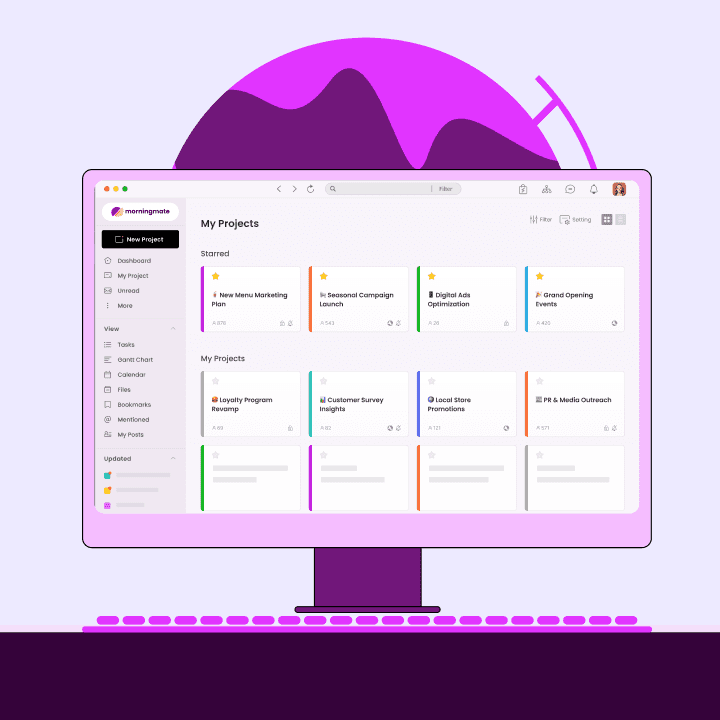
This is exactly the problem that Morningmate was built to solve. Morningmate is a lightweight work management tool that combines task tracking with a built-in team chat — all in one place. Teams can assign tasks, set deadlines, attach files, and follow updates without ever leaving the platform. Because its interface is modeled on familiar social and messaging apps, even non-technical teams adopt it quickly with no learning curve.
One of Morningmate's most useful features for managers is its Feed view — a social-media-style activity stream that shows real-time updates on tasks and projects. Instead of sending a "quick update?" message to five people, you open the feed and see exactly what moved forward and what didn't. That's task coordination that actually works.
You can explore how task management works for remote and hybrid teams to see how this fits into different work environments.
Task Management vs. Micromanagement: Knowing the Difference
A common fear among managers is that adding more structure to task tracking will feel controlling. But there's a meaningful difference between visibility and surveillance. Good task management gives your team more autonomy — not less — because everyone knows what they're responsible for and can self-manage against it.
Micromanagement happens when a manager fills the visibility gap with constant check-ins. When your task workflow provides that visibility automatically, you don't need to check in — and your team doesn't feel watched. You shift from reactive to proactive leadership.
The McKinsey model of performance management increasingly emphasizes outcomes over activity as the measure of team health. When your task tracking system is outcome-focused, managers and employees are aligned on what actually matters.
Approach | Without Task Management | With Structured Task Coordination |
|---|---|---|
Progress check | Manual message to each team member | Visible in shared feed or board instantly |
Blocker identification | Discovered too late, after deadline | Flagged early via task status updates |
Accountability | Unclear — diffused across the group | Single owner per task, visible to all |
Priority alignment | Each person interprets urgency differently | Shared task list with priority labels |
Meeting frequency | Daily standups required for visibility | Async updates reduce meeting load |
Measuring Progress: The Metrics That Actually Matter for Task Management
Once your task workflow is structured, you can start measuring what actually matters. Forget hours worked. Here are the metrics that show real team progress:
Task completion rate: What percentage of tasks assigned in a given week are completed on time? A consistent drop here is an early warning signal.
Cycle time: How long does it take from task creation to task completion? Longer cycle times often reveal process bottlenecks.
Blocker frequency: How often do tasks get stuck? High blocker rates point to dependency issues or unclear requirements at the task tracking stage.
Rework rate: How often are completed tasks sent back for revisions? High rework usually means the definition of done wasn't clear enough upfront.
On-time delivery rate: The clearest signal of whether your task coordination is working or not.
Track these weekly, not monthly. Small dips are easier to address early, and your team will appreciate that progress is being measured fairly — based on outcomes rather than presence.
How Teams Improve After Adopting Structured Task Management
The impact of moving from scattered communication to structured task management is measurable. Teams that switch from email and personal messenger apps to a centralized task tracking tool consistently report improvements across every key productivity metric.
Morningmate customers — drawn from over 550,000 teams worldwide — regularly report that replacing WhatsApp threads and email chains with Morningmate's combined task management and built-in chat reduces time spent on status updates and information-chasing by a significant margin. When task coordination lives in one place alongside team communication, the gap between activity and progress closes fast.
Team Performance Improvement After Adopting Structured Task Tracking
+67%
On-time task completion
+54%
Blocker resolution speed
-41%
Redundant check-in meetings
Fig 2: Reported improvements in teams with structured task coordination vs. unstructured communication tools (illustrative)
Make Task Management a Team Habit, Not Just a Manager's Tool
The biggest mistake managers make with task tracking is treating it as a top-down reporting mechanism. When your team sees task management as something done for you rather than with them, adoption collapses and the system becomes noise.
Frame task coordination as a shared benefit. Your team members get clarity on what they're accountable for. They spend less time in unnecessary meetings. They don't have to chase colleagues for information. And they can show their own progress without anyone asking. That's a win for everyone.
Start small: introduce task management to one project or one team before rolling out broadly. Build the habit of updating task statuses daily — not for the manager, but as a professional norm. Celebrate the teams that close tasks on time. Make visible progress feel rewarding, not punitive.
If your team is currently relying on email threads or personal messenger apps to coordinate work, consider trying a tool like Morningmate, which is designed to feel as familiar as the apps people already use — but built specifically for work. Its task management features sit alongside built-in chat so nothing gets lost between conversations and action items. You can read more about choosing the right team collaboration tool for your specific needs.
The question "is my team busy or actually making progress?" shouldn't be hard to answer. With the right task management habits and tools in place, the answer is always right in front of you — no meetings, no chasing, no guesswork. That's when real momentum starts.