Project Management

Task management is supposed to bring clarity to your team's work — but for millions of managers, the most critical decisions about who owns what, what got approved, and why a project changed direction are buried somewhere in someone's inbox. Not in a shared workspace. Not in a project board. In an email thread from three weeks ago that only two people were copied on. That's not a minor inconvenience. It's a structural problem that quietly derails productivity, accountability, and team trust every single day.
If you've ever had to chase down a decision by searching through old emails or digging through WhatsApp message history, you already know the cost. According to Harvard Business Review, professionals spend an average of 28% of their workweek reading and responding to email — time that could be spent doing actual work. And that figure doesn't account for the time lost trying to reconstruct decisions that were never documented properly in the first place.
The real issue isn't email itself. It's that email and personal messaging apps were never designed for task coordination. They're communication tools, not work management systems. When your team runs task workflows through these channels, context gets lost, ownership becomes fuzzy, and the people who need visibility most — managers, ops leads, executives — are always the last to know what's actually happening.
Why Important Decisions End Up in Inboxes in the First Place
This problem doesn't happen because people are disorganized. It happens because email and chat are frictionless. It's faster to fire off a message than to log into a project tool, create a task, assign it, and set a due date. So teams default to the path of least resistance — and decisions get made in threads that disappear the moment the conversation moves on.
There's also a habit problem. Many teams, especially non-technical ones, have never had a proper task tracking system in place. They've always used email or WhatsApp, and switching feels like a big lift. But the hidden cost of staying comfortable is enormous. When a project stalls because someone can't find the approval that was given in a Slack thread six weeks ago, that's not a communication failure — it's a task management failure.
McKinsey research found that improving the way employees communicate and collaborate could raise productivity by 20 to 25 percent. That's not a marginal gain. That's the difference between a team that executes and one that spins its wheels.
Where Decisions Live | Risk to Task Management | Visibility for Managers |
|---|---|---|
Email threads | High — context buried, hard to search | Very low |
WhatsApp / personal chat | Very high — no structure, no record | None |
Standalone project tools (Jira, Asana) | Medium — complex, low adoption | High, but only for tech teams |
Unified work management platform | Low — decisions logged with context | Full visibility across all teams |
The Real Cost of Scattered Task Tracking
When task coordination happens in silos — across email, chat apps, and verbal conversations — the downstream effects compound quickly. Deadlines slip because no one has a single source of truth. Duplicate work happens because two people didn't know the other had started. And accountability evaporates because there's no record of who agreed to what and when.
For managers and operations leads, the pain is even sharper. You can't get a clear picture of what your team is actually working on without interrupting them to ask. Status updates become a recurring meeting that could have been a shared task board. The cognitive overhead of keeping track of everything — across channels, across people — is exhausting and unsustainable as a team scales.
Where Work Hours Are Lost Weekly Due to Poor Task Management
6 hrs
Searching emails
4.5 hrs
Status check-ins
5 hrs
Duplicate work
8 hrs
Total lost weekly
Fig 1: Estimated weekly hours lost per manager due to poor task workflow practices (illustrative, based on industry benchmarks)
What Good Task Management Actually Looks Like
Effective task management doesn't mean using the most powerful tool on the market. It means having a system where work is visible, decisions are documented, and every person on your team knows exactly what they're responsible for and when. That's the baseline. Everything else — integrations, automations, dashboards — is secondary.
Here's what a functional task workflow should guarantee for any team:
Every task has a clear owner. Not a group. One named person responsible for delivery.
Deadlines are visible to everyone involved. No one should need to ask "when is this due?"
Decisions are attached to the relevant task. If a scope changed, that conversation lives next to the task — not in a thread no one can find.
Managers have real-time visibility without needing to interrupt their team for updates.
Files and context travel with the work. Attachments, notes, and references should live inside the task, not in a separate email.
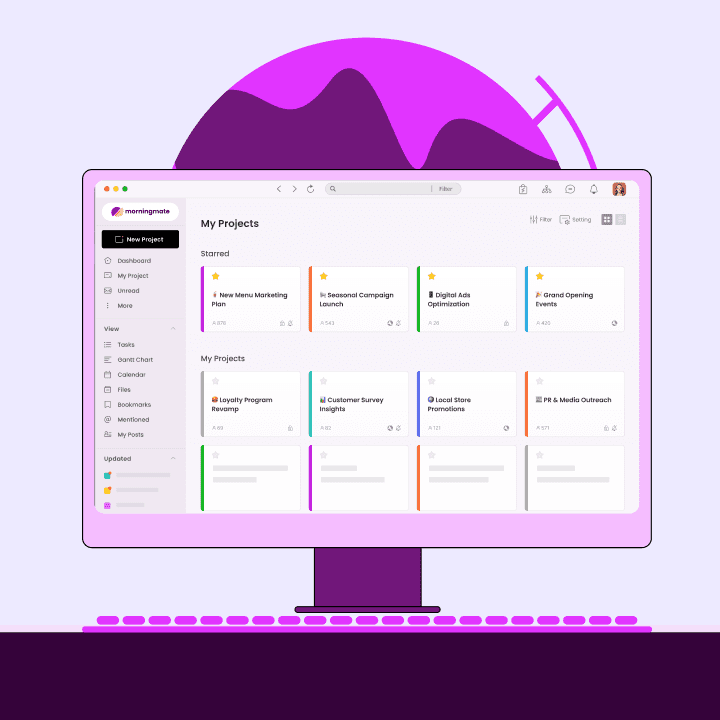
This is where tools like Morningmate make a practical difference. Morningmate is a lightweight work management platform that combines task tracking, built-in chat, and file management in one place. The task boards let your team assign work, set deadlines, and attach files — while the built-in chat keeps conversations tied to the right context, not scattered across WhatsApp and email. For non-technical teams especially, the interface feels familiar from day one, which means actual adoption rather than a tool that sits unused.
Signs Your Team Has Outgrown Email-Based Task Coordination
There's usually a tipping point. Teams that managed fine on email at five people start falling apart at twenty. The signals are predictable — and if any of these sound familiar, your task management system needs an upgrade.
You're running a weekly status meeting just to find out what's happening
Someone misses a deadline because they didn't see the email
Two team members do overlapping work because neither knew the other had started
A decision gets reversed because the original approval was in a thread no one could locate
New hires take weeks to get up to speed because all context is locked in someone else's inbox
You're copying five people on every email "just to be safe"
Each of these is a task workflow failure dressed up as a communication problem. The fix isn't more meetings or more emails. It's moving work into a system designed for task coordination — not one designed for sending messages.
According to Asana's Anatomy of Work report, employees switch between apps an average of ten times per hour when trying to coordinate work. Each switch costs attention, time, and momentum. Consolidating task management into a single platform doesn't just save time — it protects the deep focus your team needs to do meaningful work.
How to Bring Decisions Out of Inboxes: A Practical Framework
Moving from email-based chaos to structured task management doesn't have to be a massive change initiative. Here's a straightforward approach any team can start with this week.
Step 1 — Audit where decisions currently live
Spend one week logging every decision that comes through email or personal chat. Not to judge the behavior, but to see the volume and types of decisions that aren't being captured anywhere. This alone is usually enough to convince even the most email-loyal team member that something needs to change.
Step 2 — Create a single system for task tracking
Pick one tool and make it the home for all active work. Every project, every deliverable, every approval request goes into the task management system — not into an inbox. The key is consistency. Partial adoption defeats the whole purpose.
Step 3 — Attach decisions to tasks, not to people
When a decision gets made — a deadline shifts, a scope changes, a budget is approved — it should be recorded as a comment or note on the relevant task. That way, anyone who needs to understand the history of a piece of work can find it without bothering a colleague or digging through old emails.
Step 4 — Replace status meetings with shared visibility
If your task workflow is working properly, most status meetings become redundant. Managers can see what's in progress, what's blocked, and what's been completed without scheduling time with the team. Reserve meetings for decisions and creative thinking — not for information transfer that a well-maintained task board already provides.
Step 5 — Keep chat in context
One of the biggest reasons decisions get buried is that the conversation about a task happens in a separate channel from the task itself. When your chat and your task management live in the same system, the context stays connected. Morningmate's built-in chat works exactly this way — conversations happen alongside the work, so nothing important disappears into a separate app.
Comparing Task Management Approaches: Email vs. Structured Systems
Not all teams are starting from the same place. Some rely entirely on email, others use a patchwork of tools. Here's how different approaches compare across the metrics that matter most for task coordination and management visibility.
Capability | Email + WhatsApp | Complex Tools (Jira/Asana) | Morningmate |
|---|---|---|---|
Task ownership clarity | ❌ None | ✅ Strong | ✅ Strong |
Decision documentation | ❌ Scattered | ✅ Good | ✅ Contextual |
Ease of adoption | ✅ Very easy | ❌ Steep learning curve | ✅ Simple for all teams |
Manager visibility | ❌ Requires chasing | ✅ Dashboard views | ✅ Real-time feed + tasks |
Built-in communication | ⚠️ Fragmented | ❌ Requires integrations | ✅ Native chat included |
The pattern is clear. Email does one thing adequately — low-friction messaging — but it fails at every dimension of structured task management. Complex tools like Jira are powerful, but they require training and ongoing upkeep that most non-technical teams won't sustain. The middle ground — simple, structured, and built for real team coordination — is where tools like Morningmate sit, and that's exactly the gap most growing teams need to fill.
The Measurable Difference Structured Task Management Makes
Teams that shift from inbox-based work coordination to a structured task management system see measurable improvements quickly — often within the first month. Fewer missed deadlines. Faster onboarding. Less time spent in status meetings. More confidence from leadership that work is actually happening as planned.
Team Performance Improvements After Adopting Structured Task Management
45%
Fewer missed deadlines
60%
Less time in status meetings
38%
Faster team onboarding
72%
Improved manager visibility
Fig 2: Reported improvements by teams after transitioning from email-based to structured task tracking systems (illustrative)
For business owners and executives managing growing teams, the visibility gain alone is worth the switch. When you can see the status of every active project across every department without calling a meeting or sending a follow-up email, your decision-making becomes faster and more confident. That's not a productivity hack — that's how well-run organizations are supposed to work.
Morningmate's Feed view — which feels like a social media timeline — gives managers a running, real-time view of what their team is posting, completing, and working on. It's one of the features that makes the tool unusually easy to adopt, because it doesn't look or feel like traditional project software. It looks like something your team already uses every day. Over 550,000 teams worldwide have made that shift, and you can learn how to migrate your team off email with a few simple steps.
Stop Losing Work Decisions to the Inbox
Task management isn't a luxury for large enterprises with dedicated operations teams. It's a basic requirement for any team that wants to grow without things falling through the cracks. If your most important decisions are still living in someone's email inbox, you're not just disorganized — you're building on an unstable foundation that will cost you more as your team scales.
The good news is that fixing this doesn't require a massive transformation. It starts with one simple commitment: work decisions belong in your task management system, not in private threads. Every task tracked, every decision recorded, every team member aligned — that's what effective task coordination looks like. And that's the standard your team deserves to work to. For teams looking to find the right task management tool without the complexity of enterprise software, the options have never been better.