Project Management

Real estate moves fast. A lead comes in on a Saturday morning, a showing needs to be scheduled by noon, and three agents are waiting on contract documents — all while your property manager is fielding maintenance requests from a tenant across town. Without a clear system for real estate team communication and task management, things fall through the cracks. Deals stall. Clients get frustrated. Your team burns out chasing updates instead of closing sales.
Most real estate teams still run on a patchwork of WhatsApp threads, email chains, and verbal check-ins. It works — until it doesn't. When your team grows past a handful of agents, or when you're managing multiple listings simultaneously, that informal approach starts costing you real money and real opportunities.
The good news is that fixing this doesn't require an expensive, complex software overhaul. It requires the right structure, clear habits, and a tool that your whole team will actually use. This guide walks you through exactly how to build that system for your real estate operation.
Why Real Estate Teams Struggle With Communication
Real estate is fundamentally a relationship business — but it's also a logistics business. You're coordinating buyers, sellers, lenders, inspectors, attorneys, and agents across timelines that shift constantly. That makes communication more critical here than in almost any other industry.
According to McKinsey research, employees spend nearly 20% of their workweek searching for internal information or tracking down colleagues for updates. In real estate, where timing is everything, that wasted time translates directly into missed opportunities.
The core problem isn't that your team lacks communication — it's that communication is scattered. A buyer inquiry lands in one agent's personal inbox. A task reminder lives in someone's paper notepad. A contract update gets buried in a WhatsApp group with 40 other messages. Nobody has the full picture.
The Hidden Cost of Scattered Information
When information lives in too many places, your team spends more time managing communication than doing actual work. Agents double up on tasks. Managers repeat themselves in three different channels. Important deadlines get missed because nobody knew who owned them.
This is especially painful for operations leads and team managers at growing brokerages. As your headcount grows, the informal "just text me" system breaks down completely. You need visibility — not just presence.
Building a Smarter System for Real Estate Team Communication
Great real estate team communication isn't about talking more — it's about talking in the right places, at the right time, with the right people. Here's how to structure it.
1. Separate Channels by Purpose
One of the biggest mistakes real estate teams make is using a single group chat for everything — deal updates, scheduling, water cooler chat, urgent client issues. Everything competes for attention and nothing gets the focus it deserves.
Instead, create distinct spaces for distinct purposes. A good starting structure looks like this:
Active listings: One dedicated space per property or deal, where all updates, documents, and tasks live together
Team announcements: A broadcast channel for updates that everyone needs to see
Agent support: A space where agents can ask questions or flag issues without clogging up deal channels
Client coordination: A shared space (internal-only) for tracking client communication and follow-ups
This structure alone reduces the "where did that message go?" problem by 80%. Your agents know exactly where to look and where to post.
2. Make Task Ownership Explicit
In real estate, ambiguity is expensive. "Someone will handle the inspection coordination" almost always means nobody handles it until the last minute. Every task needs a name attached to it, a deadline, and a clear definition of done.
This is where a proper task management system pays for itself. Rather than relying on mental notes or reminder texts, tasks should live in a shared space visible to the whole team. When a manager can see at a glance which listings have open tasks, which are overdue, and who's carrying the most load — that's real operational visibility.
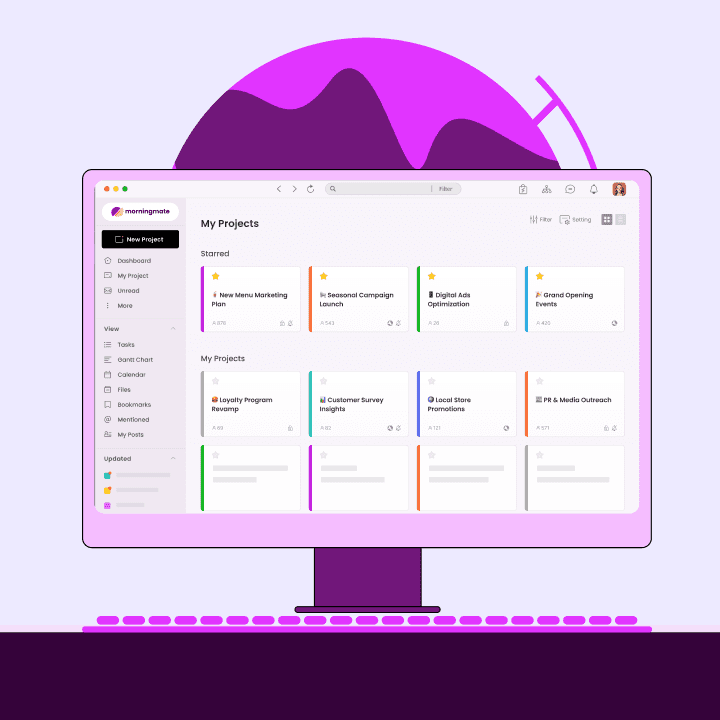
Tools like Morningmate are built exactly for this. It's a lightweight work management platform that combines task management with built-in team chat — so your agents don't have to toggle between a project tool and a separate messenger. Everything lives in one place, organized by project or property, with tasks assigned to specific team members and deadlines clearly visible.
3. Use Async Communication as a Default
Real estate agents are rarely sitting at a desk. They're at showings, driving between properties, or on calls with clients. Expecting instant responses from a team that's constantly mobile is a recipe for frustration on both sides.
Harvard Business Review has consistently noted that high-performing teams set clear norms around communication — including when it's okay not to respond immediately. Async-first communication respects your team's focus time while still keeping everyone informed.
This means using written updates instead of voice calls for non-urgent information, tagging the right people in posts rather than broadcasting to everyone, and setting response time expectations clearly within each channel.
Task Management for Real Estate: A Property-by-Property Approach
The most effective real estate teams treat each property — or each deal — as its own mini-project. That means every listing gets its own task list, communication thread, and document folder. This approach keeps information clean and makes handoffs seamless when an agent is out sick or a deal changes hands.
A Sample Task Structure for a New Listing
Here's a practical checklist you can adapt for any new property your team takes on:
Pre-listing prep: Assign tasks for photography, staging coordination, MLS data entry, and disclosure document collection
Listing live: Tasks for social media posts, open house scheduling, agent outreach, and digital ad setup
Offer stage: Tasks for reviewing offers, communicating with buyer agents, and scheduling attorney review
Under contract: Tasks for inspection coordination, appraisal scheduling, title communication, and contingency deadlines
Closing prep: Tasks for final walkthrough, document review, closing confirmation, and post-closing follow-up
When these tasks are tracked in a shared system rather than in someone's head or personal to-do app, the whole team benefits. Managers get visibility. Agents get clarity. Nothing slips through the cracks at the worst possible time.
Handling Recurring Tasks Without Losing Your Mind
Beyond deal-specific tasks, real estate teams carry a heavy load of recurring operational work — weekly pipeline reviews, monthly performance check-ins, regular social media updates, and lease renewal tracking for property managers. These recurring tasks need a home that isn't your memory.
Setting up recurring task templates in your work management tool saves hours of administrative overhead every month. It also means a new team member can onboard faster — the task structure is already built, they just need to be assigned to it. You can read more about building effective recurring workflows in our guide to team task management best practices.
Bringing Communication and Tasks Together: What Good Looks Like
The best real estate teams don't treat communication and task management as separate systems. They treat them as two sides of the same coin. A task update should trigger a relevant notification in the right chat thread. A question asked in chat should be able to turn into an assigned task in seconds.
This is the gap that most tools fail to bridge. Email handles communication but not tasks. Spreadsheets handle tasks but not communication. Personal messenger apps handle quick chats but nothing else. The result is that your team ends up managing their tools more than their actual work.
Morningmate is designed to close that gap. Its Feed view — which looks and feels like a familiar social media interface — lets agents post updates, share files, and tag teammates on any deal. The built-in chat functions like WhatsApp, so there's zero learning curve. And all of it is connected to task management, so nothing gets lost in a separate app. For real estate teams that have resisted adopting new software because "the team won't use it," the familiarity of Morningmate's interface tends to be the deciding factor.
Remote and Hybrid Real Estate Teams: Extra Considerations
If your brokerage has agents working across different cities — or if your property management team is split between an office and the field — remote communication challenges layer on top of everything else. Gallup research shows that remote workers who feel disconnected from their team report significantly lower engagement and higher turnover intentions. For real estate, where agent retention is already a challenge, this matters enormously.
The fix isn't more video calls. It's better structure. When your remote agents can see exactly what's happening on every deal, contribute to conversations without waiting for a team meeting, and complete their assigned tasks without needing to interrupt a manager — they feel connected and in control. That structure is what keeps good agents around.
Practical Steps to Get Your Team Aligned This Week
You don't need a three-month implementation plan. Here's what you can do right now to start improving real estate team communication and task management at your organization:
Audit your current channels. List every place work-related communication is happening right now — email, WhatsApp, iMessage, Slack, verbal updates. You'll probably count at least five. That's your problem on paper.
Pick one tool as your single source of truth. It doesn't have to be perfect. It has to be something every person on your team will actually open every day.
Create a template for your most common deal type. Whether that's a residential listing, a commercial lease, or a property management intake — build a task checklist and use it on every deal going forward.
Set communication norms in writing. Decide what goes in chat versus a task comment, what requires same-day response versus next business day, and who needs to be looped in on what. Write it down and share it with the team.
Review and adjust after 30 days. No system is perfect on day one. After a month, ask your team what's working and what's still falling through the cracks. Iterate from there.
The goal isn't perfection. The goal is consistency — a shared system that everyone understands and trusts, so your team can focus on what actually matters: serving clients and closing deals.
If you're looking for a starting point, Morningmate's combination of task management, team chat, and file sharing — all in a single, easy-to-navigate workspace — makes it a natural fit for real estate teams that want structure without complexity. Used by over 550,000 teams worldwide, it's built for the way real teams actually work, not the way enterprise software vendors think they should. You can explore more about keeping distributed teams aligned in our article on remote team communication strategies.