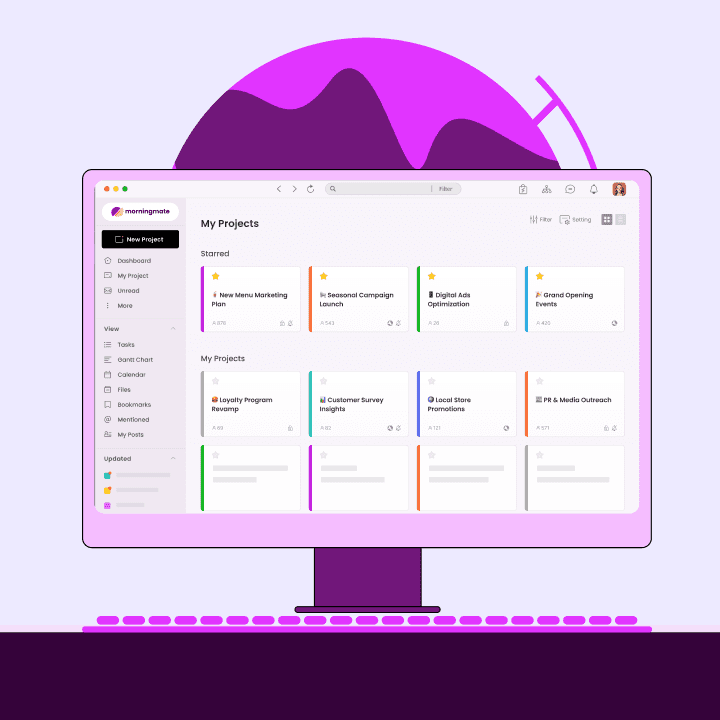
Project Management

You know that unsettling moment when a project goes off track because someone forgot to reserve the conference room? Or even worse—when budgets spiral out of control because no one monitored resource allocation? 73% of projects fail due to poor planning, not a lack of talent.
A well-crafted checklist can turn chaos into clarity. Here’s what we’ll discuss:
The difference between project and program checklists
A 10-step process to create effective project lists
A free customizable template (ready for immediate use)
Expert tips for managing multiple projects
Proven strategies for dynamic project tracking
With Morningmate, you can keep checklists actionable and relevant. It transforms static lists into collaborative workflows, ensuring nothing slips through the cracks. Plus, it keeps everyone aligned without the need for endless status meetings. More on this later.
What Is a Project Management Checklist?
Think of a project management checklist as your project’s flight plan. It’s a sequential list of tasks, milestones, and checkpoints that guide your team from start to finish. Unlike random to-do lists, these checklists follow a strategic order—each item builds on the previous one.
A solid checklist encompasses everything: initial planning steps, resource needs, communication protocols, and quality checks. It serves as your single source of truth, preventing costly oversights.
Why Project Checklists Are Essential for Success
Here’s the hard truth: human memory falters under pressure. When deadlines approach and stakeholders are anxious, critical tasks can easily slip your mind.
Checklists offer three transformative benefits:
Consistency across projects – New team members can follow the same proven process.
Risk reduction – Identify potential issues before they escalate.
Accountability – Everyone knows their responsibilities and deadlines.
Research from the Project Management Institute shows that teams using structured checklists complete projects 23% faster with 31% fewer defects. This isn’t luck; it’s systematic thinking in action.
💡 Pro tip: Your checklist becomes significantly more effective when it’s visible to everyone. Morningmate's feed view allows teams to track checklist progress without searching through folders or asking for updates.
What’s the Difference Between a Project and a Program Checklist?
Project checklists focus on individual initiatives with specific endpoints. They track tasks for one particular outcome—like launching a website, opening a store, or delivering a product feature.
Program checklists manage multiple related projects at once. They monitor:
Dependencies between projects
Shared resource allocation
Portfolio-level milestones
Cross-project risks
Think of it this way: A project checklist helps you build one house perfectly, while a program checklist ensures an entire neighborhood is constructed on time, with shared utilities and resources efficiently distributed.
The complexity can grow quickly. While project lists may contain 50-100 items, program lists often exceed 500 checkpoints across various workstreams. That’s why program managers need top-notch project management tools with Gantt charts and dependency tracking—exactly what Morningmate's timeline view offers.
How to Build a Project Management Checklist (Step-by-Step)
Creating a robust checklist isn’t rocket science, but it does require methodical thinking. Skip a step, and you may find gaps when it’s too late to address them affordably.
We’ve refined this 10-step process through hundreds of projects. Follow it closely, and you’ll catch issues before they become problematic.
Step 1: Define the Project Vision and Scope
Start with the why before diving into the what. Your vision statement should clarify: What does success look like? What’s included (and what’s NOT)?
Write your scope in clear language:
Core objectives (3-5 maximum)
Boundaries and exclusions
Success metrics
Keep this visible throughout the project. In Morningmate, we pin our vision statement at the top of the project feed—ensuring everyone sees it daily.
Step 2: Identify Stakeholders and Requirements
List everyone involved in your project. Missing a stakeholder can derail your timeline later.
Create a simple stakeholder matrix:
Primary: Decision-makers and approvers
Secondary: Team members and contributors
Tertiary: End users and affected departments
Next, gather requirements from each group.
💡 Pro tip: Use Morningmate's posts feature to collect requirements directly—stakeholders can comment on their needs, creating an audit trail you’ll appreciate later.
Step 3: Set Clear Goals and Deliverables
Vague goals can doom projects. Turn unclear objectives into SMART deliverables that your team can actually check off.
Instead of saying "improve customer experience," specify:
Reduce support ticket response time to under 2 hours
Launch a self-service portal with 10 FAQ articles
Achieve an 85% customer satisfaction score
Each deliverable should have an owner and a deadline. No exceptions.
Step 4: Allocate Budget and Resources
Money matters, but resource conflicts can be even more disruptive. Identify both financial and human resources early on.
Your resource checklist should track:
Budget by category (tools, contractors, materials)
Team member availability and allocation percentage
Equipment and software needs
External vendor requirements
Smart teams use workload views to identify overallocation before burnout occurs. Morningmate's resource dashboard shows who is overwhelmed and who has capacity—essential for a realistic project management plan.
Step 5: Create a Work Breakdown Structure (WBS)
Break your project into manageable parts. Each major deliverable should be divided into tasks, which can further be broken down into subtasks.
The magic number? No task should exceed 40 hours. Larger tasks can hide complexity and cause delays.
Structure your WBS hierarchically:
Project phases
Major deliverables
Work packages
Individual tasks
Visual learners benefit from Gantt charts here. Drag-and-drop dependencies in tools like Morningmate make WBS creation feel less like a chore.
Step 6: Develop a Project Timeline or Schedule
Timing is crucial. Build your schedule backward from the deadline, allowing buffer time for unexpected issues.
Key scheduling elements include:
Task dependencies (what must finish before the next begins)
Milestone dates (non-negotiable checkpoints)
Buffer time (15-20% minimum)
Resource availability windows
Color-code your timeline by team or phase. When everyone can see how their work impacts others, accountability increases.
Step 7: Plan for Communication and Collaboration
Silence can kill projects faster than budget cuts. Establish communication rhythms from the start.
Your communication checklist should include:
Meeting frequency (daily standups, weekly reviews)
Status report format and frequency
Escalation paths for blocked work
Collaboration tool agreements
We’ve eliminated email chaos for centralized communication. Morningmate's real-time chat keeps discussions tied to specific tasks—no more searching through inboxes.
Step 8: Identify Risks and Create a Risk Management Plan
Every project has hidden challenges. Identify them early, or they will find you.
Create a risk register that includes:
Risk description and probability
Impact level (high/medium/low)
Mitigation strategies
Risk owners
Trigger indicators
Review risks weekly. New ones can arise as projects progress. Smart teams tag high-risk tasks in their project management system for added visibility.
Step 9: Set Up Tools to Monitor Progress and Tasks
You can’t manage what you can’t measure. Configure your tracking system before work begins.
Essential monitoring setup includes:
Progress indicators (percentage of project completed, burndown charts)
Task status workflows (not started → in progress → review → done)
Automated notifications for overdue items
Dashboard views for different stakeholders
Morningmate's customizable dashboards allow each team member to see their personal priorities while managers track overall progress. One source of truth is far better than scattered spreadsheets.
Step 10: Review, Adjust, and Optimize As You Go
Static checklists become obsolete. Living checklists adapt to changing realities.
Schedule regular checklist reviews:
Weekly team retrospectives
Monthly stakeholder check-ins
Post-milestone assessments
Document what works and what doesn’t. Update your checklist template for future projects. This continuous improvement process turns good teams into exceptional ones.
Program Management Checklist: What’s Different?
Program management is not just about managing larger projects; it involves coordinating multiple components while ensuring strategic alignment.
Think of it as a conductor leading an orchestra rather than playing a solo instrument. Different skills require a different checklist.
Key Phases in Program Oversight
Program checklists encompass four distinct phases that standard project lists often overlook:
1. Portfolio Planning Phase
Verify strategic alignment
Map inter-project dependencies
Plan resource pool capacity
Establish governance structure
2. Integration Management
Synchronize cross-project milestones
Resolve shared resource conflicts
Conduct combined risk assessments
Create a unified reporting framework
3. Benefits Realization
Track cumulative value
Measure strategic objectives
Monitor portfolio health indicators
Assess stakeholder satisfaction across projects
4. Continuous Optimization
Review project prioritization
Make resource reallocation decisions
Trigger portfolio rebalancing
Aggregate lessons learned
Each phase requires executive-level thinking. You’re not just delivering projects; you’re driving business transformation.
Checklist Items for Multi-Project Coordination
Managing multiple projects requires specialized checklist items that single-project templates lack:
Dependencies and Conflicts
Cross-project dependency matrix
Resource sharing agreements
Conflict escalation procedures
Priority override protocols
Communication Amplification
Multi-stakeholder update schedules
Executive dashboard requirements
Cross-team collaboration forums
Integrated status reporting
Resource Management
Skill inventory across teams
Quarterly capacity planning
Vendor management coordination
Budget reallocation triggers
Risk Management
Cascading risk assessments
Portfolio-level contingencies
Early warning indicators
Integrated mitigation strategies
The complexity increases significantly. While project managers track 50-100 items, program managers handle 300-500 checkpoints across multiple workstreams.
That’s why spreadsheets often fail at the program level. You need tools designed for complexity. Morningmate's Gantt timeline view visually displays cross-project dependencies, helping you identify conflicts before they escalate. The platform’s workspace feature allows you to maintain separate project feeds while consolidating them into program-level dashboards.
Tips for Using Checklists Effectively
A checklist is only as effective as its implementation. We’ve seen teams create impressive lists that end up unused while projects suffer. Don’t be one of those teams.
These three practices distinguish checklist champions from those who struggle.
Keep It Dynamic and Editable
Static checklists are merely organizational theater—they look good but achieve little.
Your checklist must adapt because:
Requirements can change mid-project
Improved processes emerge from experience
Team capacity can vary
External factors may necessitate pivots
Incorporate flexibility into your system. Use version control to track changes and date-stamp major updates. Most importantly, empower team members to suggest improvements without bureaucratic hurdles.
In Morningmate, we treat checklists as living documents. Team members can comment directly on checklist items, proposing updates that project managers can approve with a single click—no meetings required.
Assign Responsibilities
A task without an owner is unlikely to get done. Period.
Every checklist item should include:
One primary owner (the final decision-maker)
Clear criteria for project completion
A specific deadline
An escalation contact if blocked
Avoid the "team responsibility" trap. When everyone is responsible, no one is. Even collaborative tasks need a designated point person to drive completion.
Visual accountability influences behavior. When Morningmate displays owner photos next to tasks in the feed view, procrastination decreases significantly. Public visibility fosters positive peer pressure.
Review Regularly and Track Completion
What gets measured gets managed. Schedule mandatory checklist reviews:
Daily: 5-minute standup to address blockers
Weekly: 30-minute deep dive on upcoming items
Monthly: Strategic assessment of checklist effectiveness
Monitor more than just completion rates. Track:
Average time spent on each task type
Common blockers and bottlenecks
Items frequently pushed to the next week
Tasks completed but requiring rework
Use this data to refine future checklists. If certain items consistently take longer, adjust your estimates. If specific dependencies repeatedly cause delays, restructure your sequence.
Ready to Master Your Projects with Morningmate?
Project chaos is a choice, not a necessity. A well-crafted project checklist can turn overwhelming tasks into manageable steps, enabling teams to track progress and consistently meet project goals. You now have the tools to create checklists that lead to successful projects.
Key Takeaways:
Clearly define the project scope and vision before creating tasks.
Break down work into manageable segments (under 40 hours).
Assign tasks to individual owners for accountability.
Review project data weekly and adjust your checklist as needed.
Agile project management requires five times more coordination than single projects.
We’ve evaluated every project management platform available. Morningmate stands out by transforming checklists into collaborative workflows. Your lists remain visible, trackable, and dynamic—exactly what modern teams need to deliver on time, every time.
Stay organized, stay connected, get work done with Morningmate
FAQs
What is a checklist in project management?
A project management checklist is a structured list of tasks, milestones, and verification points that guide your team from start to finish. Unlike simple to-do lists, these checklists incorporate project management best practices to ensure that nothing is overlooked.
What are the 10 areas of project management?
The Project Management Body of Knowledge identifies these essential areas:
Integration - Coordinating all project elements.
Scope - Defining boundaries and deliverables.
Schedule - Creating realistic timelines.
Cost - Planning and tracking the project budget.
Quality - Establishing standards and verification processes.
Resource Management - Managing people, equipment, and materials.
Communications - Keeping stakeholders updated and fostering team collaboration.
Risk - Identifying and mitigating potential threats.
Procurement - Managing vendors and contracts.
Stakeholder Engagement - Managing expectations and securing buy-in.
What are the 7 C's of project management?
The 7 C's framework helps project teams successfully deliver complex projects:
Clarity - Clear project goals and success metrics.
Capability - The right skills and project management tools for the job.
Commitment - Buy-in from project sponsors and stakeholders.
Communication - Transparent updates on project performance.
Collaboration - Cross-functional teamwork using modern project management tools.
Continuity - Consistent business processes and methodologies.
Completion - Defined endpoints with measurable outcomes.
What are the 10 steps in the project management checklist?
The project management process follows these sequential steps:
1. Define Vision and Scope - Create your project charter.
2. Identify Stakeholders - Map everyone who impacts project success.
3. Set Goals and Deliverables - Define measurable outcomes.
4. Allocate Resources - Plan the budget and team capacity.
5. Create a Work Breakdown Structure - Break down project tasks into manageable parts.
6. Develop Project Schedule - Build a timeline using the program evaluation review technique.
7. Plan Communication - Establish update rhythms and channels.
8. Identify Risks - Anticipate and prepare for potential obstacles.
9. Set Up Monitoring Tools - Configure dashboards for tracking progress.
10. Review and Optimize - Apply lessons learned to future projects