Project Management

Right now, your team might include a 58-year-old operations director who prints her agendas, a 34-year-old project lead who lives in Slack, and a 24-year-old coordinator who communicates almost entirely in voice notes. They all show up to the same meetings, work toward the same goals — and sometimes feel like they're speaking completely different languages. Managing a multigenerational team isn't a niche challenge. For most managers today, it's just Tuesday.
Four generations are currently active in the global workforce: Baby Boomers, Gen X, Millennials, and Gen Z. Gallup research has found that while generational differences in values are often overstated, real differences in communication preferences, feedback expectations, and technology adoption do shape how people work day to day. Ignoring those differences doesn't make them disappear — it just creates friction that slows your team down.
The good news is that multigenerational teams, when managed well, consistently outperform homogeneous ones. Different career stages bring different strengths: institutional knowledge, fresh perspectives, digital fluency, and seasoned judgment all in the same room. Your job as a manager isn't to flatten those differences — it's to build an environment where each generation can contribute without being asked to work in a way that doesn't suit them.
Why Multigenerational Management Is Getting Harder — and More Important
The span between the youngest and oldest workers on a single team has widened significantly over the past decade. Longer working lives, delayed retirements, and the rapid entry of Gen Z into professional roles mean it's now common to have a 35-year age gap within one department. That's not just a communication challenge — it's a management design challenge.
At the same time, hybrid and remote work has stripped away many of the informal moments — hallway conversations, shared lunches, ad hoc check-ins — that used to smooth over generational friction naturally. When your team is distributed, you can't rely on organic relationship-building. You have to be deliberate.
Harvard Business Review notes that managers who try to apply a single management style across all age groups tend to struggle more with retention and engagement. The teams that thrive are those where leaders adapt their approach — not by stereotyping, but by actually listening to how individuals prefer to work and communicate.
Understand the Differences Without Relying on Stereotypes
Generational labels are a starting point, not a rulebook. Not every Millennial wants constant feedback, and not every Boomer resists digital tools. What generational research gives you is a set of tendencies shaped by shared historical context — useful as a lens, not a label.
Here's a practical summary of what tends to differ across generations in workplace settings:
Communication style: Older workers often prefer structured, formal communication — emails, scheduled meetings, documented decisions. Younger workers tend to favor real-time, informal exchanges — quick messages, voice notes, fast feedback loops.
Feedback expectations: Gen Z and younger Millennials typically want frequent, specific feedback. Gen X and Boomers often prefer feedback tied to outcomes and delivered less frequently but with more weight.
Technology comfort: Digital nativity varies widely. Some experienced team members may use fewer tools by choice, not inability. Some younger team members may be fluent in consumer apps but unfamiliar with professional workflows.
Work-life expectations: Younger generations are more likely to push back on always-on culture. Older workers may value loyalty and long-term tenure signals. Neither is wrong — they just require different management conversations.
The most effective move you can make is simply asking. During one-on-ones, find out how each person prefers to receive updates, what kind of feedback feels most useful, and what tools or workflows feel like friction to them. You'll learn more in one conversation than from any generational framework.
Build Communication Systems That Work Across the Spectrum
One of the biggest sources of multigenerational tension is communication tooling. When half your team is in WhatsApp groups and the other half is still using email chains, work gets scattered. Updates get missed. Accountability disappears into message threads nobody can find two weeks later.
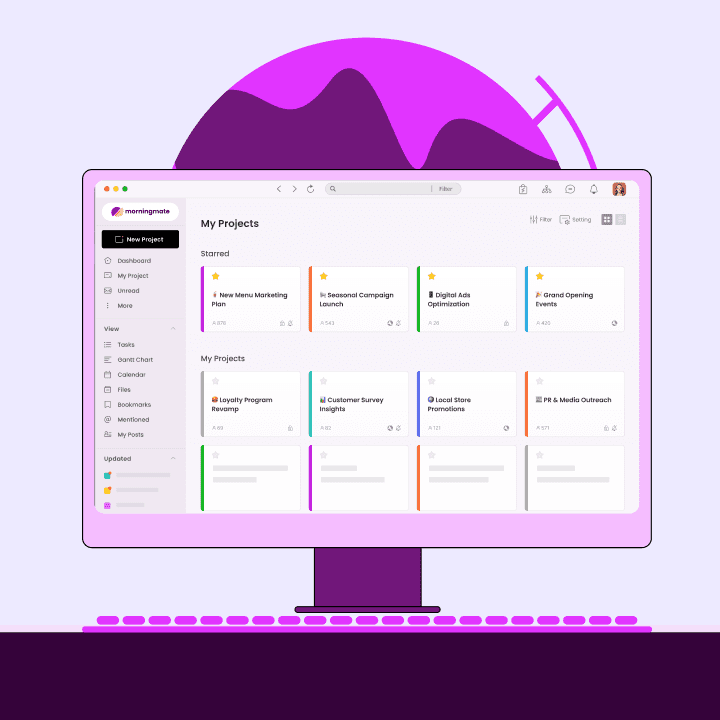
This is where the right platform makes a concrete difference. Morningmate is a work management tool designed for exactly this kind of team — it combines task management, a built-in team chat, and a social media-style Feed view that makes updates easy to share and follow without a learning curve. Because the interface feels familiar (similar to tools people already use in their personal lives), it doesn't alienate team members who aren't particularly tech-savvy.
When choosing or optimizing your communication tools for a multigenerational team, look for:
A single source of truth for task updates — so nothing lives only in someone's inbox
Async-friendly channels that don't require everyone to be online at the same time
Simple, low-barrier interfaces that don't punish people with less technical experience
Clear separation between social/informal communication and work updates
The goal isn't to force everyone onto the same tool and hope for the best. It's to find a system that accommodates different working styles without creating a fragmented mess. You can read more about this in our guide on async communication for distributed teams.
Create Feedback Loops That Respect Different Preferences
A rigid, one-size-fits-all feedback cadence will leave some team members overwhelmed and others feeling invisible. Managing a multigenerational team well means being flexible about how and how often you check in.
Adapt Your Cadence, Not Your Standards
You don't need different performance expectations for different generations — you need different delivery mechanisms. A 26-year-old coordinator might thrive with weekly one-on-one check-ins and regular micro-feedback. A 52-year-old senior manager might find that excessive and prefer a monthly deep-dive conversation with clear outcome metrics.
The standard you're holding everyone to — quality of work, accountability, collaboration — stays consistent. The wrapper around how you communicate about it can flex.
Make Feedback a Two-Way Street
Experienced team members often have sharp observations about how the team is functioning — and they may not share them if the culture doesn't invite it. Younger team members may share freely but need structure to do it constructively. Build in both formal feedback moments (quarterly reviews, retrospectives) and informal ones (open-door check-ins, anonymous pulse surveys) so everyone has a channel that suits them.
Leverage Each Generation's Strengths — Deliberately
The real payoff of a multigenerational team isn't just tolerance of difference — it's actively using those differences to get better outcomes. That requires intentional structure, not just goodwill.
Reverse Mentoring
Pair younger team members with senior ones — but flip the direction sometimes. A junior team member who grew up on social media might help a senior colleague think through a digital campaign strategy. A seasoned operations lead has navigated crises and organizational politics that no amount of online research can replicate. Formalizing this exchange — even as a lightweight monthly pairing — creates genuine cross-generational respect.
Assign Projects That Mix Experience Levels
When you structure project teams intentionally — mixing seniority, not defaulting to experience siloes — knowledge transfer happens naturally. Younger team members see how experienced colleagues approach ambiguity. Senior team members are exposed to new methods and tools. Everyone teaches without being put on a stage.
Morningmate's task management features make this kind of cross-functional coordination easier to manage. You can assign tasks, set visibility across team members, and track progress without holding constant status meetings — which matters when your team spans different working styles and time zones. It's used by over 550,000 teams globally, including many hybrid and remote setups exactly like this one.
Handle Conflict Between Generations Without Taking Sides
Generational friction tends to surface in specific flashpoints: debates over remote work flexibility, disagreements about how quickly decisions should be made, or tension around communication norms. Left unaddressed, these conflicts harden into "us vs. them" dynamics that are genuinely difficult to undo.
When you see generational tension emerging, resist the urge to validate one perspective over another. Instead, redirect the conversation toward shared goals. What outcome is everyone actually trying to achieve? What's the disagreement really about — values, process, or tooling? Most generational conflicts, when you drill down, are actually solvable process problems dressed up as cultural clashes.
McKinsey research on organizational performance consistently shows that psychological safety — the feeling that you can speak up without being judged — is the factor most correlated with high-performing teams, regardless of age composition. Building that safety takes time, but it starts with how you handle the first few conflicts as a manager.
A Practical Checklist for Managing a Multigenerational Team
Use this as a starting point for an honest audit of how your team is set up right now:
Have you asked each team member individually how they prefer to communicate and receive feedback?
Does your team have one central place for work updates — or are decisions scattered across email, WhatsApp, and verbal conversations?
Are your feedback rhythms flexible enough to accommodate different preferences without compromising standards?
Do your project teams intentionally mix experience levels, or do senior and junior staff mostly work in separate tracks?
Have you addressed any generational friction directly rather than letting it simmer?
Is your team's primary tool genuinely accessible to everyone — including people who aren't especially tech-forward?
If you answered "no" or "not sure" to more than two of these, that's your roadmap. Pick one and start there.
Set Up Your Workspace to Support Every Working Style
One consistent barrier to multigenerational collaboration is tool overload — too many apps, too many logins, too many notification streams. People default to whatever feels easiest, which is usually email or personal messaging apps. Work then lives in five different places and no one has full visibility.
Consolidating into a single, simple workspace goes a long way toward reducing that friction. Morningmate brings chat, task management, and file sharing into one place with an interface that doesn't require a training manual. For teams where members span a wide range of tech comfort levels, that simplicity isn't a compromise — it's the feature. You can explore how other teams structure their workflows in our guide on choosing the right team collaboration tool.
Managing a multigenerational team is one of the more nuanced leadership challenges you'll face — but it's also one of the most rewarding when it clicks. The teams that get it right aren't the ones that pretend differences don't exist. They're the ones that build systems flexible enough to hold those differences, and a culture clear enough that everyone knows what they're working toward together.