Project Management

Most teams run into the same invisible wall at some point. Work is getting done — tasks are assigned, deadlines are met — but something still feels off. People can't find that process doc from three months ago. New hires keep asking the same onboarding questions. Decisions get made, but nobody wrote down why. That wall has a name: it's the gap between knowledge management and work management, and ignoring it costs more than most managers realize.
These two disciplines often get lumped together or, worse, completely ignored in favor of each other. But they serve different purposes and solve different problems. Understanding where they overlap — and where they diverge — is one of the most practical things you can do for your team's long-term productivity and sanity.
This article breaks down what each term actually means, why the distinction matters, and how to build a workplace where both work together instead of against each other.
What Is Work Management?
Work management is the system your team uses to plan, assign, track, and complete work. It answers the questions: What needs to get done? Who is doing it? By when? It covers task lists, project timelines, status updates, workload visibility, and team coordination.
Good work management removes ambiguity from execution. When someone joins a project, they should immediately understand what's in progress, what's blocked, and what's next — without having to ask five people. Effective work management is less about the tool you use and more about the habits and structure you build around it.
Common Signs Your Work Management Is Broken
You don't always notice poor work management until it's causing real damage. Watch for these patterns:
Tasks live in email threads, WhatsApp groups, or someone's personal notebook
Deadlines slip because assignments were never formally recorded
Managers spend significant time just finding out what's happening
The same work gets done twice because nobody had visibility
Status updates happen in meetings rather than being visible by default
According to Asana's Anatomy of Work report, workers spend a significant portion of their time on "work about work" — status checks, searching for information, and chasing updates — rather than on the skilled work they were actually hired to do. Fixing work management directly claws back that lost time.
What Is Knowledge Management?
Knowledge management is how your organization captures, organizes, and shares what it knows. It answers different questions: How do we do things here? Why did we make that decision? What did we learn from that project? Think SOPs, wikis, onboarding guides, meeting notes, retrospectives, and documented processes.
If work management is about what's happening now, knowledge management is about preserving institutional memory — so the team doesn't have to start from scratch every time, and so that knowledge doesn't leave when a person does.
The Hidden Cost of Poor Knowledge Management
The cost here is less visible but just as real. Research published in Harvard Business Review has shown that employees spend a substantial amount of their workweek searching for information they can't easily find — duplicating effort, making decisions without full context, or simply giving up and asking a colleague who then also has to stop what they're doing.
For growing teams, this problem compounds fast. What worked when you had eight people completely breaks when you hit fifty. Tribal knowledge — things only certain people know — becomes a liability rather than an asset.
Onboarding takes longer because processes aren't documented
Teams reinvent solutions to problems already solved
Key knowledge walks out the door when someone resigns
Inconsistent processes across teams because nobody wrote down the right way
Knowledge Management vs. Work Management: The Core Difference
Here's the simplest way to think about it: work management is active, knowledge management is cumulative. Work management keeps today's projects moving. Knowledge management makes sure you get smarter with every project you finish.
They operate on different time horizons. A task board is relevant right now, this week, this quarter. A process document or decision log is relevant today and also eighteen months from now when a new team member needs to understand why the product works the way it does.
Where They Overlap
The overlap is where things get interesting — and where most teams drop the ball. Every work management action produces knowledge. A completed project leaves behind decisions, lessons, and context. A resolved customer issue creates a solution that should be documented. A recurring task contains implicit knowledge about how it should be done.
Teams that treat work management and knowledge management as separate silos lose that connection. The project finishes, the task board gets archived, and all the hard-won knowledge disappears with it. The teams that compound their effectiveness over time are the ones who build handoffs between the two — capturing knowledge as a natural output of getting work done.
Why Most Tools Only Solve Half the Problem
A lot of productivity tools are built for one or the other. Project management platforms like Jira or Asana focus heavily on work execution — tickets, sprints, dependencies. Dedicated knowledge bases like Notion or Confluence are built for documentation and information architecture. Both are valuable, but both create a problem: your team ends up managing multiple disconnected systems.
When work happens in one place and knowledge lives somewhere else, the connection between them weakens. People forget to document. They don't update the wiki after a project wraps. The SOP becomes outdated and nobody notices until it causes a problem.
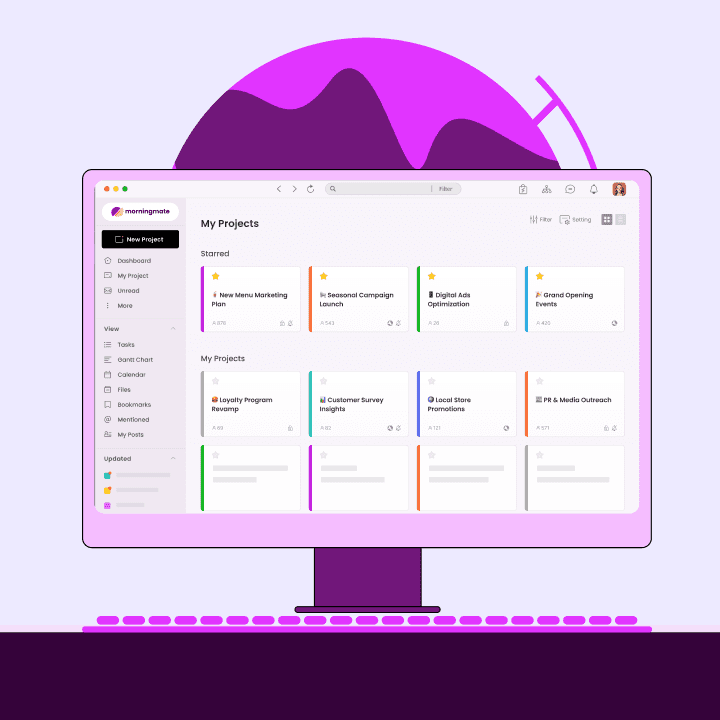
This is part of the reason tools like Morningmate have found traction with growing teams. Morningmate is a lightweight work management platform where tasks, updates, and conversations live in one shared workspace — built around a Feed view that feels familiar (think social media-style updates) and a built-in chat that works like the messaging apps your team already uses. Because communication and task management are in the same place, context doesn't get lost between systems. When someone closes out a task, the discussion thread that led to that outcome is right there alongside it.
How to Build a System That Handles Both
You don't need to overhaul everything at once. A practical approach is to layer knowledge management on top of your existing work management habits, starting with the highest-value moments.
Step 1: Identify Your Knowledge Gaps
Start by asking your team a simple question: what do you spend time searching for that should already be written down somewhere? Common answers include how-to processes, approval workflows, client communication guidelines, and recurring project checklists. These gaps are your starting point — not a comprehensive wiki overhaul.
Step 2: Build Documentation Into Your Work Workflow
Documentation fails when it's treated as a separate task. Instead, make it a natural part of completing work. A few practical ways to do this:
Add a "document learnings" step to every project close-out
Use task descriptions to capture not just what to do, but why and how
When a recurring question comes up in chat, turn the answer into a shared document immediately
Assign a rotating "knowledge owner" for each team or project
Step 3: Choose Tools That Don't Separate Context from Work
The best setup keeps context close to the work itself. When your task board is disconnected from your communication tool, and your communication tool is disconnected from your file storage, knowledge falls through the cracks at every handoff point.
Morningmate addresses this directly — its built-in file management and post-based Feed mean that documents, updates, and tasks live in the same shared workspace. For non-technical teams especially, this reduces friction significantly. You don't need to train people on three different platforms just to keep work and knowledge aligned.
A Practical Framework: The Knowledge Loop
Think of the relationship between work management and knowledge management as a loop, not a one-way street. Work generates knowledge. Knowledge improves how future work gets done. That loop only functions if you close it deliberately.
Here's a simple version of that loop for any team:
Plan — Use documented knowledge (SOPs, past project notes) to inform how you structure new work
Execute — Manage tasks, communicate updates, and coordinate in one place
Capture — After key milestones, document decisions, outcomes, and process changes
Share — Make that knowledge accessible to the whole team, not just the people who were in the room
Improve — Use captured knowledge to plan the next cycle better
This loop doesn't require a sophisticated tech stack. It requires consistent habits and a workspace that makes the handoff easy. McKinsey research on organizational performance consistently highlights that knowledge-sharing behaviors — not just knowledge-storing tools — are what differentiate high-performing teams from average ones.
Which One Should You Focus On First?
If your team is struggling with basic execution — missed deadlines, unclear ownership, duplicated effort — work management is the right starting point. You can't build useful knowledge on top of chaotic execution. Get the work structured first.
If your team has reasonable execution habits but keeps hitting the same problems repeatedly, reinventing solutions, or losing momentum when people leave — that's a knowledge management problem. The operational foundation is there; now you need to start building on it.
Most growing teams actually need both at once, just phased. Start with work management, build in light documentation habits, then gradually formalize your knowledge systems as your team scales. Morningmate's task management and Feed-based collaboration is designed specifically for this kind of gradual, lightweight approach — useful on day one without requiring a full implementation project before you can see any value.
The Bottom Line
Knowledge management and work management are not competing priorities — they're two sides of the same coin. Work management helps your team execute. Knowledge management helps your team learn. Together, they turn a group of capable people into an organization that genuinely gets better over time.
The teams that figure this out early — that build the habit of capturing what they know as they go — are the ones that scale without chaos. They onboard faster, make better decisions, and stop solving the same problems twice. That's not a technology outcome. It's a discipline one. But having the right workspace makes the discipline a whole lot easier to maintain.