Project Management

Institutional knowledge is everything your team has learned about how your company works — the workarounds, the decisions, the reasoning behind your processes. When that knowledge lives inside personal messenger apps and chat threads, it is invisible to anyone who wasn't in the conversation. It doesn't transfer. It doesn't scale. And as your team grows, the cost of losing it compounds fast.
If your team still relies on email or WhatsApp to coordinate work, you are not just dealing with scattered updates. You are actively eroding the organizational memory that makes a growing company function. Here is why that happens, what it costs you, and how to stop it before it becomes a serious problem.
Why Chat Feels Like Enough — Until It Isn't
Chat tools are fast, familiar, and low-friction. That is exactly why teams default to them for everything — including decisions that deserve a permanent record. When you're small, this works fine. Everyone was in the room (or the thread). Everyone knows the context.
But as companies grow past twenty, fifty, or a hundred people, that shared context disappears. New hires have no visibility into why things are done a certain way. Managers spend hours re-explaining decisions that were already made. Teams duplicate work because they can't find what was discussed before. Harvard Business Review has noted that collaborative overload — the cumulative drain of poorly organized communication — is one of the biggest hidden costs in modern organizations. Chat-first cultures accelerate this problem dramatically.
The Real Cost of Decisions That Live in Chat
Losing a conversation thread is annoying. Losing the institutional knowledge inside that thread is something much more serious. Here's what actually happens when decisions stay buried in chat:
Knowledge Walks Out the Door With People
When an employee leaves, they take everything they know with them — including every undocumented decision they made or participated in. If those decisions only existed in private messages or group chats they owned, that knowledge is gone. Gallup estimates that employee turnover costs US businesses over $1 trillion per year, and a significant portion of that cost is invisible: it's the time teams spend re-learning things the organization already figured out.
New Team Members Can't Get Up to Speed
Onboarding a new hire into a chat-heavy culture is painful. There is no single place to go to understand how decisions are made, what's been tried before, or what the current direction is on any given project. They have to ask someone — who then has to reconstruct context from memory or dig through months of messages. This slows down onboarding significantly and puts unnecessary pressure on your senior team.
Decisions Get Relitigated Over and Over
Without a traceable record of why a decision was made, teams relitigate the same questions repeatedly. A pricing strategy that was debated and settled six months ago gets brought up again — because no one can find the original reasoning. This wastes meeting time, creates friction between team members, and undermines trust in leadership.
Accountability Becomes Impossible to Track
When deliverables are assigned in a chat thread and followed up on in a different thread — or not at all — nobody has a clear picture of who owns what. Things fall through the gaps, and when they do, it's hard to understand where the breakdown happened. This is especially common in hybrid and remote teams where there's no daily in-person touchpoint to catch things before they slip.
What Institutional Knowledge Actually Looks Like
Before you can protect institutional knowledge, it helps to know what you're looking for. Most of it falls into three categories:
Decision records: Why did we choose this vendor? Why did we stop offering that service? Why do we handle client escalations this way?
Process knowledge: The real workflow — not the idealized one in a doc nobody reads, but how the team actually gets work done, including the workarounds.
Relationship and context knowledge: Who handles what, which stakeholders are involved in which decisions, and why certain team structures exist the way they do.
None of this belongs in a chat thread. All of it should be attached to the work it relates to — visible, searchable, and accessible to anyone who needs it.
The Shift You Need to Make: From Chat-First to Context-First
The solution isn't to stop using chat. Fast, informal communication has a real place in team collaboration. The shift is about making sure that decisions, context, and accountability live somewhere more permanent than a message thread.
This is the gap that tools like work management platforms are designed to close. When communication and task management happen in the same place, decisions don't get separated from the work they belong to. Context stays attached. History is searchable. New team members can actually see what happened and why.
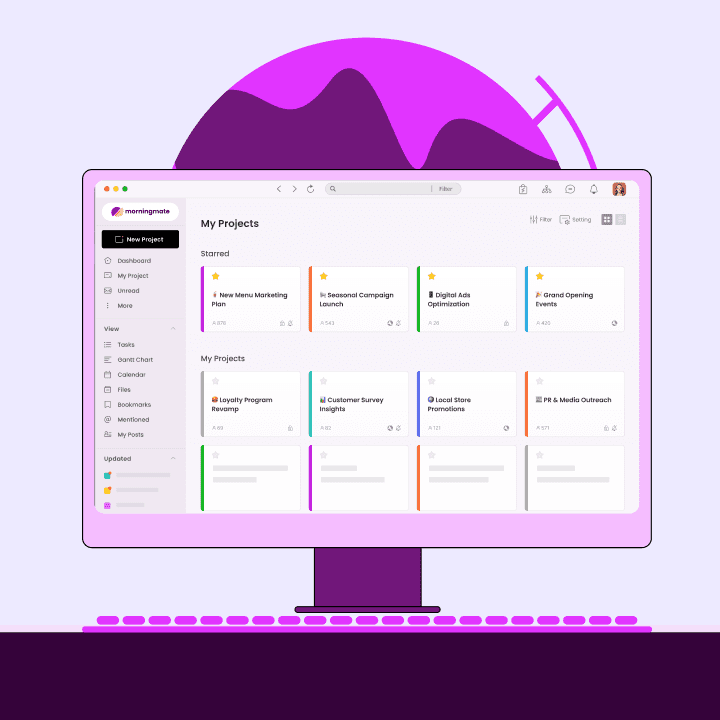
Morningmate, a lightweight work management tool used by over 550,000 teams, is built around exactly this idea. Its Feed view — which feels familiar to anyone who's used social media — lets teams post updates, decisions, and files directly to a shared workspace, organized by project or team. Unlike a chat thread that scrolls away into history, these posts stay accessible and are easy to find later. The context stays with the work, not buried in someone's inbox.
A Practical Framework for Preserving Institutional Knowledge
You don't need a massive documentation overhaul to start protecting your team's knowledge. You need a few clear habits that the whole team follows consistently.
Step 1: Make Decisions Visible, Not Just Verbal
Every meaningful decision — a strategic direction, a vendor choice, a process change — should be written down and attached to the relevant project or task. It doesn't have to be long. A two-sentence summary of what was decided and why is infinitely more useful than a conversation that happened on a call nobody recorded.
Step 2: Separate Urgent Chat From Permanent Context
Use chat for quick, time-sensitive exchanges. Use your work management workspace for anything that needs to be findable later. This distinction sounds simple, but it requires intentional team behavior — especially if your team is used to doing everything in WhatsApp or Slack. Helping your team make this switch is one of the highest-leverage moves you can make as a manager.
Step 3: Assign Ownership to Every Task
If a task doesn't have a named owner and a due date attached to it, it doesn't exist. Make this a non-negotiable. When accountability is visible — when everyone can see who owns what — institutional knowledge about roles and responsibilities becomes part of the system itself, not just unspoken tribal understanding.
Step 4: Build a Simple Onboarding Trail
For every major project or team area, maintain a short living document or pinned post that explains the current state, recent decisions, and who's responsible for what. This is your onboarding trail — the thing a new hire can read to get up to speed without having to pull ten people into meetings. Morningmate's file management and post features make this easy to maintain without creating a separate documentation system your team has to remember to update.
Step 5: Do a Monthly Knowledge Audit
Once a month, ask your team: what decisions did we make this month that aren't written down anywhere? What processes changed that nobody documented? It takes fifteen minutes. It prevents months of confusion later.
What This Looks Like in Practice
Imagine an operations lead at a 60-person hybrid company. Her team has been coordinating a vendor transition for three months — mostly over WhatsApp and email. When a new operations associate joins and needs to understand the current status, she has to sit through a 90-minute briefing, during which the ops lead realizes she can't remember several key decisions that were made in early conversations.
Now imagine the same scenario where that vendor transition was managed inside a shared workspace. Every decision — why they chose this vendor, what terms were negotiated, what the timeline looks like — is attached to the relevant tasks. The new associate reads through the project feed in 20 minutes and comes to the briefing with specific questions instead of starting from zero.
That's the difference institutional knowledge management makes. Not a perfect system — just a visible one. McKinsey research has found that improving knowledge sharing and communication within organizations can increase productivity by 20 to 25 percent. That number gets real fast when you think about how much time your team currently spends re-explaining things that should already be written down.
The Connection Between Knowledge and Growth
Growing companies often think their biggest challenge is hiring the right people or building the right product. But a quieter challenge runs underneath all of that: maintaining organizational coherence as you scale. When your team doubles in size, the informal knowledge-sharing that worked at twenty people breaks down completely.
The companies that scale well are the ones that treat knowledge as infrastructure — not something that happens naturally, but something that gets built, maintained, and protected. That means moving decisions out of chat and into systems where they can be found, referenced, and built upon.
Morningmate was built for exactly this kind of team — growing, often distributed, needing structure without complexity. Its task management, built-in chat, and shared Feed work together to keep communication and context in the same place, so your team isn't constantly playing catch-up. For teams who have been managing everything through personal messenger apps, it offers a familiar interface that doesn't require a steep learning curve to adopt. That matters when you're trying to actually change team behavior, not just add another tool nobody uses.
The next time a key decision gets made on a call, in a DM, or over lunch — ask yourself: will anyone be able to find this six months from now? If the answer is no, that's where your institutional knowledge is leaking. Start there.