Project Management

Managing a property management team is one of those roles that looks straightforward from the outside — until you're deep in it. You're coordinating maintenance crews, leasing agents, and admin staff across multiple properties, all while keeping landlords happy and tenants from leaving bad reviews. The operational complexity is real, and it compounds fast as your portfolio grows.
The biggest challenge most property management leaders face isn't finding good people — it's keeping them aligned. When your team is split across different sites, relying on WhatsApp groups and email chains for daily updates, things fall through the cracks. Maintenance requests go untracked. Lease renewals get missed. Nobody has a clear picture of what's actually happening across the portfolio.
This guide walks you through how to manage a property management team more effectively — from building clear accountability structures to setting up the right communication systems so your team can actually work together, not just stay busy.
Why Property Management Teams Break Down
Property management is inherently distributed work. Your team rarely sits in the same place at the same time. A leasing agent might be showing a unit while a maintenance tech is across town handling an emergency repair — and both need to loop back to the same manager by end of day.
According to Gallup's State of the Global Workplace report, teams with low engagement show significantly higher rates of errors and missed handoffs — a pattern that maps directly onto property management operations where coordination failures have real financial consequences, from costly vacancy days to unresolved maintenance that turns into legal liability.
The root cause is almost always the same: unclear ownership, scattered communication, and no single source of truth for who's doing what.
Build a Clear Team Structure First
Before you optimize workflows, you need to know who owns what. A property management team typically includes leasing agents, maintenance coordinators, property managers, and admin or accounting staff. Each role needs defined responsibilities — not just a job title.
Define Ownership by Property and Function
Assign each team member clear ownership — either by property, by function, or both. For example, one property manager might own all tenant communications for a specific building, while another handles vendor relationships portfolio-wide. When something goes wrong, ownership clarity is what stops problems from bouncing between people indefinitely.
Use a simple RACI framework (Responsible, Accountable, Consulted, Informed) to map out key processes like lease renewals, maintenance escalations, and move-out inspections. It sounds formal, but even a basic version written in a shared document eliminates enormous amounts of confusion.
Set Up Regular Sync Rhythms
Weekly team check-ins and brief daily standups keep your property management team aligned without eating the whole day. Keep weekly meetings focused on portfolio-level issues — vacancy rates, pending maintenance, upcoming renewals. Use daily standups (even async ones) for immediate updates.
Async communication is especially valuable for field-based teams. Not everyone can jump on a call at 9am when half your crew is already on a job site. Building async habits — short written updates, shared task boards — keeps information flowing without forcing everyone onto the same schedule.
Create Systems for Task and Maintenance Tracking
One of the fastest ways to improve how you manage a property management team is to get every task out of inboxes and messenger apps and into a shared system. When a tenant submits a maintenance request, that request needs to live somewhere everyone on the team can see — with a status, an assigned owner, and a deadline.
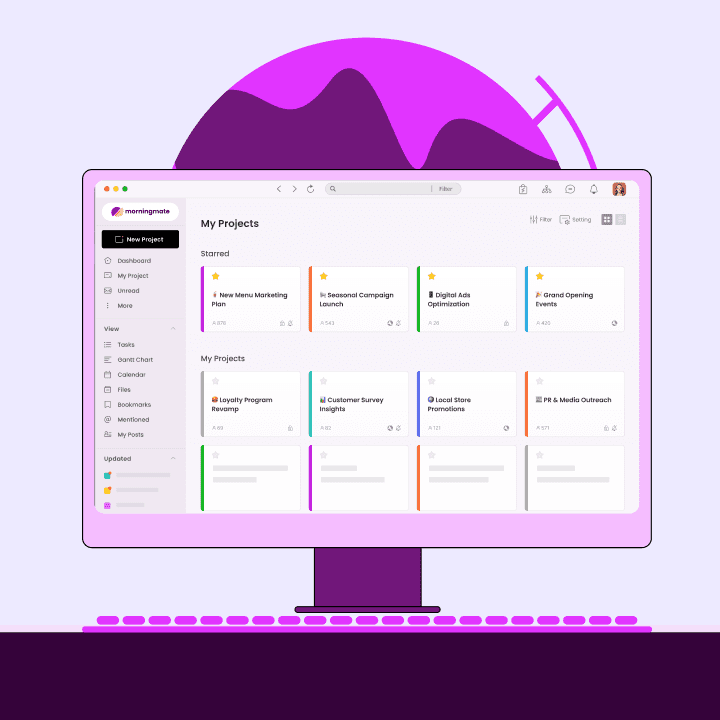
This is where a tool like Morningmate fits naturally into a property management operation. It's a lightweight work management platform built around task management and team communication — designed to replace the chaos of WhatsApp groups and email threads without the steep learning curve of complex project tools. For non-tech teams like maintenance crews or leasing staff, that simplicity matters.
Build a Maintenance Request Workflow
A reliable maintenance workflow looks like this:
Tenant submits a request (phone, email, or tenant portal)
Property manager logs it as a task with priority level, assigned tech, and target completion date
Maintenance tech updates the task status as they work (in progress, waiting on parts, completed)
Property manager reviews and closes the task, then follows up with the tenant
When this process lives in a shared system rather than a group chat, nothing gets lost. More importantly, you have a record — useful when tenants dispute whether something was addressed, or when you're reporting to property owners.
Track Lease Timelines Proactively
Lease renewals and move-outs are predictable — you know they're coming. Set up a recurring task or calendar reminder system so your leasing team is reaching out to tenants 60–90 days before lease end, not scrambling two weeks before vacancy. Proactive lease management is one of the highest-leverage habits in property management.
A shared task management board visible to your whole team makes it easy to see which renewals are in progress, which units are heading toward vacancy, and where someone needs to step in.
Fix How Your Team Communicates
Most property management teams communicate across too many channels — text messages, personal WhatsApp, email, phone calls, the occasional sticky note. The result is that important information lives in someone's private inbox instead of being visible to the whole team.
Research from Harvard Business Review consistently points to communication fragmentation as a leading cause of coordination failure in distributed teams — and property management teams are about as distributed as it gets.
Consolidating team communication into one place — separate from personal messaging apps — is not just a nice-to-have. It's operational hygiene. When a maintenance tech messages a vendor about a part, that conversation should be somewhere their manager can see it if needed. When a leasing agent updates the status of a unit showing, that update should be visible to the whole team, not buried in a thread.
Separate Channels for Different Types of Work
Structure your team's communication with intention. Consider organizing by property, by function, or by urgency level:
Property-specific channels for updates tied to a specific building or unit
Maintenance channel for urgent repair requests and vendor coordination
Leasing channel for unit availability, showings, and application updates
General team channel for announcements and non-urgent updates
Morningmate's built-in chat — which works with an interface familiar to anyone who's used WhatsApp — makes this kind of channel structure easy to adopt even for teams that aren't comfortable with complex software. You can set up dedicated spaces for each property or team function, keeping conversations organized without a steep learning curve.
Give Your Team Visibility — and Give Yourself Oversight
One of the underrated parts of learning how to manage a property management team is figuring out how to stay informed without micromanaging. You need visibility across your portfolio without becoming the bottleneck for every decision.
The answer is structured transparency. When your team logs tasks, updates statuses, and communicates in a shared workspace, you don't need to chase updates — you can see them. That shift from reactive check-ins to proactive visibility changes how you manage entirely.
Run Weekly Portfolio Reviews
A weekly review doesn't need to be a long meeting. It can be a 20-minute async review of your task board — checking open maintenance requests, upcoming lease deadlines, and any flagged issues. What matters is that it's consistent and that it gives you a real picture of portfolio health.
Use this review to catch problems early. A maintenance request that's been sitting open for five days is a flag. A unit with no leasing activity two weeks after listing is a flag. Catching these patterns early means you can act before they become bigger problems.
Build a Culture of Documentation
Property management runs on paper trails — lease agreements, inspection reports, vendor invoices, tenant correspondence. But beyond the legal documents, your team should also be documenting operational decisions and processes. When a new team member joins, they should be able to get up to speed without spending three weeks asking everyone how things work.
Store your SOPs, checklists, and key information somewhere centralized and searchable. Morningmate's file management and feed features let teams post updates, attach documents, and keep knowledge organized — so institutional knowledge doesn't live exclusively in one person's head or email account.
Develop Your People, Not Just Your Processes
Systems matter, but the people running them matter more. High turnover is a persistent challenge in property management, and it usually comes down to a few things: unclear expectations, poor communication from leadership, and feeling undervalued.
McKinsey research on workforce development highlights that employees who feel their growth is supported are significantly more likely to stay — and more likely to perform at a higher level while they do. That applies directly to property management teams, where experienced staff carry enormous operational knowledge that's costly to replace.
Set Clear Expectations and Give Regular Feedback
Every team member should know what good performance looks like in their role. For a maintenance tech, that might mean response time targets and tenant satisfaction scores. For a leasing agent, it could be showing-to-application conversion rates and days-on-market benchmarks. When expectations are clear, feedback becomes easier to give — and easier to receive.
Don't save feedback for annual reviews. Brief, regular check-ins — even 15 minutes every few weeks — keep people on track and signal that you're paying attention to their work. That consistency builds trust over time.
Invest in Cross-Training
In a small or mid-sized property management team, single points of failure are dangerous. If your only maintenance coordinator goes on leave, does anyone else know how to triage incoming requests? Cross-training doesn't mean everyone does everyone's job — it means enough people understand enough of each function to keep things moving.
Pair newer team members with experienced ones for a period. Document key processes so they're learnable. And use your team collaboration tools to make institutional knowledge accessible, not siloed.
A Quick Checklist for Property Management Team Managers
If you're looking for a practical starting point, work through this list and identify where your team has gaps:
Every team member has clearly defined ownership over specific properties or functions
Maintenance requests are tracked in a shared system, not a group chat
Lease renewal outreach starts 60–90 days before expiration
Team communication is organized by channel, not scattered across personal apps
You have a weekly rhythm for reviewing portfolio status
Key processes are documented and accessible to the whole team
Each team member knows what good performance looks like in their role
You have a cross-training plan so no single person is a critical dependency
Managing a property management team well isn't about having the most sophisticated tools or the most detailed processes. It's about building enough structure so your team can do their best work without everything running through you. Get the fundamentals right — clear ownership, shared visibility, consistent communication — and the complexity becomes manageable.