Project Management

At some point, every growing team hits the same wall. Work is scattered across email threads, WhatsApp groups, and half-forgotten spreadsheets. Someone asks for an update, and three people send three different answers. So the instinct kicks in: maybe we need another tool. But before you open another browser tab and start another free trial, it's worth asking a different question — do you actually need a new tool, or do you need a better workflow?
The answer, more often than not, is the latter. Most teams don't suffer from a shortage of software. They suffer from unclear ownership, inconsistent habits, and no agreed-upon way of working together. Adding another tool on top of that chaos usually just creates one more place where things get lost.
The good news is that you can build a team workflow that actually works — one that brings clarity, accountability, and consistency — without signing up for anything new. Here's how to do it.
Why Most Team Workflows Break Down
Before fixing a workflow, you need to understand why it failed in the first place. In most teams, the breakdown isn't dramatic. It's gradual — a slow drift from "we have a system" to "everyone kind of does their own thing."
Research from Harvard Business Review consistently shows that teams underperform not because of a lack of talent or tools, but because of poor coordination and unclear expectations. When people don't know who owns what, or where to find the latest update on a project, they improvise. And improvisation at scale becomes chaos.
Common signs your workflow is broken:
The same question gets asked in five different places
Deadlines slip because no one had full visibility
Work gets duplicated — or worse, dropped entirely
Updates live in someone's inbox or personal chat
Onboarding a new team member takes weeks because nothing is documented
Sound familiar? The fix isn't a new app. It's a set of agreements about how your team works.
Step 1 — Audit What You Already Have
Start by mapping out every tool and channel your team currently uses to communicate and manage work. Be honest. Include the unofficial ones — the WhatsApp group chat, the shared Google Doc that no one updates, the email thread that somehow became the source of truth for a major project.
Ask yourself three questions for each one:
What is this actually used for day-to-day?
Is the whole team using it, or just some people?
What information is getting lost or delayed here?
This audit often reveals something surprising: you don't have too few tools — you have too many, used inconsistently. The goal of this step is to consolidate, not add. Identify the one or two tools your team already uses most, and build your workflow around those.
Step 2 — Define Clear Ownership for Every Type of Work
One of the fastest ways to improve a team workflow without touching your tech stack is to get ruthlessly clear about ownership. Every task, project, and recurring responsibility needs a named owner — not a team, not a department, but a specific person.
This doesn't mean one person does everything. It means one person is accountable for making sure it gets done. The RACI model (Responsible, Accountable, Consulted, Informed) is a simple framework you can apply immediately without any new software — a quick shared document works fine.
A practical way to apply this:
List every recurring workflow your team runs (e.g., weekly reports, client onboarding, content publishing)
Assign a single owner to each
Document what "done" looks like for each workflow
Share this with the whole team so expectations are visible
When everyone knows who owns what, the number of "just checking in" messages drops dramatically. That alone can reclaim hours of collective focus time each week.
Step 3 — Create Communication Norms That Stick
Most workplace communication problems aren't about the tool — they're about the norms around using it. McKinsey research on organizational health has long pointed to communication clarity as one of the strongest predictors of team performance. Yet most teams never sit down to define how they want to communicate.
Here are a few norms worth establishing explicitly:
Separate Urgent From Non-Urgent
Decide which channel is for time-sensitive communication and which is for everything else. If your team uses chat for both, everything starts to feel urgent — and nothing gets the attention it deserves. For example: chat is for quick questions that need a response within the hour; everything project-related lives in your task management tool.
Set Response Time Expectations
This is especially important for remote or hybrid teams. Agreeing that non-urgent messages should be answered within 24 hours — and that not everything requires an immediate reply — reduces the anxiety that drives people to send the same message in five places.
Keep Updates Where the Work Lives
Progress updates should live next to the task or project they relate to — not in a separate chat message that disappears after two days. This is where tools like task management systems earn their keep, because they make context permanent and searchable.
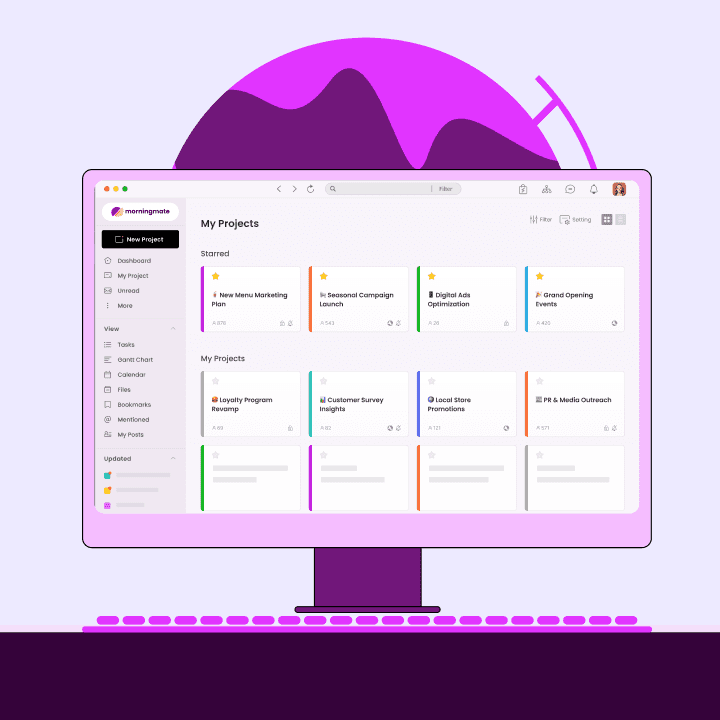
This is also where Morningmate becomes genuinely useful for teams already struggling with scattered updates. Morningmate is a lightweight work management tool that combines task management with a built-in chat — so conversations and work happen in the same place. The feed-style interface means updates are visible to the whole team without anyone having to ask for a status report.
Step 4 — Build a Simple Weekly Rhythm
A workflow isn't just about where work gets done — it's about when. Teams that work well together almost always have some kind of shared rhythm: a predictable cadence of check-ins, reviews, and planning moments that keep everyone aligned without requiring constant ad-hoc meetings.
You don't need a complex system. A simple weekly structure might look like this:
Monday: Each team member posts their priorities for the week (async, no meeting needed)
Wednesday: A brief mid-week check-in to surface blockers early
Friday: A short team update — what got done, what's carrying over, and any lessons worth sharing
The key is consistency, not complexity. A rhythm only works if everyone follows it, every week, without being reminded. Build it into your workflow documentation and revisit it quarterly to see if it still fits how your team works.
Step 5 — Document the Workflow So It Outlives Any One Person
Here's a test: if your best team member left tomorrow, how long would it take for things to fall apart? If the answer is "immediately," you have a knowledge management problem — and it's one that no new tool will fix if the underlying knowledge isn't captured anywhere.
Gallup's research on employee engagement highlights that teams where roles and responsibilities are clearly defined consistently outperform those where expectations are ambiguous. Documentation is what makes clarity permanent.
Start small. For each major workflow, document:
The steps involved, in order
Who is responsible for each step
Where the relevant files or information live
What the output looks like when it's done correctly
This doesn't have to be a formal 10-page document. A simple shared note or a pinned post in your team workspace works perfectly. The point is that anyone — including someone brand new to the team — can follow it without needing to ask five people for help.
What to Do When Your Current Tools Genuinely Aren't Enough
Sometimes, after doing all of the above, you realize that your existing stack has a real gap. The most common one: your communication channel and your work management system are completely disconnected, so context keeps getting lost between the two.
In that case, the answer isn't to add another tool — it's to replace two fragmented ones with one that does both. That's the exact problem Morningmate was built to solve. Rather than maintaining a separate chat app and a separate project tool, Morningmate brings them together in a single workspace. Teams can manage tasks, share files, and communicate — all without switching tabs or losing context. The interface is designed to feel familiar, closer to WhatsApp or a social media feed than a complex enterprise platform, which means adoption tends to be much faster even for non-technical teams.
If you're considering a consolidation rather than an addition, that's a different — and much more defensible — decision.
The Workflow Comes First, The Tool Comes Second
The teams that collaborate best aren't necessarily using the most sophisticated software. They've agreed on how they work, who owns what, and where information lives. That agreement is the workflow — and it exists in the heads and habits of the people on your team, not in any app.
Start there. Audit what you have, define ownership, set communication norms, build a weekly rhythm, and document everything that matters. Do all of that, and you may find that the tool you already have — or one simple replacement — is more than enough to get your team working the way you've always wanted.
The next time someone suggests buying another tool to fix a collaboration problem, ask the better question first: do we have a process problem or a software problem? Most of the time, it's the former. And that's entirely within your power to fix — starting today.