Project Management

Running an event — whether it's a corporate conference, a product launch, or a multi-day festival — depends almost entirely on how well your team communicates. Missed briefings, unclear task ownership, and last-minute updates buried in WhatsApp threads are the kinds of problems that don't just cause frustration. They cause events to fall apart in real time, in front of real audiences.
Event management teams face a unique communication challenge: they're often distributed across vendors, venues, and departments, working under tight deadlines where a single dropped message can ripple into something much larger. The right communication tools don't just keep people informed — they keep everyone coordinated, accountable, and moving in the same direction.
If your team still relies on email chains and personal messenger apps to coordinate events, you're not alone — but you're likely leaving a lot of room for costly errors. Here's what modern event management team communication actually looks like, and which tools are worth your attention.
Why Communication Breaks Down in Event Management Teams
Event teams are cross-functional by nature. You have logistics coordinators, AV technicians, marketing leads, catering vendors, and on-site staff — all needing different information at different times. When that information lives across email inboxes, personal phones, and scattered spreadsheets, things fall through the cracks fast.
Research from Harvard Business Review has shown that collaborative work demands have increased dramatically, yet most teams lack the structured systems to handle that volume without burning people out or losing critical context. In event environments where timelines compress and stakes are high, this gap becomes even more damaging.
Common communication breakdowns in event teams include:
Updates shared in personal WhatsApp groups that external vendors can't access
Task ownership that exists only in someone's head — or in a thread nobody can find
Version confusion around run sheets, seating charts, or briefing documents
No single source of truth for what's confirmed versus still pending
Real-time coordination on event day relying entirely on phone calls
What to Look for in Event Management Team Communication Tools
Not every communication tool is built for the pace and structure that event management demands. Before evaluating specific options, it helps to know what capabilities actually matter for your team's workflow.
Centralized Task and Update Management
Your tool needs to connect conversations to action items. A chat message saying "the AV equipment arrives Thursday" is only useful if it's also attached to a task someone owns, with a deadline and a status. Without that link, information stays loose and accountability stays vague.
Look for tools that let you create tasks directly from conversations or announcements, assign them to team members, and track progress without switching between five different apps.
Real-Time Messaging with Context
On-the-day event coordination moves fast. Your team needs a chat tool that's immediate but also organized — not a personal messenger app where important instructions disappear under casual conversation. Channels or threads organized by topic, team, or event phase make it far easier to find the right information when you need it most.
File and Document Access
Event teams work with a constant flow of documents: run sheets, vendor contracts, floor plans, branding assets, scripts. Your communication tool should make these easy to share, find, and update without hunting through email attachments or asking "which version is current?" in a group chat.
Accessibility for Non-Tech Team Members
Event teams often include staff and vendors who aren't particularly tech-savvy — catering managers, decorators, on-site crew. If your communication tool requires training or has a steep learning curve, adoption will be patchy and your coordination will suffer. The best tools feel immediately familiar, even to first-time users.
The Best Communication Tools for Event Management Teams
Here's a practical breakdown of the tools most commonly used by event teams, and where each one fits best.
Morningmate — For Teams That Need Everything in One Place
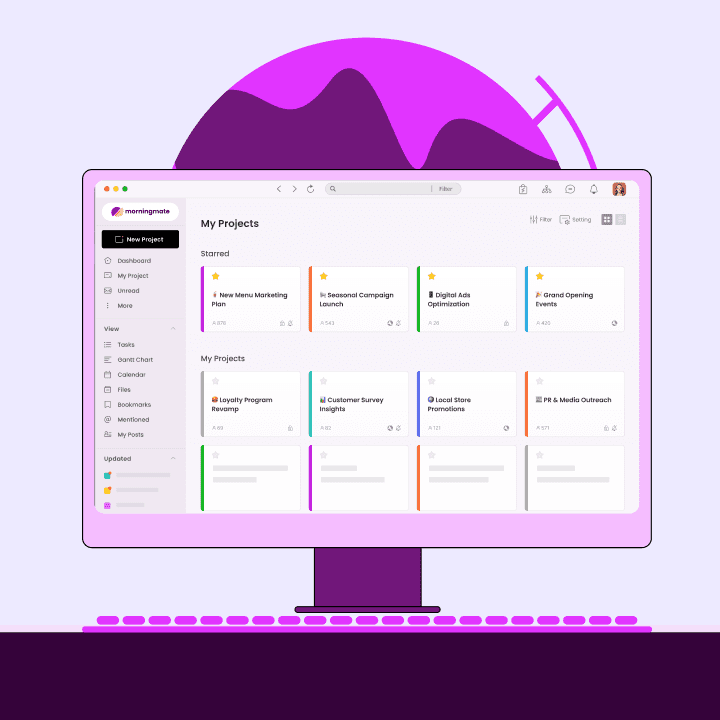
Morningmate is a lightweight work management tool that combines task management, built-in team chat, and file sharing into a single, easy-to-use workspace. For event teams, the combination matters: you can post an update about a venue change in the Feed (which looks and feels like a familiar social media interface), attach the revised floor plan, and create follow-up tasks — all without leaving the platform.
The built-in chat works similarly to WhatsApp, which means even less tech-comfortable team members can get up to speed immediately. But unlike personal messenger apps, conversations in Morningmate are organized by project or team, so your event logistics don't get mixed up with unrelated chatter. For event managers dealing with multiple workstreams — venue, catering, marketing, on-site crew — this kind of structured clarity is genuinely valuable.
You can explore how structured team communication tools compare if you're still deciding on the right fit for your organization.
Slack — For Larger Teams With Complex Integrations
Slack is a strong choice for event teams embedded within larger organizations that already use a range of software tools. Its channel structure works well for organizing communication by event phase or department, and its app integrations are extensive. The tradeoff is cost and complexity — Slack can become noisy quickly, and without disciplined channel management, important information still gets lost.
Asana or Monday.com — For Project-Heavy Event Operations
If your event management involves deeply complex project timelines with multiple dependencies, dedicated project management tools like Asana or Monday.com offer powerful planning features. However, they're heavier tools with steeper learning curves, and they lack native real-time chat — meaning your team will still need a separate messaging solution running alongside them.
WhatsApp — Convenient but Not Built for Work
Many event teams still default to WhatsApp for day-of communication, and while it's fast and familiar, it creates real problems. There's no task management, no file organization, no way to separate professional and personal communication, and no audit trail if something goes wrong. It works fine for a quick heads-up — but it shouldn't be the backbone of your event coordination.
How to Set Up Communication for an Event Team — A Practical Framework
Choosing the right tool is only part of the challenge. How you structure communication within that tool matters just as much. Here's a simple framework that works well for most event teams.
Step 1: Create a Central Event Workspace
Before any planning begins, set up a dedicated workspace or project for the event. Every team member — internal staff and key external vendors — should be added here. This becomes the single source of truth for all updates, documents, and tasks related to the event.
Step 2: Organize by Workstream, Not by Person
Create separate channels or sections for each major workstream: Logistics, Marketing and Promotions, On-Site Operations, Vendor Coordination, and so on. Organizing by workstream rather than by individual means that when someone is sick or unavailable, the relevant information is still accessible to whoever steps in.
Step 3: Link Every Update to a Task
Enforce a simple habit: every update that requires action should have a corresponding task with an owner and a deadline. This is where tools like Morningmate add real value — the platform lets you create and assign tasks directly within your communication feed, so nothing stays as just a message.
Step 4: Establish a Daily Check-In Rhythm
As the event approaches, build in a structured daily check-in — either a short async post or a brief stand-up — where each workstream lead shares what's done, what's pending, and what's blocked. This creates visibility across the full team without requiring endless meetings. You can read more about making async communication work for distributed teams if your event team spans multiple locations.
Step 5: Create an Event-Day Communication Protocol
Define in advance how your team will communicate on the day itself. Who has authority to make last-minute changes? Which channel gets used for urgent issues? Who is responsible for communicating with external vendors on the ground? Getting this agreed ahead of time prevents a chaotic free-for-all when the pressure is highest.
Trends Shaping Event Team Communication in 2026
Event management is evolving quickly, and the communication tools supporting it are evolving too. A few trends are worth paying attention to as you build out your team's toolkit.
Hybrid Events Are Raising the Communication Bar
As hybrid events — those with both in-person and virtual components — have become standard, coordinating teams across physical and digital spaces has become more complex. McKinsey research on hybrid work consistently highlights that teams without structured communication systems struggle disproportionately with coordination across locations. Event teams managing hybrid formats need tools that work equally well for remote coordinators and on-site staff.
Smaller Teams Are Running Bigger Events
Leaner event teams are becoming the norm, with more reliance on freelancers, agencies, and contractors brought in per event. This makes onboarding speed critical — your communication tool needs to be something a new collaborator can understand and contribute within hours, not days. Overly complex platforms with long setup times simply don't fit this model.
The Shift Away from Personal Messaging Apps for Work
Gallup's ongoing employee engagement research points to clarity of communication as a key driver of team effectiveness. Organizations across industries are increasingly recognizing that relying on personal apps like WhatsApp for work coordination creates accountability gaps, data security risks, and burnout from the blurring of work and personal life. Purpose-built tools that keep work communication structured and separate are quickly replacing personal messenger apps in professional event environments.
Choosing the Right Tool for Your Event Team
The right communication tool for your event team ultimately depends on your team's size, technical comfort level, and the complexity of your events. But a few principles hold across almost every situation.
Prioritize tools your whole team — not just tech-savvy members — will actually use consistently
Choose a platform that connects communication to task management, so updates translate into action
Make sure files and documents live in the same workspace as your conversations
Avoid tools that require extensive setup or training to get value from
Look for something that works for both the planning phase and the fast-paced event day itself
For many event teams — especially those at growing companies or agencies managing multiple events at once — a tool like Morningmate fits this description well. It's built to replace the scattered combination of email and personal messenger apps with one organized workspace that anyone can use from day one, without a steep learning curve or an expensive enterprise contract. Used by over 550,000 teams worldwide, it's the kind of tool that scales from a 10-person team managing a single annual conference to a larger operations team running events across multiple locations year-round.
If you're evaluating your options, take a look at the best collaboration tools for remote and hybrid teams for a broader comparison. The goal isn't to find the most powerful tool on the market — it's to find the one your team will actually use, consistently, when it matters most.