Project Management

Task management is hard enough on its own — but delegating it to someone else? That can feel almost impossible. If you've ever caught yourself thinking "it'll just be faster if I do it myself," you're not alone. Most managers and team leads feel this pull, and it's one of the most common blockers to building a truly scalable team. The instinct to hold on to work isn't a personality flaw. It's a deeply human response rooted in how we think about trust, quality, and control.
The problem is that this instinct comes with a real cost. When you hold on to every task, you become the bottleneck. Your team doesn't grow. Your own work suffers. And the team coordination that should be flowing smoothly starts to stall at your desk. Task tracking becomes reactive rather than proactive, and before long, your entire workflow is organized around what you personally have bandwidth for — not what the team is actually capable of.
So why does delegating work feel harder than just doing it yourself? And more importantly, how do you get past it? Let's dig into the real reasons behind delegation resistance — and what you can do to build a task workflow that actually works for your whole team.
The Psychology Behind "I'll Just Do It Myself"
Delegation isn't just a skills problem — it's a mindset problem. According to Harvard Business Review, many managers struggle to delegate because they lack confidence in their team members, feel personally accountable for outcomes, or simply don't know how to hand off work clearly. Sound familiar?
There's also the "competence gap" illusion — the belief that no one else can do the task as well as you can. In some cases that might be true in the short term. But holding onto work to avoid a temporary quality dip often creates a much bigger long-term problem: a team that never develops the skills to support you.
Then there's the overhead problem. Explaining a task, setting context, answering follow-up questions, reviewing the work — for a simple task, this can genuinely take longer than doing it yourself. This is especially true when your task coordination system is fragmented: instructions buried in emails, updates scattered across chat apps, and no clear way to track what's been done.
The Real Reasons Task Management Breaks Down When You Delegate
Delegation fails most often not because people are bad at communicating, but because the systems supporting task management are weak. Here are the most common reasons task workflow falls apart the moment you try to hand something off:
No single source of truth: When task tracking lives across email threads, WhatsApp groups, and sticky notes, the person you've delegated to has no clear reference point for what's expected.
Unclear ownership: If it's not obvious who is responsible for what, work either gets duplicated or quietly falls through the cracks.
No visibility for managers: Without a way to see progress at a glance, managers feel anxious and end up micromanaging — or doing the task themselves just to feel in control.
Poor async communication: When your team is distributed or hybrid, real-time check-ins aren't always possible. Task coordination needs to work without requiring everyone to be online at the same time.
Feedback loops are slow: If the person doing the task can't easily ask questions or flag blockers, small issues snowball into big ones.
Delegation Challenge | Root Cause | Impact on Team |
|---|---|---|
No clear task ownership | Verbal handoffs only | Tasks missed or duplicated |
Manager has no visibility | No task tracking system | Micromanagement or dropped balls |
Context lost in handoff | Info scattered across tools | Rework and delays |
Slow feedback loops | No built-in communication channel | Blockers go unresolved |
How Much Time Poor Task Management Actually Costs You
The overhead of bad delegation isn't just frustrating — it's quantifiable. Gallup research consistently shows that managers who delegate effectively generate significantly higher revenue and team performance than those who don't. And yet the systems most teams rely on — email, WhatsApp, verbal check-ins — actively make delegation harder by spreading information across disconnected places.
Time Wasted Weekly on Poor Delegation Practices (Hours per Manager)
7 hrs
Email-based teams
5 hrs
Chat-only tools
2 hrs
Structured task tracking
Fig 1: Estimated weekly time lost to delegation friction by communication method (illustrative)
A Practical Framework for Task Management When Delegating
Good delegation isn't about letting go and hoping for the best. It's about building a task workflow that gives both you and your team member the structure to succeed. Here's a simple four-step framework you can apply immediately:
1. Define the task with full context
Don't just assign a task — write it down with clear context. What's the goal? What does "done" look like? What decisions can the person make independently, and when should they loop you in? A well-written task brief eliminates most follow-up questions before they happen. This is where having a solid task management tool pays off immediately.
2. Assign clear ownership and a deadline
Every task should have one owner, not a group. When everyone is responsible, no one is. Pair the assignment with a realistic deadline and make sure both you and the assignee can see the due date clearly — not buried in a chat message that scrolls away in hours.
3. Build in visible progress tracking
This is where most delegation falls apart. If you can't see progress without sending a check-in message, you'll either micromanage or lose track entirely. Your task tracking system needs to show status at a glance — not require a meeting to find out where things stand.
4. Keep communication attached to the task
When questions or updates happen in a separate chat thread, context gets lost. The best task coordination happens when conversation and task tracking live in the same place. That way, anyone joining the project later can catch up instantly without needing a briefing call.
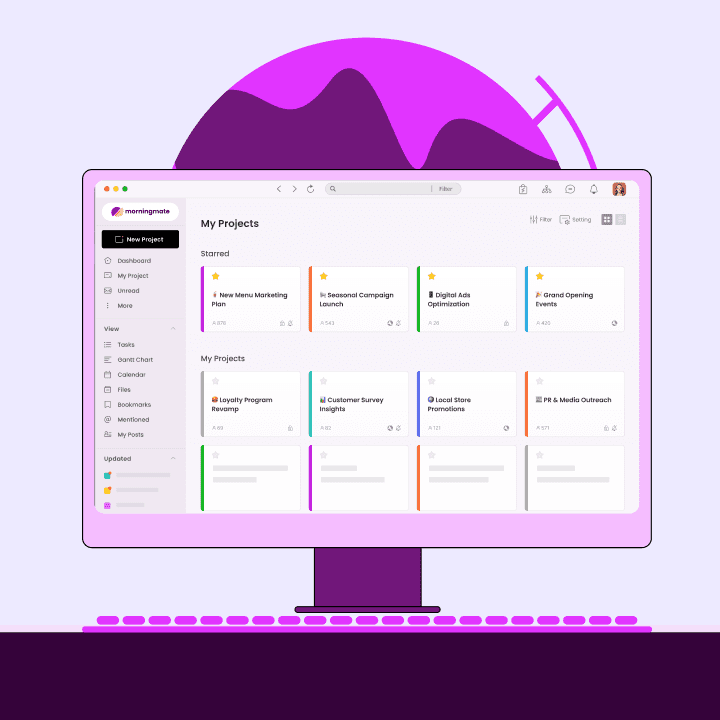
This is exactly the kind of workflow that tools like Morningmate are built to support. Morningmate is a lightweight work management tool that combines task management with built-in chat — so your team can discuss, assign, and track work in one place, without switching between apps. Unlike heavier tools like Jira or Asana, it's simple enough that even non-technical teams can pick it up in minutes.
Task Management Tools: What Actually Supports Delegation?
Not all task tracking tools are created equal when it comes to supporting real delegation. Some are so complex they create more friction than they solve. Others are too lightweight to give managers the visibility they need. The right tool sits in the middle: structured enough to keep everyone aligned, simple enough that your team actually uses it.
Asana's State of Work report found that workers spend a significant portion of their week on "work about work" — status updates, searching for information, following up on tasks — rather than the actual work itself. Better task coordination tools directly reduce this overhead.
Feature Needed for Delegation | Email + Chat Apps | Morningmate |
|---|---|---|
Assigned task ownership | Manual, easily missed | Built-in assignee field |
Progress visibility | Requires manual check-in | Real-time status view |
Communication attached to task | Scattered across apps | Built-in chat per task |
Ease of adoption | High (already familiar) | High (social-media-style feed) |
File management | Attachments buried in threads | Centralized file management |
Building a Team Culture Where Task Management Actually Flows
Tools matter, but culture matters more. Even the best task workflow will break down if your team doesn't feel safe flagging blockers, asking questions, or pushing back on unrealistic deadlines. Delegation works when people feel accountable without feeling afraid.
Here's what that looks like in practice:
Normalize status updates as a habit, not a sign of failure. When task tracking is a regular rhythm — not just something that happens when things go wrong — people are more honest about where they're stuck.
Celebrate completed delegated work publicly. When your team sees that handing off work leads to recognition for the person who did it, trust in the system builds quickly.
Review your own delegation rate. Are you actually handing off work, or just saying you will? Weekly check-ins on your own task management habits can reveal patterns you didn't know were there.
Create a shared space for task coordination. When your whole team can see what's in progress, what's done, and what's blocked, you stop needing to ask for updates — they're just visible.
Morningmate's Feed view — which looks and feels like a social media timeline — makes it easy for teams to share updates, post task progress, and keep everyone in the loop without scheduling another meeting. Over 550,000 teams use it to replace the scattered updates of email and WhatsApp with one organized, searchable workspace. You can learn more about making async communication work for your team in our related guide.
Task Management After Delegation: Tracking Without Micromanaging
One of the biggest fears managers have about delegating is losing visibility. And that fear is valid — but it's a systems problem, not a people problem. When your task tracking gives you real-time visibility into status, deadlines, and blockers, you don't need to hover. You can trust the process because the process is transparent.
Think of it like a dashboard. You don't need to personally drive every car to know which ones are running. You just need to be able to see the dashboard. Good task management tools give you exactly that — without requiring your team to send you constant updates just to keep you informed.
Manager Confidence in Delegation Before vs. After Structured Task Tracking Adoption (%)
31%
Before (no system)
58%
After (basic tools)
82%
After (full task coordination)
Fig 2: Manager confidence in delegating improves significantly with structured task management systems (illustrative)
Start Small: Your First Step Toward Better Task Management and Delegation
You don't need to overhaul your entire workflow overnight. Task management gets better incrementally, and so does your ability to delegate. Start with one task this week that you'd normally do yourself — and hand it off properly. Write it down. Assign it clearly. Set a deadline. Make it visible.
Notice what happens. Most of the time, the task gets done. And often, it gets done in a way you didn't expect — which is actually a good sign. It means your team member brought their own thinking to it. That's what healthy task workflow looks like in action.
If your current tools are making task coordination harder than it needs to be — if you're still sending task instructions over WhatsApp or chasing updates via email — it might be time to look at a dedicated work management platform. Tools like Morningmate are specifically designed to make task management simple for every kind of team, not just developers or technical users. The built-in chat means your team doesn't need a separate app for communication, and the familiar feed-style interface means adoption is fast. You can explore more about building team task management habits in our related post.
Delegation stops feeling impossible when your task tracking system removes the friction. The goal isn't to do less — it's to lead more. And that starts with trusting your team enough to give them a real shot, backed by the right task management tools to make success visible for everyone.