Project Management

If your team is still juggling spreadsheets, email chains, and sticky notes to track who's doing what — you already know the frustration. Work gets duplicated, deadlines get missed, and nobody has a clear picture of where things stand. Cloud-based planning software exists to solve exactly that problem.
At its core, cloud-based planning software is a digital tool hosted on remote servers that lets teams plan, assign, and track work from anywhere — without installing anything or maintaining local infrastructure. Because everything lives online, every team member sees the same real-time information, whether they're in the office, at home, or on the other side of the world.
The shift toward these tools isn't just a trend driven by remote work hype. It reflects a fundamental change in how modern teams operate. Work is no longer linear, confined to one office or one time zone. Your planning tools need to match that reality.
How Cloud-Based Planning Software Actually Works
Traditional planning tools — think desktop project management software or shared Excel files — require manual updates and constant back-and-forth to keep everyone in sync. Cloud-based planning software replaces that model with a single, always-updated workspace that everyone accesses through a browser or app.
When someone updates a task status, adds a comment, or uploads a file, that change is instantly visible to the entire team. There's no "latest version" confusion, no emailing attachments back and forth, and no waiting for someone to push an update to a shared drive.
The Infrastructure Behind the Tool
Cloud-based software runs on servers managed by the software provider — usually through platforms like AWS, Google Cloud, or Microsoft Azure. This means your team gets enterprise-level reliability and security without your IT team having to manage it. Updates, patches, and new features roll out automatically.
For small and mid-sized teams especially, this removes a massive operational burden. You focus on the work, not on maintaining the tools that support it.
Why Teams Are Moving to Cloud-Based Planning in 2026
The adoption numbers tell a clear story. According to Gartner, worldwide cloud spending continues to grow year over year as organizations prioritize flexibility and remote accessibility in their technology stacks. Planning and collaboration tools are among the fastest-growing categories.
Beyond the numbers, there are practical reasons teams make the switch. Here are the most common ones:
Real-time visibility: Managers and team leads can see exactly where every project stands without scheduling a status meeting.
Remote and hybrid compatibility: Whether your team is fully distributed or split between office and home, everyone works from the same source of truth.
Easier onboarding: Most modern cloud tools are designed to be intuitive — no training courses required to get a new hire up to speed.
Scalability: As your team grows, cloud tools scale with you. You add users, not servers.
Reduced IT overhead: No installations, no version mismatches, no server maintenance.
Harvard Business Review has noted that one of the biggest friction points for remote teams is the lack of shared context — people working without knowing what others are doing or why decisions were made. Cloud-based planning software directly addresses this by making work and communication visible to everyone involved.
Key Features to Look for in Cloud-Based Planning Software
Not all cloud-based planning tools are built the same. Some are heavy, complex platforms designed for enterprise software teams. Others are lean and focused on getting work organized without a steep learning curve. Before choosing one, it helps to know what features actually matter for your team's day-to-day work.
Task Management
This is the foundation of any planning tool. You need to be able to create tasks, assign them to the right people, set deadlines, and track their progress. Look for features like task dependencies, priority labels, and clear status indicators so nothing falls through the cracks.
A good task management system also gives managers a bird's-eye view of the team's workload — not just what's due, but what's in progress and what might be at risk.
Built-In Communication
Here's where many teams run into trouble: they use one tool for planning and a completely different app for communication. Work decisions get made over WhatsApp, context gets lost, and the planning tool becomes outdated the moment anyone switches to chat.
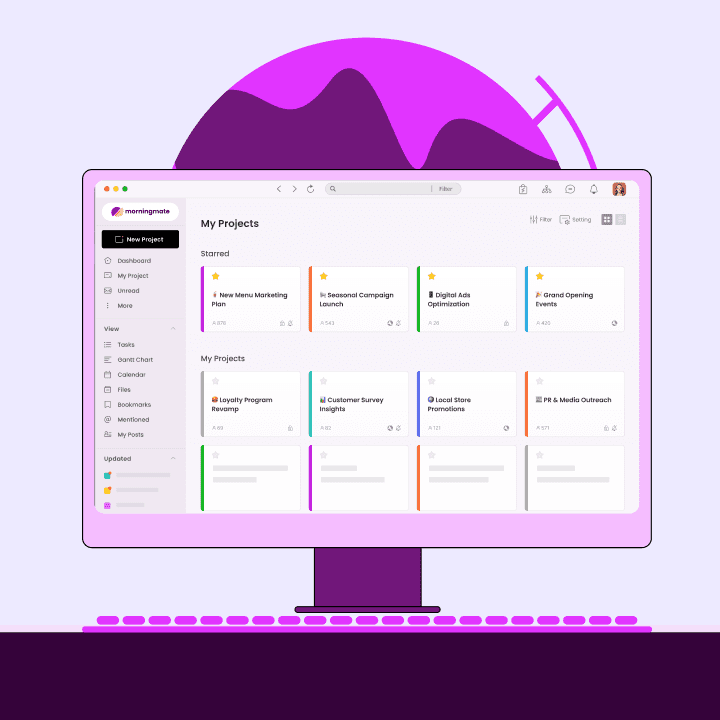
The better approach is a tool that connects communication directly to work. Morningmate, for example, is a work management platform that combines task management with a built-in chat — similar in feel to WhatsApp, so it's immediately familiar to anyone on your team, technical or not. Conversations stay tied to the work they're about, which means no more hunting through message threads for a decision someone made three weeks ago.
File Management
Every planning tool should make it easy to attach, find, and share files without leaving the platform. When files live alongside the tasks and conversations they belong to, your team spends less time searching and more time doing.
A View That Matches How Your Team Thinks
Some teams think in lists. Others work better with a visual board or a timeline. The best cloud-based planning tools offer multiple views so people can organize work in the way that makes sense to them. Morningmate takes an interesting approach here — its Feed view displays work updates in a format that looks like a social media feed, which makes it easy for non-technical teams to stay on top of what's happening without learning a new mental model.
Cloud-Based Planning vs. Traditional Tools: A Practical Comparison
If you're still on the fence about switching, it helps to put the two approaches side by side.
The gap in productivity between teams using integrated cloud tools and those relying on email and spreadsheets is significant. McKinsey research has consistently shown that improving communication and collaboration tools is one of the highest-leverage investments a team can make — reducing time wasted on coordination and freeing people to focus on actual output.
Traditional Tools | Cloud-Based Planning Software |
|---|---|
Files stored locally or on shared drives | Everything stored and synced in the cloud |
Manual updates and version control | Real-time updates visible to the whole team |
Separate tools for planning and communication | Integrated workspace for both |
Limited to office or VPN access | Accessible from any device, anywhere |
IT team manages updates and maintenance | Vendor handles all infrastructure |
Who Benefits Most from Cloud-Based Planning Software
The honest answer is: almost any team that does coordinated work. But some situations make the case more urgently than others.
Remote and Hybrid Teams
When your team isn't in the same room, you lose the informal alignment that happens naturally in an office. Cloud-based planning tools replace those hallway conversations with structured, visible workflows. Everyone knows what's happening, what they're responsible for, and how their work connects to the bigger picture.
Growing Companies Without Formal Processes
When a company is small, informal communication works. Once you cross a certain threshold — usually somewhere between 15 and 30 people — the informal approach starts to break down. Decisions get made without the right people knowing, work gets duplicated, and accountability becomes fuzzy.
Cloud-based planning software gives growing teams the structure they need without forcing them to adopt enterprise-level complexity. Tools like Morningmate are specifically built for this space — powerful enough to manage cross-team work at scale, but simple enough that a non-technical operations team can pick it up and run with it from day one.
Teams Still Relying on Email and Personal Messaging Apps
If your team's main coordination happens over Gmail threads or a WhatsApp group, you already know the pain points. Important updates get buried, new team members have no way to catch up on context, and it's almost impossible to track who agreed to do what. Moving to a dedicated cloud-based planning tool solves this not by adding complexity, but by giving scattered conversations a proper home.
This is one of the core problems Morningmate was designed to address — replacing the chaos of email and personal messenger apps with one organized workspace that doesn't require a technical team to set up or maintain.
How to Choose the Right Cloud-Based Planning Tool for Your Team
With dozens of options on the market, the choice can feel overwhelming. Here's a simple framework to narrow it down:
Start with your team's biggest pain point. Is it task visibility? Communication? File chaos? The right tool solves your actual problem, not a theoretical one.
Consider your team's technical comfort level. A powerful tool nobody uses is worse than a simple tool everyone adopts. If your team includes non-technical members, prioritize ease of use.
Look for integrated communication. Separate planning and chat tools create silos. Find a platform where both live together.
Check for mobile accessibility. Your team should be able to check tasks and updates from their phone without a degraded experience.
Test it with a real project. Don't evaluate a tool in a vacuum. Run a short pilot with an actual project your team is working on and see how it fits your workflow.
Making the Switch: What to Expect
Switching to cloud-based planning software doesn't have to be a big-bang migration. The most successful transitions happen gradually, starting with one team or one project type before rolling out more broadly.
The first few weeks usually involve some habit change — getting people to log tasks in the tool instead of sending an email, or posting updates in the platform instead of a group chat. That friction is normal and temporary. Once the team sees that the tool actually reduces the noise in their day, adoption tends to accelerate on its own.
The key is to make the tool the path of least resistance. If your planning software is easier to use than email, people will use it. That's the bar worth setting — and it's entirely achievable with the right tool. For teams looking to improve communication across remote or hybrid setups, getting the tooling right is the first and most important step.