Project Management

Something shifted quietly over the last few years. Teams stopped waiting for Monday morning stand-ups to move work forward. Decisions started getting made in shared documents at 11pm. Projects progressed while half the team slept. If that sounds familiar, you're already living the reality of asynchronous work — and the teams doing it well are pulling ahead.
Managing projects across time zones used to mean exhausting scheduling gymnastics — someone always had to join at an unreasonable hour, and half the meeting was spent recapping context for people who missed the last one. Asynchronous work flips that model. Instead of syncing people, you sync information. Instead of real-time presence, you build systems that let work move forward without anyone waiting on anyone else.
This isn't just a remote work trend. It's becoming the default operating mode for ambitious teams. Harvard Business Review has argued that asynchronous communication is essential to protecting deep work — the kind of focused, high-quality output that constant meetings actively destroy. The question isn't whether async is worth adopting. It's how to do it without losing the coordination and visibility your team needs.
Why Async Work Is Gaining Ground Fast
The numbers tell a clear story. Gallup research consistently shows that flexible, location-independent work arrangements are among the top factors employees consider when evaluating job opportunities. For companies trying to hire across borders, async isn't just a productivity strategy — it's a talent strategy.
At the same time, meeting culture is costing companies more than most leaders realize. When every decision requires a call, you're not just losing hours — you're creating bottlenecks. A developer in Singapore can't move forward until a product manager in London wakes up. A sales update sits in someone's inbox until the weekly sync. Work stalls not because people aren't working, but because the system requires real-time participation to function.
Async removes those bottlenecks. It gives people the ability to contribute on their own schedule while keeping the whole team aligned through shared context, documented decisions, and structured updates.
The Real Challenge: Coordination Without Chaos
Here's the part nobody talks about enough. Async work doesn't fail because people can't work independently. It fails because the team loses visibility. You stop knowing who's working on what. Updates get buried in email threads. Questions go unanswered for 18 hours because nobody knew they were asked. The tool that was supposed to reduce meetings ends up spawning more of them just to re-establish what's happening.
The solution isn't more discipline — it's better structure. Async work needs a home: a single place where tasks live, updates are visible, and nothing important gets lost in someone's personal WhatsApp or inbox.
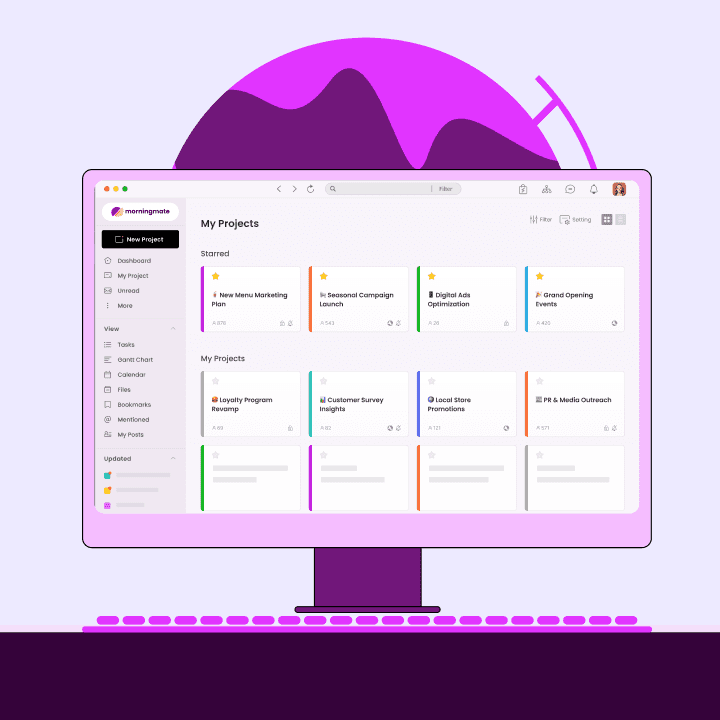
This is exactly where tools like team collaboration platforms become critical infrastructure rather than optional add-ons. Morningmate, for example, is a lightweight work management tool built around a social-media-style Feed view and a built-in chat interface that mirrors what most people already use in their personal lives. Teams can post updates, assign tasks, share files, and have threaded conversations — all in one place, without needing to switch between five apps or dig through email chains to find context.
How to Build an Async-First Project System
Switching to async doesn't mean eliminating all meetings overnight. It means redesigning how information flows so that meetings become a choice rather than a necessity. Here's a framework that works for teams of all sizes.
Step 1: Define What Needs to Be Documented
Start by auditing where decisions and updates currently live. If the answer is "in someone's head" or "in a Slack DM," that's your first problem to fix. Every project should have a source of truth — a place where the current status, open tasks, blockers, and key decisions are visible to anyone on the team, regardless of their time zone or working hours.
Get specific about what needs to be written down. This typically includes project goals and scope, task assignments with clear owners and deadlines, status updates (at least weekly), decisions made and the reasoning behind them, and any blockers that need input from others.
Step 2: Set Communication Windows, Not Open Availability
One of the most common async mistakes is expecting people to be continuously available even when nobody said they had to meet. Define response time expectations explicitly. For most teams, a four-hour response window during working hours is reasonable. For cross-time-zone work, 24 hours is a fair standard for non-urgent communication.
Post these expectations somewhere visible — in your team's workspace, not buried in an onboarding doc nobody reads. When everyone knows the rules, nobody feels anxious about not seeing an immediate reply, and nobody feels obligated to respond to a Slack ping at midnight.
Step 3: Replace Status Meetings with Structured Updates
The weekly status meeting is often the easiest thing to cut — and the most impactful. Replace it with a written update posted to a shared channel or feed at a consistent time each week. Ask each team member to share three things: what they completed, what they're working on next, and any blockers they need help with.
This takes five minutes to write and five minutes to read. Compare that to a 45-minute meeting where half the attendees are waiting for their turn to speak. The async version gives everyone the same information with a fraction of the time cost — and it creates a record you can reference later.
Step 4: Use Tasks as the Primary Communication Layer
In a well-designed async system, the task itself carries the conversation. Instead of asking questions in a separate chat thread that loses context over time, comments, attachments, and status updates live directly on the task card. Anyone who picks up that task two weeks later has everything they need without having to hunt through messages.
Morningmate's task management does exactly this — each task can carry files, comments, and assignments, so context travels with the work rather than sitting in a separate chat thread. For distributed teams managing multiple projects simultaneously, that kind of built-in structure saves hours of back-and-forth every week. It's a sharper contrast than it sounds compared to managing tasks in WhatsApp groups or long email chains, where context disappears the moment the conversation moves on.
Async Across Time Zones: Practical Scenarios
Frameworks are useful. Real examples are more useful. Here's how async-first principles play out in common cross-timezone scenarios.
The Handoff
Your team in Toronto wraps up their day just as your team in Bangalore is starting theirs. Instead of a handoff call that forces someone to attend at 7am or 9pm, the Toronto team posts a structured end-of-day update to the project feed: what's done, what's in progress, what's waiting for input, and where files live. The Bangalore team reads it, picks up the open tasks, and moves forward. No meeting required.
The Cross-Timezone Decision
A decision needs input from three people across three different time zones. Instead of finding a meeting slot that works for everyone — which might be days away — the team lead posts the question to the shared workspace with all relevant context attached, tags the three stakeholders, and sets a 48-hour window for responses. Decisions get made faster, and every input is documented in one place.
The Project Review
At the end of a project sprint, instead of a retrospective meeting, the team lead sends a short async survey — what went well, what didn't, what should change. Responses come in over 24 hours. The lead synthesizes them into a summary posted to the project feed. Everyone reads it. Some leave comments. The process takes less than two hours of collective time rather than a 90-minute meeting where half the team says nothing.
The Tools Your Async Stack Needs
Async work doesn't require an elaborate tech stack. But it does require the right foundation. Here's what your team actually needs — and what you can skip.
A shared task and project workspace: This is non-negotiable. Tasks need owners, deadlines, and a place for context. Spreadsheets won't cut it at scale.
A team communication channel that isn't email or WhatsApp: You need threaded conversations that stay attached to the right context — not a flood of unstructured messages across personal devices.
File storage that lives next to your work: Files shouldn't live in someone's Google Drive with a shared link pasted into a chat. They should be attached to the task or project they belong to.
A clear documentation habit: The best tools in the world don't help if people don't use them consistently. Start with a one-page team protocol: what goes where, when updates are expected, how urgent issues get flagged.
You don't need separate apps for each of these. Morningmate brings task management, team chat, and file management into one workspace — which matters more than it sounds when you're trying to keep a distributed team aligned. The fewer places people have to check, the more likely they are to actually check them. For teams coming from email or WhatsApp, the interface feels immediately familiar, which means adoption doesn't require a training program.
What to Keep Synchronous
Async-first doesn't mean async-only. Some conversations genuinely benefit from real-time interaction — and forcing them into written form actually makes them worse. High-stakes relationship building, complex problem-solving that needs rapid back-and-forth, and anything involving sensitive feedback are areas where live conversation adds real value.
A practical rule: if a written exchange has gone back and forth more than three times without resolution, schedule a call. If a new team member is onboarding, do a live walkthrough of the workspace and tools. If someone seems disengaged or struggling, reach out directly — don't leave it to an async thread.
The goal is to make meetings intentional rather than habitual. When your team does meet, it should be because a meeting is genuinely the best format for what you need — not because that's just how you've always done things.
Making the Transition: A 30-Day Starter Plan
If you're moving a team toward async-first project management, slow and deliberate beats fast and chaotic. Here's a practical sequence.
Week 1 — Audit your current communication: Map where work-related communication actually happens right now. Email, WhatsApp, Slack, verbal conversations — count them all. Identify the top three places where information gets lost or decisions go undocumented.
Week 2 — Set up your async workspace: Choose a single platform for tasks, updates, and team communication. Migrate your active projects there. Define the structure: what a task card should include, how updates should be posted, where files should live.
Week 3 — Run one async experiment: Replace one recurring status meeting with a written update format. Give it two weeks before judging it. Gather honest feedback from the team — what's working, what feels unclear.
Week 4 — Document your team protocol: Write a one-page guide covering response time expectations, what belongs in tasks versus chat, how urgent issues get escalated, and when a meeting is actually warranted. Share it with the whole team and revise it together.
This isn't a one-time project — it's a shift in how your team operates. Expect it to feel slightly uncomfortable in the first few weeks. That discomfort usually means you're replacing old habits with better ones, not that something is going wrong.
The Leadership Shift That Makes Async Work
The hardest part of going async isn't the tools — it's the mindset. Most managers have been trained, implicitly or explicitly, to equate visibility with presence. If people are in the office or on a call, work is happening. If they're not, it's uncertain. Async work requires shifting from monitoring presence to measuring output.
That means defining what good work looks like in concrete terms — tasks completed, milestones hit, quality of deliverables — rather than relying on the feeling of being in the loop. It means trusting your team to manage their own time and flagging blockers proactively. And it means modeling the behavior you want: posting your own updates, documenting your own decisions, and not sending messages at 11pm that imply an expectation of immediate response.
When leadership commits to async norms, the rest of the team follows. When leadership makes exceptions — scheduling last-minute calls, sending urgent messages outside working hours, skipping documented updates — the whole system weakens. Consistency at the top is what makes the culture stick.
Managing projects across time zones without endless meetings is genuinely achievable. It requires the right structure, the right tools, and the willingness to trade old habits for smarter ones. Teams that get this right don't just save hours — they build a more resilient, more focused, and frankly more sustainable way of working together.