Project Management
AI tools for project management are everywhere right now. Every software vendor seems to have bolted an "AI assistant" onto their product, and your inbox is probably full of promises about how it will save you hours every week. Some of those promises are real. Many are not.
The honest truth is that AI in the workplace is a mixed bag — and the difference between tools that genuinely free up your time and tools that quietly create more work often comes down to how well they fit into the way your team already works. Before you adopt anything new, it pays to think critically about what problem you are actually trying to solve.
This article breaks down where AI project management tools deliver real value, where they tend to overcomplicate things, and how to make smarter decisions before adding yet another tool to your team's plate.
Why AI in Project Management Is Worth Taking Seriously
The interest in AI tools for project management is not just hype. McKinsey research suggests that AI-driven automation has the potential to improve productivity across knowledge work by handling repetitive, low-judgment tasks — the kind that fill up a project manager's day without moving anything forward.
For teams dealing with async communication, scattered updates, and missed deadlines, even a modest reduction in administrative work can have a meaningful impact. The key word is "can." The gains are real only when the tool fits the workflow — not when the workflow has to bend around the tool.
Where AI Tools Actually Save Time
There are a handful of areas where AI consistently delivers. These are tasks that are repetitive, pattern-based, and do not require deep human judgment — exactly the kind of work AI handles well.
Summarizing Meetings and Long Threads
If your team runs on meetings and long message threads, AI-generated summaries can be genuinely useful. Tools that automatically transcribe a call and produce a structured recap — action items, decisions, next steps — save the person who used to manually write that up anywhere from 20 to 45 minutes per meeting.
This is one area where the time savings tend to be consistent and measurable. The output does not need to be perfect to be useful — even a rough summary that someone can scan in two minutes beats reading through a 90-message thread.
Drafting Routine Communications
Status updates, project briefs, onboarding instructions — these are documents that follow predictable structures. AI writing assistants can draft a solid first version in seconds, which you then refine. That shift from blank page to editing saves a surprising amount of cognitive energy over a week.
The important caveat: you still need to review and edit. Teams that skip this step end up sending out generic, slightly-off communications that erode trust over time.
Automatic Task Categorization and Prioritization Suggestions
Some project management platforms now use AI to suggest task priorities based on due dates, dependencies, and team workload. When it works well, this reduces the mental overhead of triaging a backlog every Monday morning. Your team opens the tool and the most pressing items are already surfaced.
This is most effective for teams with a large volume of repeatable tasks — think operations teams, support workflows, or content pipelines — rather than complex project work with a lot of ambiguity.
Spotting Risks Before They Become Problems
AI tools trained on project data can flag when a project is likely to slip — based on patterns like tasks going overdue, blocked dependencies, or team members being over-allocated. Harvard Business Review has noted that one of the highest-value uses of AI at work is anticipating problems rather than reacting to them. That applies directly here.
For a manager overseeing multiple workstreams, an early warning system like this can prevent the kind of last-minute fire drills that eat an entire Friday afternoon.
Where AI Tools Create More Work Than They Save
This is the part most vendor marketing leaves out. AI tools for project management can just as easily become a source of friction, overhead, and confusion — especially for teams that are not already working in a structured, centralized way.
AI Features Layered on Top of Chaos
Here is a pattern that plays out constantly: a team adopts a complex project management platform because it has impressive AI features, but they have not yet solved the underlying problem of scattered communication. Tasks are still being assigned over WhatsApp. Updates are still happening over email. The AI has nothing clean to work with, and its suggestions are unreliable because the data going in is incomplete.
AI does not fix a broken workflow — it amplifies whatever is already there. If your foundation is messy, AI makes it messier, faster. Getting the basics right first — a single place where work lives, consistent habits around updates — is what creates the conditions for AI to actually help.
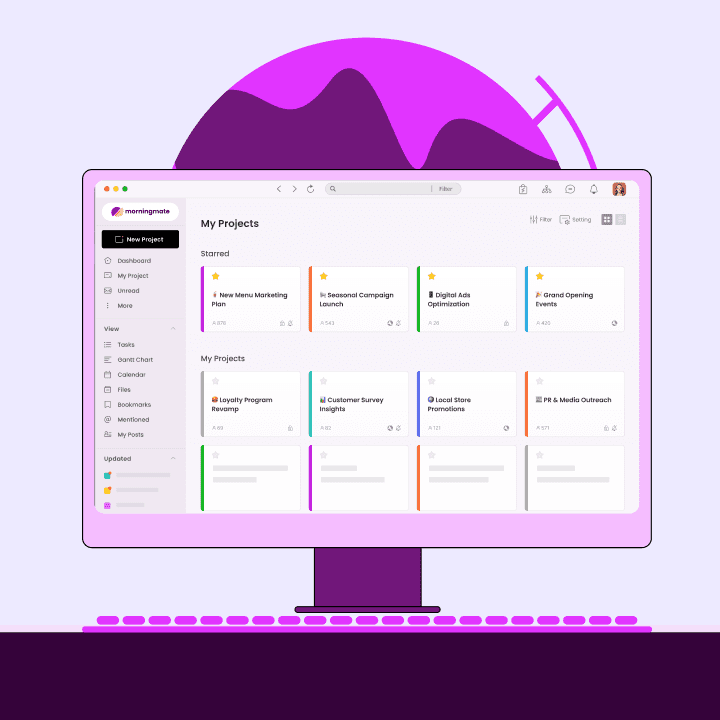
This is part of why tools like Morningmate — a lightweight work management platform that replaces email threads and personal messenger apps with one organized workspace — tend to be a better starting point for many teams. When communication and task management are already in one place, any AI layer you add later has real, structured data to work with.
Over-Complicated Tools That Require Constant Maintenance
Some AI-powered project management tools are genuinely powerful — and genuinely exhausting to maintain. They require detailed project configurations, custom fields, automation rules, and regular cleanup to keep the AI's suggestions relevant. For a dedicated project management office or a technical team with a full-time ops person, that investment might make sense.
For a 20-person marketing team or a growing services business? The maintenance overhead often outweighs the benefit. There have been multiple studies stating that adoption rates fall sharply when tools require significant configuration before they deliver value.
Notification Overload Disguised as Intelligence
Many AI tools generate a lot of output. Automated summaries, proactive nudges, suggested deadlines, risk alerts — when all of this hits your team simultaneously, it adds to cognitive load rather than reducing it. People start ignoring the notifications entirely, which defeats the purpose, or they spend time triaging AI-generated noise instead of doing actual work.
The best AI features are quiet ones. They surface only what matters, only when it matters, and they do not require the user to manage the AI itself as a separate task.
Replacing Human Judgment Where It Still Belongs
AI is not good at nuance. It cannot tell you that a task marked "low priority" is actually urgent because of a conversation that happened offline. It cannot read the interpersonal dynamics that are causing a project to slow down. When teams over-rely on AI prioritization without applying human context, they sometimes work efficiently on the wrong things.
The best use of AI in project management is to handle the low-judgment, high-volume tasks so that your team has more time and mental energy for the high-judgment decisions that genuinely require a human.
A Practical Framework for Evaluating Any AI Project Management Tool
Before committing to a new tool, run it through these questions with your team:
What specific task is this replacing? If you cannot name a concrete, recurring task that takes real time today, the tool is solving a theoretical problem.
Does it require our team to change how we work first? If yes, be honest about whether your team will actually make that change — or whether the tool will sit unused after the first month.
What does the maintenance burden look like after month three? Ask vendors directly. The answer tells you a lot.
Where does the data come from? AI is only as useful as the inputs it gets. If your work is still scattered across email and personal chats, no AI tool will fix that.
Can non-technical team members use it without training? This matters enormously for adoption. If your operations or field team needs a 90-minute onboarding session, the tool is too complex.
Getting the Foundation Right Before Adding AI
The teams that get the most out of AI tools for project management are almost always the ones who have already solved their basic coordination problem. They have one place where tasks live. They have consistent habits around status updates. Their communication is searchable and organized rather than buried in personal message threads.
If your team is still juggling WhatsApp groups, email chains, and a spreadsheet that one person maintains, that is the problem to solve first. Morningmate is built specifically for this — it gives teams a central workspace that combines task management and built-in team chat in an interface that feels familiar, like a social feed and a messaging app rolled into one. Because the interface is intuitive, even non-technical teams actually use it consistently, which is the thing that makes any future AI layer worth having.
The Right Mindset Going Into 2026
The most useful framing for AI tools in project management is this: treat them as a way to reduce the cost of low-value work, not as a replacement for good team habits or strong management. The teams winning with AI in 2026 are not necessarily using the most sophisticated tools — they are using well-chosen tools on top of a solid operational foundation.
Be selective. Start with the specific bottlenecks that cost your team real hours every week. Measure whether the tool actually reduces those hours, or whether the setup and maintenance quietly adds them back. And resist the pressure to adopt every shiny new AI feature just because it exists.
The teams that will get the most out of AI are the ones who stay intentional — using it where it genuinely helps, and keeping humans in the loop where judgment, relationships, and context still matter most.