Project Management

Effective task management is the backbone of any well-run operation — and yet, for thousands of growing SMBs, it is quietly collapsing inside WhatsApp group chats. When your team is five people, a quick message works fine. When it becomes twenty, thirty, or fifty people across departments, that same group chat becomes a liability: tasks buried in threads, accountability impossible to enforce, and status updates requiring a manual chase every single time. The problem is not effort — your team is working hard. The problem is that the system was never built to scale.
This is not a communication style issue. It is a structural one. Task management requires context, ownership, history, and visibility. WhatsApp provides none of those reliably at scale. What it provides is speed and familiarity — and those two qualities have seduced operations teams into using it for far more than it was ever designed to handle.
If you are an ops manager spending your mornings reconstructing yesterday's decisions from chat scrolls, manually following up on deliverables, or trying to onboard new hires by pointing them to a 2,000-message group thread, this article is built for you. Here is a systems-level look at exactly why WhatsApp-based task tracking breaks down — with a framework to fix it permanently.
The Compounding Cost of Chat-Based Task Management
The failure of WhatsApp for task tracking is not sudden — it compounds. Each missed task, each repeated question, each re-explained process adds friction that slows the whole operation down. McKinsey research found that workers spend an average of 19% of their working week searching for and gathering information — that is nearly one full day per person, per week, lost to a system problem that looks like a people problem.
For an ops manager, the costs show up in predictable ways: duplicate work because nobody saw a task was already in progress, missed deadlines because there was no single source of truth, and onboarding that takes three times longer because institutional knowledge lives in someone's phone. The Asana Anatomy of Work report consistently highlights that employees spend a disproportionate amount of time on "work about work" — coordinating, chasing, and clarifying — rather than the actual work itself. That ratio gets dramatically worse when task coordination happens inside a chat app.
Here is how those costs typically accumulate across a growing team:
Operational Area | WhatsApp-Based Task Management | Structured Task Management System |
|---|---|---|
Task ownership | Implied by message sender, easy to miss | Assigned, visible, logged |
Status visibility | Requires manual follow-up messages | Real-time, centralized view |
Deadline tracking | Set in message, buried in scroll | Set in task, notified automatically |
Onboarding new staff | No history, context scattered | Full task history accessible immediately |
Cross-team coordination | Separate groups, fragmented updates | Shared workspace, unified view |
The SCALE Framework: Why Task Management Fails in Chat
To diagnose this systematically, use the SCALE framework — five structural reasons why chat-based task tracking disintegrates as teams grow. Each letter represents a specific operational failure mode. Each one is fixable, but only if you acknowledge that the tool itself is the root cause, not the behavior of your team.
S — Signal loss: Tasks assigned in chat disappear into scroll. There is no persistent, pinned, searchable task record. A message is a notification, not a commitment.
C — Context collapse: The conversation thread that led to a task decision is disconnected from the task itself. Someone executing the work has no idea why a decision was made.
A — Accountability gaps: When everyone can see a message but nobody is formally assigned, diffusion of responsibility takes over. Nobody follows through because everybody assumed someone else would.
L — Latency in coordination: Cross-team task management in WhatsApp requires forwarding messages across groups, which creates version drift and delays.
E — Exclusion of new team members: Onboarding into a chat-based system means inheriting hundreds of messages with no structure, no index, and no way to surface what matters.
Where Teams Lose Time: Chat-Based Task Tracking vs. Structured Systems
61%
Time on "work about work"
45%
Tasks missed or duplicated
78%
Managers manually chasing status
Fig 1: Common task management failure indicators in chat-reliant teams (illustrative, based on industry patterns)
S — Signal Loss: Task Management Needs Persistence
A task assigned in a WhatsApp message has a half-life measured in minutes. The moment the next conversation starts, the task is buried. There is no inbox for tasks, no flag that persists, and no way to surface what is outstanding without scrolling back through history.
In operations, signal loss is lethal. An outstanding vendor invoice, a compliance deadline, or a cross-department handoff cannot live in a chat message and be reliably acted on. Proper task management requires that a task exist as its own object — with a name, owner, due date, and status — independent of any conversation. When the task and the conversation are fused, the task dies when the conversation moves on.
C — Context Collapse: Task Workflow Needs History
Good task coordination is not just about who does what by when. It is about why. When a task is created inside a structured system, the conversation that led to it, the files attached to it, and the decisions recorded in it travel with the task permanently. When it is assigned over WhatsApp, none of that context survives the moment.
Consider a practical example: your ops team is coordinating a supplier contract renewal. The negotiation, the terms discussed, the approval chain — all of it happens across three different WhatsApp groups over two weeks. A month later, someone needs to verify what was agreed. There is no record. There is only scroll. Context collapse is how institutional knowledge gets destroyed at growing companies, and it happens one group chat at a time.
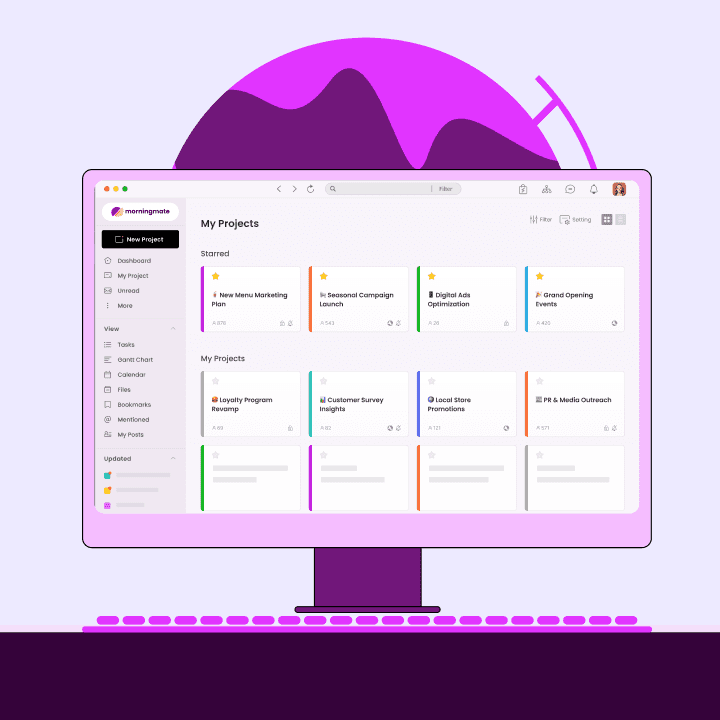
This is one area where a tool like Morningmate makes a structural difference. Morningmate's task cards attach conversations, files, and comments directly to each task — so context does not just live in chat history, it lives inside the work itself. Every new team member, every handoff, every audit has a complete record.
A — Accountability Gaps: Task Tracking Requires Clear Ownership
Harvard Business Review and organizational research consistently point to role clarity as one of the strongest predictors of team performance. WhatsApp does not support role clarity. When a message says "can someone handle the vendor follow-up?" that is not a task assignment — it is a hope. In a structured task management system, that same request becomes a task with a named owner, a due date, and a status that is visible to the whole team.
In a WhatsApp group of twenty people, the bystander effect is not a personality flaw — it is a predictable system outcome. When tasks are implicit and ownership is unclear, accountability cannot exist. This is why ops managers in chat-reliant teams spend so much time chasing status: the system was never designed to enforce completion, only to transmit messages.
L — Latency: Cross-Team Task Coordination Breaks in Silos
In a siloed chat environment, coordinating across teams means forwarding messages between groups, re-explaining context, and hoping the receiving team acts on a message that was never formally directed at them. Every forward introduces a delay, a distortion, or a dropped ball.
A vendor onboarding process that touches procurement, finance, and operations might involve five different WhatsApp groups, with each team seeing only their slice of the workflow. No single person — not even the ops manager — has a complete, up-to-date view of where the process stands. That is not a coordination problem. It is a tool architecture problem.
E — Exclusion: Onboarding Collapses Without Structured Task Management
When a new operations coordinator joins your team, how long does it take them to understand what is in flight, what is their responsibility, and where to find the information they need? In a WhatsApp-based environment, the answer is weeks — and even then, they will be missing context that nobody thought to re-explain.
Structured task management means every in-progress task, every assigned responsibility, and every attached document is immediately accessible to a new team member from day one. Onboarding time drops. Repeated questions drop. The manager's time spent hand-holding drops. That is not a soft benefit — it is a measurable operational gain.
Applying the SCALE Framework with Morningmate: A Worked Example
Here is how a standardized vendor onboarding workflow looks when you move it out of WhatsApp and into a structured task management system like Morningmate — a lightweight work management tool used by over 550,000 teams worldwide, designed to be simple enough for any non-tech team to use immediately.
The old WhatsApp flow: Procurement sends a message to the ops group saying a new supplier is ready to onboard. Someone in finance replies asking for the contract. The contract is sent as a file in a separate DM. Finance approves over chat. Operations sets up the vendor account. Three weeks later, nobody can confirm when the account was activated or who approved the terms.
The Morningmate flow: A standardized "Vendor Onboarding" task template is created once by the ops manager. Each new vendor triggers a new task card with pre-set subtasks: contract collection, finance approval, account setup, confirmation. Each subtask is assigned to the relevant person with a due date. Files attach directly to the task. Comments replace WhatsApp messages. The entire workflow — from initiation to completion — is visible in real time on a shared board. Every team member, including the new hire who started last week, can see exactly where any vendor stands at any moment.
Morningmate's feed view also means updates appear in a familiar, social-media-style interface — so adoption is fast even across non-technical departments. The built-in chat functions like WhatsApp in look and feel, which removes resistance from team members who are comfortable with messaging. But unlike WhatsApp, conversations here are anchored to specific tasks — context and accountability are baked in by design. You can learn more about building these kinds of structured workflows at our guide to standardizing team workflows.
Before vs. After: Measuring the Impact of Structured Task Management
The shift from chat-based task tracking to structured task management is not incremental — it is categorical. Here is what the operational difference looks like across key metrics:
Metric | WhatsApp-Based Task Tracking | Structured Task Management |
|---|---|---|
Time to find task status | 10–20 min (manual scroll or follow-up) | Under 30 seconds |
Onboarding time to productivity | 2–4 weeks | 3–5 days |
Process repeatability | Depends on individual memory | Template-driven, consistent |
Manager time spent chasing updates | 60–90 min/day | Under 10 min/day |
Audit and compliance readiness | Near impossible to reconstruct | Full history, exportable |
Operational Efficiency Gains After Switching to Structured Task Management
70%
Reduction in missed tasks
55%
Faster cross-team handoffs
80%
Less time chasing status
Fig 2: Reported efficiency improvements after adopting structured task management tools (illustrative, based on industry benchmarks)
Implementation Checklist: Moving Your Team to Structured Task Management
The transition does not need to be complex. Use this checklist to make it systematic — and use it as the ops document you share with your team when you roll out the change.
Audit your current task sources. List every WhatsApp group where tasks are currently assigned. That is your migration list.
Define your core task categories. For each team or function (ops, finance, logistics, HR), identify the five most common recurring task types.
Build reusable task templates. Create a template for each recurring task type — with standard subtasks, assignees, and due date logic pre-configured.
Assign a single workspace per team. Each team gets one project board in your task management system. No parallel WhatsApp groups for the same work.
Set a status-update protocol. Require that all task status changes happen inside the system, not via chat message. Make this non-negotiable from day one.
Run a 30-day discipline window. For the first month, the ops manager or team lead reviews the task board daily and flags any tasks that were updated via WhatsApp instead of the system.
Measure before and after. Track time spent chasing status updates in week one of the new system versus week one of the old approach. The data will make the case internally faster than any memo.
Task management done right is not about adding more tools — it is about removing the wrong ones. WhatsApp served your team when it was small and the stakes were low. As you scale, the cost of keeping it as your primary task tracking system compounds daily: in missed work, in duplicated effort, in onboarding failure, and in the sheer operational tax of chasing every status update manually. The SCALE framework gives you the language to explain this to your leadership and your team. The tools to fix it — including structured platforms like Morningmate, which keeps task tracking and team communication unified in one lightweight workspace — already exist and are ready to deploy. The only question is how long you wait before making the switch.