Project Management

Good task management is supposed to keep your marketing campaigns on track — but for most small teams, the real workflow looks nothing like a tidy task board. It looks like a Slack DM that says "just ping me when it's ready," a founder who approves copy over WhatsApp at 11pm, and a freelance designer who missed the brief update because it was buried in a reply-all email chain from three days ago. Sound familiar? You're not alone, and the cost is higher than you think.
The "just ping me" approach feels agile. It's informal, low-friction, and seems to respect everyone's time. But in reality, it's one of the most expensive coordination strategies a small marketing team can run. Every untracked request, every approval that lives in someone's DMs, every task that exists only in someone's memory is a liability — for your campaign timelines, your team's focus, and your sanity.
This article breaks down exactly where informal ping-based coordination breaks your marketing workflow, gives you a repeatable task management play to fix it, and shows how small teams are moving to structured task tracking without adding complexity. Let's get into it.
Where "Just Ping Me" Breaks Your Task Management
Picture this: it's the morning of your product launch email send. You need three things — final copy approval from the founder, a reviewed graphic from your freelance designer, and the confirmed send time from your email platform manager. You sent pings for all three yesterday. Two are unread. One was "approved" in a voice note you can't find. The send time comes and goes.
This isn't a people problem. It's a system problem. When task coordination happens through chat pings, it creates four specific failure modes that compound with every campaign you run.
Approvals Disappear Into Chat
Marketing work is approval-heavy. Copy, creative, budgets, post schedules — they all need sign-off, often from people outside your immediate team. When those approvals happen in chat threads, there's no record, no status, and no accountability. Research from Harvard Business Review has long flagged that knowledge workers lose enormous chunks of their day to communication overhead — and approvals chased over messaging apps are a major culprit.
Context Gets Rebuilt from Scratch Every Time
Your freelancer finishes a graphic. But the brief changed two days ago in a Slack thread they weren't tagged in. Now you're rebuilding context, re-explaining scope, and re-doing work. Adobe's research on project management consistently shows that rework from miscommunication is one of the top time killers on small teams — not lack of talent, but lack of shared context.
Task Ownership Is Invisible
When tasks live in chat, nobody can see at a glance who owns what, what's blocked, and what's overdue. The marketing manager ends up as the human task management system — mentally tracking every moving piece and chasing people all day. That's not coordination. That's bottleneck management.
Here's what "just ping me" coordination actually costs, compared to even a lightweight structured task workflow:
Coordination Area | "Just Ping Me" Approach | Structured Task Management |
|---|---|---|
Approval tracking | Buried in DMs, no audit trail | Logged on the task, visible to all |
Brief/context sharing | Re-sent per person via chat | Attached to task, always findable |
Task ownership | Assumed, never confirmed | Assigned with due date and status |
Deadline visibility | Lives in someone's memory | On the board, updated in real time |
Freelancer onboarding | Repeated verbal briefing each time | Task card with files and notes ready |
The Real Scale of the Task Management Problem
It's easy to dismiss scattered pings as a minor annoyance. But the data tells a different story. Asana's Anatomy of Work report found that workers spend nearly 60% of their time on work about work — status updates, chasing approvals, finding files — rather than the skilled work they were actually hired to do. For a two-person marketing team running a product launch, that ratio is catastrophic.
Where Small Marketing Teams Lose Time Each Week
58%
Chasing approvals & updates
41%
Rebuilding lost context
29%
Duplicate or rework tasks
Fig 1: Estimated share of weekly hours lost to coordination overhead on small marketing teams (illustrative, based on industry benchmarks)
The math is brutal. If your team works 40-hour weeks and 58% of that is coordination overhead rather than actual task execution, you're getting fewer than 17 hours of real creative and strategic output per person per week. That's where campaign quality suffers, deadlines slip, and burnout sets in.
A Repeatable Task Management Play for Campaign Work
You don't need a complex project management system. You need a lightweight, repeatable task coordination workflow that your founder, your freelancers, and your one-person-team can actually follow. Here's the play — six steps, runs on any tool, works for campaigns of any size.
Create one campaign task board per launch. Every campaign — email, social, paid, event — gets its own task board before a single ping is sent. Name it by campaign and date so everyone knows where to look.
Write every deliverable as a task card, not a message. "Design the hero banner" is a task. "Hey can you do the banner?" is a ping that will get lost. Task cards get assigned owners, due dates, and attached briefs from day one.
Attach files and briefs directly to the task. No more "can you resend the brand guidelines?" The brief, reference images, and copy doc live on the task card. Context never disappears.
Use task status as your status update. Set statuses: To Do → In Review → Approved → Done. Anyone — founder, freelancer, you — can see the current state of every deliverable without sending a single ping.
Route approvals through the task, not through chat. When something is ready for review, the task moves to "In Review" and the approver gets tagged on the task card itself — not messaged separately. Their comment or approval lives there permanently.
Run a 10-minute Monday check-in on the board, not in chat. Look at what's overdue, what's blocked, what's moving into review this week. This single habit replaces a dozen "just checking in" pings throughout the week.
Common Failure Points in Task Management — and How to Dodge Them
Even teams that commit to structured task tracking hit predictable walls. Here's where things go wrong and exactly how to prevent it.
Failure: The Founder Still Approves in WhatsApp
This is the most common breakdown. You've set up a task board, but your founder still prefers to text approvals. Fix this by making the task card the single source of truth — and documenting even WhatsApp approvals back onto the task card yourself. After a few campaigns where they can't find "what they approved," most founders convert naturally.
Failure: Freelancers Don't Use the System
Freelancers work across five different clients and five different tools. Make onboarding them to your task system zero-friction: pre-populate their task cards with everything they need before you invite them. If logging in feels like effort, they'll revert to email. The best task management tools for small teams prioritize simplicity — not feature bloat.
Failure: Tasks Get Created but Never Updated
A stale task board is worse than no board — it creates false confidence. Solve this with your Monday 10-minute check-in ritual and a team norm: if you work on something, you update its status before you close your laptop. Make task tracking a completion habit, not an admin overhead.
Failure: Chat Still Runs Parallel to the Task System
Two systems always mean one falls behind. The fix isn't to ban chat — it's to use a tool where chat and task management are in the same place. When conversation lives next to the task it's about, context stops escaping into separate apps.
How Morningmate Brings Task Management, Approvals, and Chat Together
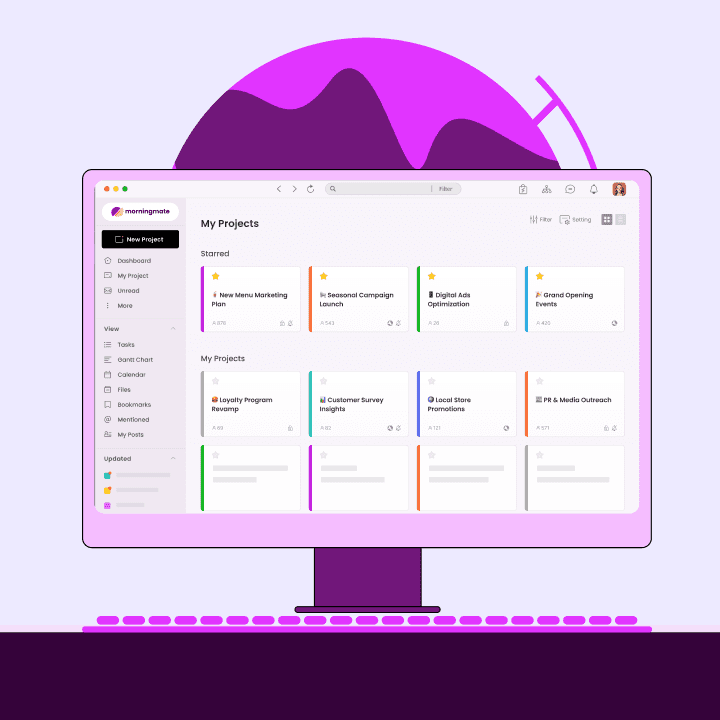
This is where Morningmate earns its place in small marketing team workflows. Morningmate is a lightweight work management tool — built specifically to replace the chaos of scattered chat and email with one organized workspace, without the learning curve of tools like Jira or Asana. It combines task management, built-in chat, and file management in a single interface that feels familiar from day one.
Here's a worked example. Say you're running a Q3 product launch campaign with one in-house designer, a freelance copywriter, and a founder who needs to approve the final email before send.
In Morningmate, you create a project called "Q3 Launch Campaign." Every deliverable — hero email, social graphics, landing page copy, paid ad variants — becomes a task card with an assigned owner, a due date, and the relevant brief attached directly to the card. Your freelance copywriter logs in, sees their tasks clearly listed in the Feed view (which looks just like a social media feed, so there's zero learning curve), and posts their draft directly as an attachment on the task. No email required.
When the copy is ready, the task status moves to "In Review" and the founder gets tagged. They review it, leave a comment on the task card — "approved, just fix the subject line" — and the change is made and documented right there. No DM chain. No voice note at 11pm. The entire approval trail lives on the task.
Meanwhile, your designer has a quick question about the brand color for the ad variant. Instead of a ping that pulls you out of whatever you're doing, they post it in Morningmate's built-in chat — which has the same WhatsApp-style interface your team already knows — and tag it to the relevant project. You answer when you're out of focus time. The question and answer stay attached to context, not buried in a separate app.
The result: your Monday board check takes 8 minutes instead of 30. Your founder stops being a bottleneck because approvals are routed and tracked automatically. Your freelancer isn't emailing you for files they can't find. And you are actually managing campaigns instead of managing pings.
Task Management Improvement After Moving Off "Ping-First" Coordination
Teams that move from informal ping-based workflows to structured task tracking report dramatic improvements — not just in how organized they feel, but in actual campaign delivery metrics. Here's how the before-and-after typically looks across key areas:
Average Improvement After Adopting Structured Task Tracking (Small Marketing Teams)
70%
Fewer missed deadlines
63%
Faster approval cycles
55%
Less time rebuilding context
Fig 2: Reported improvements after moving from ping-based to structured task management (illustrative, based on team productivity benchmarks)
Your Task Management Checklist to Apply This Week
You don't need to overhaul everything at once. Start with your next campaign and apply this checklist. These task coordination habits compound quickly — within two campaign cycles, your team will wonder how you ever ran things through pings alone.
Action | When to Do It | Done? |
|---|---|---|
Create a task board for your next campaign | Before kickoff | ☐ |
Convert every deliverable into a task card with owner + due date | Day 1 of campaign | ☐ |
Attach all briefs and files directly to the relevant task | Before assigning to freelancer | ☐ |
Route all approvals through task comments, not chat | Every review cycle | ☐ |
Schedule a 10-minute Monday board review (replace status pings) | Every Monday | ☐ |
Pick a tool where chat and task management live together | This week | ☐ |
The "just ping me" era of marketing coordination has a real expiration date for small teams. Every campaign you run on scattered pings is a campaign where quality, speed, and ownership are all at risk. Structured task management isn't about adding process — it's about removing the invisible tax your team pays every single day in chased approvals, rebuilt context, and missed deadlines. Start with one board, one campaign, and one new habit this week. The compounding effect will surprise you.
If you want task management, built-in chat, and file sharing all in one place — without the complexity that makes most tools feel like homework — Morningmate is worth 10 minutes of your time. Over 550,000 teams worldwide already use it to do exactly what this article describes. You can explore more about lightweight task management for small teams or dive into setting up approval workflows for marketing teams to go deeper on specific plays.