Project Management

Effective task management depends on one thing most operations managers assume they already have: clarity about who is responsible for what. Yet in practice, this clarity is far rarer than it appears on any org chart. Across growing SMBs, role ambiguity quietly erodes team performance — not in dramatic failures, but in the steady drip of duplicated effort, dropped tasks, and wasted hours spent figuring out who was supposed to do something that nobody did. If your team is scaling fast and your processes haven't kept pace, the ownership gap is almost certainly costing you more than you realize.
A Gallup study on employee engagement found that only about half of workers clearly know what is expected of them at work. That number should stop every operations manager cold. When task coordination breaks down at the role level, no amount of status meetings or follow-up messages will fix the underlying structural problem. You need a framework — not just better habits.
This article introduces a named framework for diagnosing and solving ownership gaps in task workflows, with concrete ops examples at each stage, a worked example using Morningmate, and an implementation checklist you can put to use this week.
The Compounding Cost of Ownership Ambiguity
Unclear ownership doesn't just create confusion in the moment — it compounds. When a task has no clear assignee, it either gets done twice (by two people who each assumed responsibility) or not at all (by two people who each assumed the other would handle it). Research published in Harvard Business Review found that in organizations with poor role clarity, managers spend up to 20 percent of their time on work that falls outside their defined responsibilities — work that drifts into their lane because nobody owns it explicitly.
Multiply that across a 30-person team and you're losing the equivalent of six full-time employees to ownership drag every week. For an ops manager trying to standardize processes and onboard new hires consistently, that's not just inefficient — it's structural debt that grows with every new hire who inherits the same ambiguous task workflows.
The table below shows what ownership ambiguity looks like in practice versus what a structured task management system delivers.
Operational Area | Without Clear Task Ownership | With Structured Task Management |
|---|---|---|
New hire onboarding | Steps missed, inconsistent experience per manager | Standardized checklist assigned to named owners |
Cross-team handoffs | Tasks fall between teams, require manual chasing | Handoff triggers visible, tracked, time-stamped |
Status visibility | Manager chases updates via chat or email | Real-time task status visible to all stakeholders |
Process documentation | Lives in someone's head or an outdated doc | Embedded in recurring task templates, always current |
Accountability on missed deadlines | Unclear who dropped the ball | Assignee history logged, root cause traceable |
Introducing the DOOR Framework for Task Management Clarity
To fix ownership ambiguity systematically, you need a model that addresses all the places it hides. The DOOR Framework — Define, Own, Operate, Review — gives operations teams a repeatable structure for making task management explicit at every stage of a workflow. Each component targets a different failure mode that causes ownership gaps to persist even in otherwise well-run teams.
This isn't a methodology overhaul. It's a diagnostic and operational lens you can apply to any existing process — onboarding, approvals, vendor coordination, cross-team projects — without rebuilding everything from scratch.
D — Define: Make Every Task Management Unit Unambiguous
The first place task tracking breaks down is at definition. A task like "coordinate vendor contracts" is not a task — it's a vague directive that three people might interpret three different ways. Proper task management starts by decomposing work into discrete, outcome-defined units with a clear start state, end state, and deliverable.
In practice: your procurement process might have a step called "send contract for review." Defined properly, that becomes: "Send finalized vendor contract PDF to legal via the contracts folder by end of day Thursday, and log confirmation in the procurement board." Now it's auditable. Now it's trainable. Now a new hire can execute it without asking three people what "coordinate" means.
The ops implication is that every recurring process in your team needs a task map — not a flowchart in a drawer, but an active task coordination system where each step is a named, assignable unit of work.
O — Own: Assign Task Ownership to One Name, Not a Team
"The ops team handles that" is the operational equivalent of nobody handling it. Task management research consistently shows that shared ownership without a named lead defaults to the bystander effect at work — everyone assumes someone else will move first. McKinsey's organizational research confirms that single-threaded ownership — one person accountable per outcome — is one of the strongest predictors of execution speed in growing organizations.
In practice: when you build out your onboarding task workflow, every step must have a person's name attached — not a role, not a department. "IT setup" is assigned to Marcus. "Benefits enrollment link" is assigned to Priya. If Marcus is out, there's a backup named in the task. The task tracking system shows you instantly whether Marcus has opened, started, or completed his step.
This single change — naming a human, not a function — eliminates the most common category of dropped tasks in growing SMBs.
% of Managers Who Report Role Ambiguity as a Top Bottleneck (2026)
61%
10–25 person teams
74%
26–75 person teams
83%
76–150 person teams
Fig 1: Role ambiguity worsens as headcount grows without process standardization (illustrative, based on industry trend data)
O — Operate: Build Task Coordination Into the Process, Not Around It
Most ops teams manage tasks around their processes rather than inside them. The handoff from sales to delivery happens in a Slack message. The approval for a vendor invoice gets lost in an email thread. The status update lives in someone's head until the weekly standup. This is where task coordination collapses — not because people are negligent, but because the system makes it easy to forget.
Operationalizing task management means building the task tracking mechanism directly into the process step. When a sales deal closes, a task is automatically created and assigned — it doesn't rely on someone remembering to create it. When an invoice arrives, the approval task appears in the right person's queue immediately, with the document attached and a deadline set.
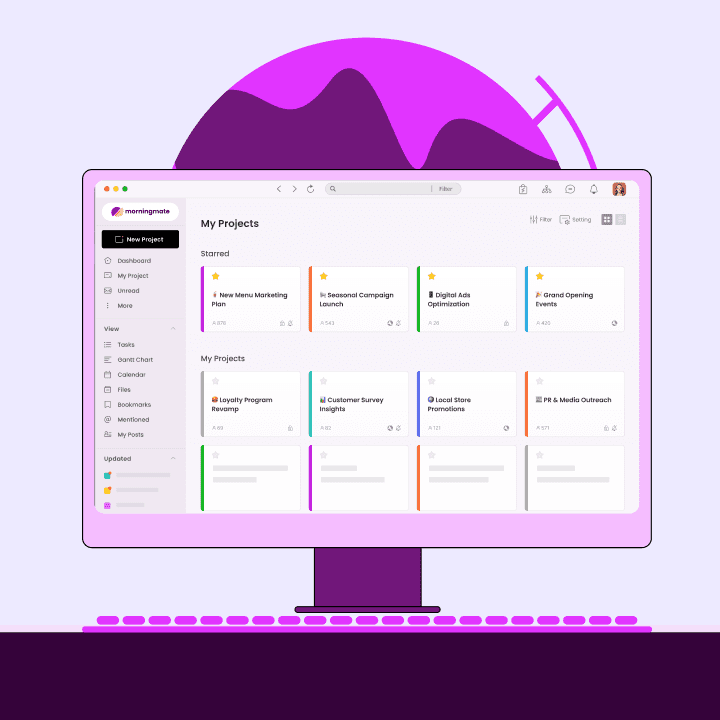
This is where a tool like Morningmate — a lightweight work management platform used by over 550,000 teams — adds real operational value. Its task boards let you create structured workflows where tasks are assigned, sequenced, and visible to the whole team in a familiar feed-style interface. There's no steep learning curve, which matters when you're onboarding non-technical staff who won't tolerate a complex PM tool.
R — Review: Make Task Management Gaps Visible Before They Compound
The final component of DOOR is where most teams skip entirely. They define tasks, assign owners, run the process — and then only find out something broke when a deadline passes or a client complains. A functioning task management system builds in structured review points that surface bottlenecks while there's still time to act.
In practice: a weekly ops review shouldn't start with "what did everyone do this week?" It should start with a filtered view of overdue tasks, unassigned items, and blocked steps. This turns the review from a reporting exercise into a decision-making session. You spend your time resolving blockers, not reconstructing what happened.
The review cadence also serves as your process audit. If the same task category keeps surfacing as overdue or ambiguous, that's a signal to redesign the Define or Own layer — not to push the team harder.
Applying the DOOR Framework with Morningmate: A Worked Example
Here's how a real ops manager might apply DOOR to a new hire onboarding process using Morningmate's task management features.
Scenario: Your team hires two new customer success reps. Historically, onboarding has been inconsistent — IT setup sometimes takes four days, benefits paperwork gets emailed back and forth, and the manager's 30-day check-in never actually gets scheduled.
Define: Break the onboarding process into 12 discrete task units — laptop provisioning, system access, tool walkthroughs, policy acknowledgment, buddy assignment, 30/60/90 check-ins — each with a clear deliverable and deadline relative to the start date.
Own: Each task is assigned to a specific name in Morningmate. IT gets laptop provisioning (due Day -2). HR owns benefits enrollment (due Day 1). The hiring manager owns the 30-day check-in (due Day 28). Nobody shares a task without a named lead.
Operate: A Morningmate project board is created from a saved onboarding template the moment an offer is accepted. Tasks auto-populate with assignees and due dates. The built-in chat keeps all onboarding communication in one thread — no emails, no scattered messages. Files like the employee handbook and benefits guide are attached directly to the relevant tasks, so the new hire finds everything in one place.
Review: Every Friday, the ops manager opens the onboarding board and filters for overdue or in-progress tasks. If IT hasn't provisioned the laptop by Day -2, that's visible before the new hire's first day — not discovered on Monday morning. The task tracking visibility removes the need to chase anyone for a status update.
The result: two new hires experience the same onboarding. No steps fall through. The ops manager spends 20 minutes reviewing a board instead of 90 minutes fielding questions and chasing confirmations.
Before vs. After: Task Management Standardization by the Numbers
The table and chart below reflect what teams typically see when they move from ad hoc task coordination to a structured task management system built on the DOOR framework.
Metric | Before Standardization | After Structured Task Management |
|---|---|---|
Time to onboard new hire to full productivity | 5–7 weeks (inconsistent) | 3–4 weeks (consistent) |
Manager time spent chasing task updates per week | 4–6 hours | Under 1 hour |
Tasks dropped at cross-team handoffs per month | 8–12 per month | 1–2 per month |
Process documentation accuracy | Out of date within weeks | Embedded in live task templates |
Team confidence in knowing who owns what | 49% (Gallup baseline) | 85%+ with named task owners |
Manager Hours Saved Per Week After Task Management Standardization
1.2 hrs
Email-based coordination
2.8 hrs
Basic task tools
5.1 hrs
DOOR + Morningmate
Fig 2: Estimated weekly manager hours recovered by task coordination approach (illustrative)
Your Task Management Implementation Checklist
Strong task management doesn't require a six-month rollout. Apply the DOOR framework to your three highest-friction processes first — onboarding, cross-team handoffs, or approvals — and measure the impact before expanding. Use this checklist to get started.
Define: Audit your top three recurring processes. Break each into discrete, outcome-defined tasks with a deliverable, start state, and deadline.
Own: Assign every task to one named individual — not a team, not a role. Document a backup owner for critical steps.
Operate: Move task coordination off email and chat threads into a dedicated task management tool. Use templates for repeatable workflows so new tasks auto-populate with the right structure.
Review: Set a weekly ops review cadence. Start with a filtered view of overdue, unassigned, or blocked tasks — not a verbal status round-robin.
Validate: After 30 days, ask your team: "Do you know who owns every task that affects your work?" If the answer isn't consistently yes, revisit your Define and Own layers.
Scale: Once one process is running cleanly, template it and roll the same structure to the next. Use Morningmate's saved project boards to replicate standardized task workflows across teams without rebuilding from scratch each time.
Task management clarity is not a culture problem — it's a systems problem. And systems problems have systems solutions. The DOOR framework gives you a structured way to diagnose where ownership breaks down in your existing workflows and fix it at the root, not at the symptom. When every task has a definition, a named owner, an operational home, and a review mechanism, you stop chasing status and start actually managing. That's the difference between a team that scales and one that just grows larger.