Project Management

Good task management is supposed to prevent chaos — but most small marketing teams only discover their coordination is broken when a deadline is already on fire. It is 9 a.m. on campaign launch day. The social graphics are sitting in a Dropbox folder nobody can find. The founder's approval came in a WhatsApp voice note at midnight. The freelance copywriter is waiting on feedback that was sent to the wrong email thread three days ago. The campaign goes live two hours late, and everyone spent the morning being reactive instead of doing actual marketing work.
Sound familiar? That chaotic launch day did not appear out of nowhere. Every missed deadline has a coordination problem hiding somewhere upstream — in an unclear handoff, an untracked approval, or a task that lived only in someone's head. The good news is that these signals are readable before they blow up, if you know what to look for.
This article gives you a practical playbook for spotting coordination breakdowns early, fixing the workflow before the deadline slips, and building task tracking habits that actually stick on a small, fast-moving marketing team.
Why Task Management Breaks Down on Small Marketing Teams
Small marketing teams move fast, which is a strength — until speed becomes an excuse for skipping structure. When you are running campaigns, content calendars, paid ads, and social simultaneously with a team of three (plus a founder who reviews everything and freelancers who disappear between briefs), task coordination becomes genuinely hard.
According to Asana's Anatomy of Work report, workers spend 58% of their time on work about work — chasing status updates, attending unnecessary check-ins, and searching for information — rather than on skilled, focused output. For a tiny marketing team, that percentage can feel even higher.
The Three Coordination Gaps That Kill Deadlines
Most deadline failures trace back to one of three specific gaps in task workflow:
Ownership gaps: A task exists but nobody has a clear name attached to it. "We" will handle it — until nobody does.
Approval gaps: Work is done but waiting on a decision from the founder, legal, or a client. This waiting time is invisible unless you are actively tracking it.
Context gaps: The task exists and is assigned, but the person doing it does not have the brief, the assets, or the prior feedback they need to move forward.
Recognising which gap you are dealing with changes how you intervene. Ownership gaps need clearer task assignment. Approval gaps need a visible queue. Context gaps need better file and information attachment at the task level.
Here is a quick diagnostic table to help you identify which coordination problem is active on your team right now:
Warning Signal | Coordination Gap Type | Likely Root Cause |
|---|---|---|
"I thought you were handling that" | Ownership gap | Tasks assigned in chat with no formal record |
Waiting on feedback for 3+ days | Approval gap | No visible approval queue or due date on review |
Freelancer asks for brief again | Context gap | Files and instructions not attached to task |
Nobody knows if task is done | Ownership gap | No status tracking or completion signal |
Campaign launches late repeatedly | All three gaps | No repeatable campaign task workflow in place |
The Early Warning Signs: Task Management Red Flags to Catch This Week
You do not need a project management consultant to spot a coordination breakdown. These are the patterns that show up on real small marketing teams weeks before a missed deadline.
Red Flag 1: Status Lives Only in Someone's Head
If your Monday morning check-in starts with "so where are we on X?" — that is a task tracking failure, not a communication failure. When status updates require a meeting to retrieve, your task workflow has no shared visibility layer. The fix is not another meeting; it is making task status visible without asking.
Red Flag 2: Approvals Have No Due Date
Sending a Google Doc to the founder for approval is not a task — it is a hope. If review requests go out without a deadline attached, they will sit in an inbox queue ranked below everything else. Harvard Business Review notes that requests without clear framing and deadlines are consistently deprioritised by decision-makers, even when the requester views them as urgent.
Red Flag 3: Chat Is Your Task List
Every team has a moment where someone pastes a task into Slack or WhatsApp and considers it assigned. But chat messages are not task management. They get buried, they have no owner field, no due date, and no completion state. McKinsey research found that employees spend an average of 28% of their workweek managing email and messaging — time that does not generate output. When task coordination happens in chat, important work disappears inside that 28%.
The chart below illustrates how teams using different coordination methods compare on meeting campaign deadlines consistently:
Teams Meeting Campaign Deadlines Consistently (% of surveyed teams)
31%
Chat-only teams
54%
Email + spreadsheet
81%
Dedicated task workflow
Fig 1: Deadline consistency by coordination method (illustrative, based on industry benchmarks)
A Repeatable Task Management Play for Campaign Launches
Here is a lightweight task coordination workflow built specifically for small marketing teams running campaign launches. You can run this in any tool that supports assigned tasks with due dates — but the discipline of the steps matters more than the tool.
Create a campaign task parent — one top-level task or project that holds everything for this campaign. Every subtask lives under it. No orphaned tasks floating in chat.
Break the campaign into phases — Creative, Copy, Approval, Scheduling, Launch, and Post-launch Review. Each phase becomes a task group with its own mini-deadline.
Assign every task to exactly one person — not "team" or "marketing." One name. If it is a freelancer, they get assigned and get access to the brief and assets in the same place.
Attach a due date to every approval request — if the founder needs to review an ad creative, the task says "Review by Thursday noon." Not "whenever you get a chance."
Build in a 48-hour buffer before launch — the last task before going live should be a final review task due two days before the scheduled launch. This is your coordination insurance.
Run a 5-minute daily async check-in — each team member updates their task statuses at the start of the day. No meeting needed. Anyone can see what is blocked without asking.
Close the loop after launch — mark every task complete. Note what broke. This becomes your template for the next campaign.
Common Failure Points in Task Coordination (and How to Dodge Them)
Even teams with good intentions hit the same walls. Here are the most common task management failure modes on small marketing teams — and the direct fix for each.
Failure: The founder becomes the bottleneck
When founder approval is required for everything — copy, creatives, budgets — and those requests go out via WhatsApp or email, they compete with every other message in the founder's life. Fix: create a dedicated "Awaiting Approval" task status. Batch approval requests into one weekly slot rather than dripping them across the day. Make the expected response time explicit in the task.
Failure: Freelancers go dark mid-task
Freelancers go quiet when they are stuck or confused — not when they are busy. This usually means the brief was incomplete or they cannot find a file. Fix: attach every resource to the task itself at the point of assignment. Not a link in a chat message sent three days ago — directly on the task card.
Failure: "Done" means different things to different people
The designer marks creative as done. The marketing manager assumed "done" included resizing for all placements. Fix: define a "definition of done" for every recurring task type. Write it once on the task template. You will use it every campaign.
Failure: Nobody notices when a task is overdue
If overdue tasks sit quietly in a spreadsheet or buried chat, nobody intervenes until the deadline is already missed. Task tracking only works if overdue items surface visibly — ideally with an automatic flag or notification rather than a manual check.
How Morningmate Brings Task Management, Approvals, and Chat Together
The reason coordination breaks down on small teams is not a people problem — it is a tool fragmentation problem. Tasks live in a spreadsheet. Conversations happen in WhatsApp. Files sit in Drive. Approvals travel through email. Nothing connects, and context gets lost at every handoff.
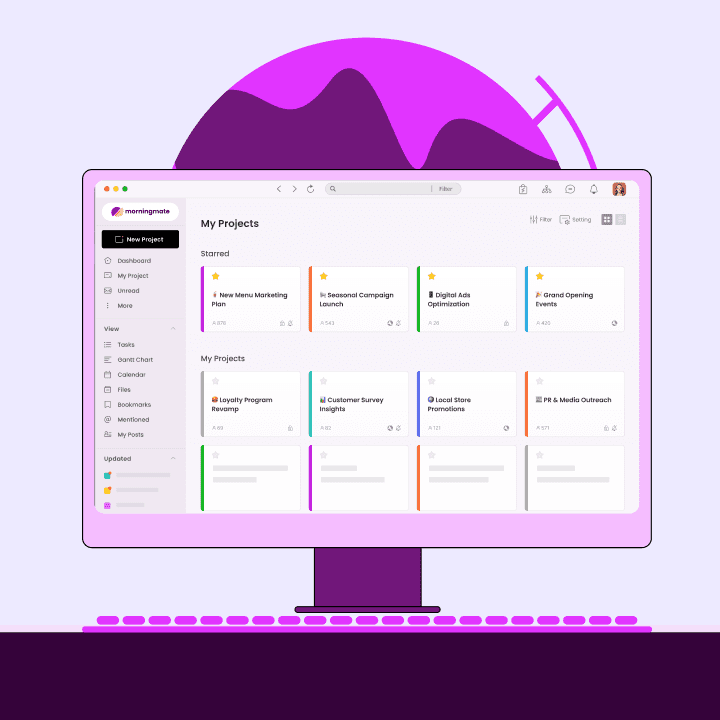
Morningmate is a lightweight work management tool that combines task management, built-in chat, and file management in a single workspace — without the complexity of tools like Jira or Asana that require a dedicated ops person to maintain. The interface looks like a social media feed, which means your freelancers and your founder can actually use it without a training session.
Worked Example: Q2 Product Launch Campaign
Here is what this looks like in practice. Your team is launching a new product feature in six weeks. You create a campaign project in Morningmate and build out the task list by phase: Creative brief, Ad copy, Landing page update, Social graphics, Founder approval, Scheduling, and Launch.
Each task gets an owner and a due date. You attach the brand brief and copy guidelines directly to the relevant tasks, so the freelance designer never has to ask where the file is. When the founder needs to approve the ad creative, you send the task directly in Morningmate's built-in chat — the approval request has a due date attached, it is visible on the project board, and it shows as "awaiting approval" so you can see the block without chasing. When the founder approves, the task status updates and the next phase unlocks automatically.
Two days before launch, your buffer review task flags. You catch that the LinkedIn image sizing is wrong — something that would have delayed launch by a day if caught on launch morning. You fix it in the buffer. The campaign goes live on time.
That entire coordination loop — task tracking, file sharing, approvals, chat — happens inside one workspace. No context switching. No lost threads. Morningmate is used by over 550,000 teams worldwide precisely because it keeps this kind of workflow accessible to teams that cannot afford to manage a complicated toolstack.
The comparison below shows how task coordination stacks up across different working styles:
Task Coordination Aspect | Chat + Spreadsheet Combo | Morningmate (unified workspace) |
|---|---|---|
Task ownership visibility | Manual, easy to miss | Assigned per task, always visible |
Approval tracking | Lost in email/WhatsApp | Status visible on task board |
Freelancer context handoff | Files scattered across tools | Files attached directly to task |
Overdue task visibility | Requires manual checking | Flagged automatically |
Context switching between tools | High — 3 to 5 apps per task | None — all in one workspace |
Time Saved When Task Management Is Centralised
Teams that consolidate task tracking into a single tool consistently recover significant time that was previously lost to coordination overhead. The chart below shows average weekly time saved across key activities when moving from fragmented tools to a unified task management system:
Average Weekly Hours Recovered After Centralising Task Management
1.5 hrs
Status update meetings
2.2 hrs
Searching for files
3.8 hrs
Chasing approvals and updates
Fig 2: Weekly hours recovered by activity after centralising task coordination (illustrative, based on productivity research benchmarks)
Your Task Management Checklist to Apply This Week
You do not need to overhaul your entire workflow this week. Start with these actions. Each one directly addresses a coordination gap that causes missed deadlines. Solid task management habits compound fast on small teams — every campaign you run with this system in place gets easier than the last.
✅ Audit your current campaign: identify every task that has no named owner and fix it today
✅ Find every pending approval and attach a hard deadline to each one
✅ Check if your freelancers have everything they need attached to their task — brief, files, feedback history
✅ Move at least one recurring task workflow out of chat and into a trackable task system
✅ Build a 48-hour buffer task into your next campaign timeline
✅ Set up a shared task board that your founder can view without being asked for a status update
✅ Define "done" for your top three recurring task types and write it on the task template
✅ After your next campaign launch, spend 15 minutes reviewing which tasks slipped and why — then update your template
Coordination problems do not announce themselves. They accumulate quietly in chat threads, unanswered emails, and vague task assignments — then surface as a missed deadline on the one day you needed everything to go right. The teams that consistently hit their campaign dates are not faster or luckier. They just have better task management habits baked into how they work. Start building yours this week, and the next launch will look a lot less like that 9 a.m. fire drill.