Project Management

Task management across a single office is hard enough. Stretch that across three time zones on a lean team of twenty people, and the hidden costs compound fast — missed handoffs, duplicated work, decisions made without context, and a growing sense that nobody actually knows what anybody else is doing. If you are an operations manager trying to standardize how work gets done in this environment, the challenge is not a communication problem. It is a systems problem.
Most advice on distributed task management focuses on tools or meeting schedules. Neither addresses the real issue: without a repeatable structure, every team member invents their own workflow, and every handoff becomes a gamble. Harvard Business Review has documented how process inconsistency at the team level costs organizations measurably more in rework and coordination overhead than the original inefficiency would have cost to fix. For a small team operating across time zones, those losses are not theoretical — they hit your sprint deliverables, your onboarding timelines, and your own sanity.
This article gives you a named, actionable framework for standardizing task coordination across time zones — not by adding more meetings, but by building the process scaffolding that lets asynchronous work actually flow. Every component includes a concrete operational example, a comparison of the before and after, and a worked implementation using Morningmate.
The Compounding Cost of Inconsistent Task Management
Before fixing anything, it helps to quantify what broken task workflow actually costs. McKinsey's research on knowledge worker productivity found that employees spend an average of 1.8 hours per day searching for information. On a 20-person team, that is 36 person-hours lost every single day — before a single task is even started.
For distributed teams, the damage multiplies. When a task handed off from the Singapore office lands in a Slack thread that the London team cannot find, the recovery cost is not just the 15 minutes it takes to locate it. It is the missed morning window, the blocked downstream task, and the status meeting you now have to schedule to reconstruct what happened. Inconsistent task tracking does not create one problem — it creates a chain.
The table below shows what that looks like in practice when you compare an ad-hoc cross-timezone workflow against a standardized task management system.
Operational Area | Ad-Hoc Cross-Timezone Workflow | Standardized Task Management System |
|---|---|---|
Task handoff | Verbal or chat-based, often lost or forgotten | Structured task card with assignee, deadline, context |
Status visibility | Requires chasing via message or call | Live task board visible to all time zones |
Onboarding new team members | Relies on tribal knowledge, inconsistent | Documented task templates, repeatable process |
Decision traceability | Buried in email threads or chat history | Attached to the relevant task record |
Cross-team coordination | Siloed by team, no shared view | Unified workspace with cross-team task visibility |
Introducing the ANCHOR Framework for Distributed Task Management
The framework presented here is called ANCHOR — short for Assign, Normalize, Centralize, Handoff, Observe, and Review. Each component addresses one specific failure point in distributed task tracking. Together, they give your operations a stable spine that does not depend on everyone being awake at the same time.
ANCHOR is not a tool — it is a structural discipline. You can apply it with whatever platform your team uses, though the implementation section below shows how morningmate makes each component significantly easier to execute without adding tool complexity.
A — Assign: Every Task Management Item Needs a Single Owner
The most common failure in cross-timezone task coordination is shared ownership — which in practice means no ownership. When a task is assigned to a team or a channel rather than an individual, it sits untouched until someone follows up.
The rule is straightforward: every task tracking item must have one named owner, one deadline, and one priority level. No exceptions. If a task requires more than one person, it gets broken into sub-tasks, each with its own owner.
Ops example: Your Singapore-based logistics coordinator creates a task for the London team to confirm a supplier delivery window. Instead of posting in a group chat, she creates a task card assigned to a specific London contact, due by 9am GMT, with the supplier email attached. No ambiguity, no follow-up message needed.
N — Normalize: Standardize Your Task Workflow Templates
Normalization means creating task templates for every recurring workflow — onboarding, client deliverables, weekly reporting, vendor coordination. When a task is created from a template, the structure, required fields, and checklist are already populated. Your team stops making decisions about how to format tasks and starts focusing on executing them.
This is particularly valuable for onboarding. Gallup research shows that only 12% of employees feel their organization onboards well. A standardized task template for onboarding — with pre-built checklists covering system access, training milestones, and first-week deliverables — reduces onboarding time and eliminates the knowledge-silo problem that plagues growing teams.
Ops example: Every time a new contractor joins your US-based team, a standardized onboarding task workflow fires automatically. It includes sub-tasks for IT setup, HR documentation, tool access, and a 30-day check-in — all pre-assigned to the relevant owners across time zones, with deadlines calculated from the start date.
Time Spent Chasing Task Status Per Week (Hours per Manager)
7.5 hrs
Email & Chat Only
5.2 hrs
Partial Task Tools
1.1 hrs
ANCHOR Framework
Fig 1: Estimated manager time spent on status chasing per week under different workflow approaches (illustrative)
C — Centralize: One Place for All Task Tracking
Knowledge silos are not caused by people being secretive — they are caused by work living in the wrong places. When task coordination happens across email, WhatsApp, spreadsheets, and slide decks simultaneously, there is no single version of truth. Every team member is working from a different mental map of what is happening.
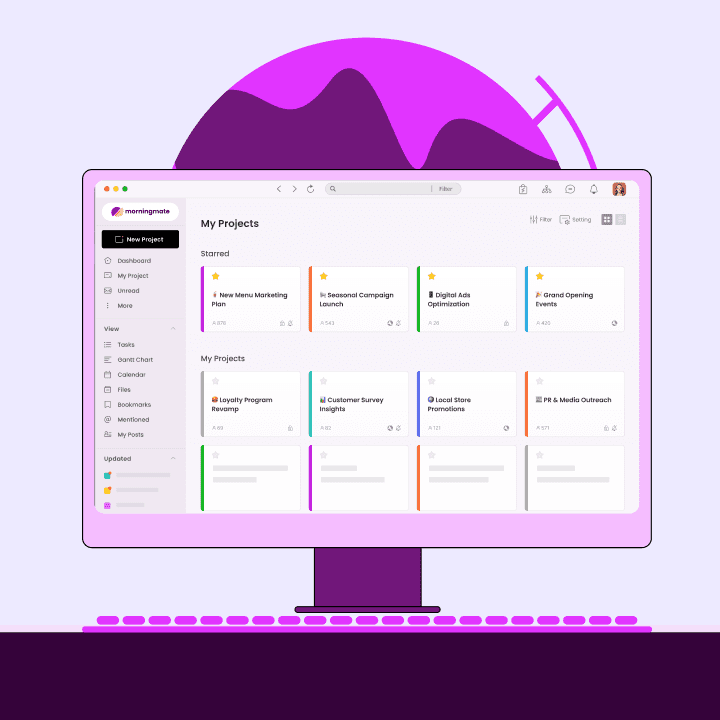
Centralization means choosing one workspace where task workflow, files, discussions, and decisions live together. Not three tools that integrate if you configure them correctly — one place. This is where Morningmate earns its place in a distributed ops stack. It is a lightweight work management platform that combines task management with built-in chat and file storage in a single, unfragmented workspace. Its feed-style interface means even non-technical team members adopt it quickly — there is no steep learning curve, which matters enormously when you are trying to standardize across a 20-person team spanning three continents.
Ops example: Instead of your US marketing lead posting campaign briefs in Google Drive, updating deadlines in a spreadsheet, and discussing revisions in Slack, everything moves into a single Morningmate project space. Any team member in any time zone can open the project and immediately understand current task status, attached files, and the discussion thread — without asking anyone.
H — Handoff: Design Task Transitions That Do Not Require a Meeting
The handoff moment is where distributed task management most visibly breaks down. When one time zone finishes and another begins, incomplete context transfers are the norm, not the exception. The fix is designing handoff protocol into the task itself.
A well-designed task handoff includes: a status note written by the outgoing owner before the end of their workday, a clear next-action labeled for the incoming owner, and any blocking issues flagged explicitly. This takes three minutes to write and eliminates the 20-minute reconstruction call the next morning.
Ops example: Your Singapore developer closes their task card at 6pm SGT with a status comment: "API integration 80% complete. Remaining: error handling for null responses. No blockers. Next: London QA to test endpoint by noon GMT." The London QA engineer opens their morning with full context, zero reconstruction required.
O — Observe: Build Task Management Visibility Without Micromanaging
Visibility and micromanagement are not the same thing — though many managers conflate them. Observation in the ANCHOR framework means building passive visibility into your task tracking system so that you never need to ask for a status update.
This requires a live task board with status categories your team agrees on — Not Started, In Progress, Blocked, Done — and a shared norm that task status is updated by the owner as work progresses, not in response to a manager's query. When this habit is established, your morning routine shifts from sending five status-chasing messages to spending five minutes reviewing the board.
Morningmate's task board view gives operations managers exactly this kind of at-a-glance visibility across all active projects and team members — without requiring complex dashboards or reports. Used across 550,000 teams worldwide, it is built for the kind of lean ops environment where managers cannot afford to spend half their morning chasing updates.
R — Review: Close the Task Management Loop with a Weekly Rhythm
The final component is a structured weekly review of task workflow health — not a status meeting, but a process audit. Every Friday, a designated ops lead reviews completed tasks against planned tasks, identifies recurring blockers, and updates or creates templates based on what broke.
This is how your task management system improves over time. Without the review step, you fix the same handoff problem every three weeks. With it, you encode the fix into your templates and eliminate the issue permanently.
Ops example: During a Friday review, you notice that three tasks in the past two weeks were delayed because vendor contact details were not attached to the task card. You update the vendor coordination template to include a required field for contact name, email, and time zone. The delay does not happen again.
Applying ANCHOR with Morningmate: A Worked Task Management Example
Here is what ANCHOR looks like in practice for a real operational flow: coordinating a monthly client report across a US-based account manager, a Singapore-based analyst, and a London-based designer.
Step 1 — Assign: The account manager creates a parent task in Morningmate titled "Q2 Client Report — [Client Name]" with three sub-tasks: Data pull (assigned to Singapore analyst, due Monday), Report draft (assigned to US account manager, due Wednesday), Design layout (assigned to London designer, due Thursday).
Step 2 — Normalize: All three sub-tasks are created from the existing "Client Report" template, which pre-populates required fields: data source links, brand guidelines attachment, and a standard checklist for review steps.
Step 3 — Centralize: All files, comments, and status updates live in the Morningmate project space for this client. No email threads, no separate Drive folder links, no parallel Slack conversation.
Step 4 — Handoff: The Singapore analyst completes their data pull and updates the task card: "Data attached as CSV. Key metric on row 47 needs account manager interpretation before draft. No other blockers." The US account manager opens their morning with that note already waiting.
Step 5 — Observe: The ops manager checks the task board Thursday morning. The design task shows "In Progress." No message sent. No call scheduled. The board tells the story.
Step 6 — Review: Friday close-out. All three tasks marked Done. The ops lead notes the data interpretation step caused a two-hour delay and adds a "Flagged items" field to the Data Pull template for next month.
ANCHOR Step | Without the Framework | With ANCHOR in Morningmate |
|---|---|---|
Assign | Posted in group chat, unclear owner | Named owner, deadline, priority on task card |
Normalize | Every report created differently each month | Template ensures consistent fields every time |
Centralize | Files in Drive, updates in Slack, draft in email | Everything in one Morningmate project space |
Handoff | Verbal or forgotten; incoming team starts blind | End-of-day status note written into task card |
Observe | Manager sends five status-chasing messages | Task board reviewed in five minutes, no messages |
Review | Same blockers recur each cycle | Blockers encoded into templates, eliminated permanently |
On-Time Task Completion Rate Before and After ANCHOR Implementation
41%
Before (Ad-Hoc)
63%
Partial Process
89%
Full ANCHOR
Fig 2: On-time task completion rate improvement across workflow maturity stages (illustrative)
Your Task Management Implementation Checklist
Apply ANCHOR in this order. Each step builds on the last, and the entire framework can be operational within two weeks without a single all-hands meeting.
Week 1, Day 1: Audit your current task tracking — identify where tasks are being created, communicated, and tracked today
Week 1, Day 2–3: Define your single task management workspace and migrate all active projects into it
Week 1, Day 4–5: Create templates for your top five recurring task workflows (onboarding, reporting, client deliverables, vendor coordination, internal reviews)
Week 2, Day 1: Publish and communicate your single-owner rule — every task must have one named owner and one deadline before it is created
Week 2, Day 2: Set the handoff protocol — owners update their task card before end of their workday with a status note and flagged blockers
Week 2, Day 3: Establish your task board review habit — 10 minutes each morning, no status messages unless the board shows a block
Week 2, Day 5: Run your first Friday review — identify one recurring blocker and encode the fix into a template
Ongoing: Review and improve templates monthly — your task management system should get measurably better each cycle
The teams that manage work effectively across time zones do not do so because they have more meetings, faster tools, or bigger ops budgets. They do it because they have built a task management system that does not rely on anyone being in the same room — or the same hour — to function. ANCHOR gives you that structure. The rest is execution.